Kids
Kid’s genre: More than a child’s play


MUMBAI: A laugh riot for both children and adults alike, the animation genre has evolved through the years along the societal and cultural expansion.
Once seen as a thing of leisure has transformed into serious business thanks to legends like Walt Disney, Charles Schultz, William Hanna, Joseph Barbera, Chuck Jones, Pixar and many more. They have made us laugh, cry and told us stories of a different world we all want to be a part of. According to Pulitzer Prize winning author and cartoonist Art Spiegelman, “Comics are the way brains think. You have small clusters of words in the mind when you speak to someone. These clusters become iconic, abstracting images indicating a visual that becomes real in your brain.”

From cave painting to 3-D animation, the industry has grown manifold. And thanks to the same, so has the genre on television. What was a mere programming block a few years ago on mainline channels has now evolved into a viable standalone genre.
Gone are the days when kids used to wait eagerly in front of their small TV screens for the weekly affair. With television being on top of the kids’ ‘To Do’ list, broadcasters have had to provide non-stop entertainment as well as evolve with them if they want to remain engaged with this age-group which is known for its short attention span.
According to those involved in the kids’ genre, it is a challenging business. With over 370 million kids under the age of 14 in India, demanding variety, new concepts and characters, storytelling is no longer a child’s play.
It all started in the US in 1979, when Nickelodeon (though its history traces back to the 1977 launch of The Pinwheel Network) was a channel dedicated to kids. An executive from Walt Disney Productions had proposed a cable TV channel with matertial from its studio, but the then Disney head turned it down, leaving the path open for the Pinwheel Network to be born. It was not until 1982 that Disney launched its channel, but kept it as a premium service for quite a few years.
Kids consume this genre daily (be it Discovery Kids, Cartoon Network, Pogo, Disney, Nick, Sonic, Nick Jr., Hungama), to forget their daily pressures – parental, peer and academic to escape into the imaginary world offered by it. The target audience ranges from infants to screenagers. The genre airs a variety of programming ranging from educational, original animation, live-action sitcoms, game shows, talk shows, dramas and sketch comedies and a late night classic programming block aimed at families, teens and adults.
Viacom18 EVP and business head, kids cluster Nina Elavia Jaipuria believes that storytelling plays a vital role as far as kid’s TV is concerned. “For me more than the story, it is how one tells a story that is important. Therefore, scriptwriting is crucial while developing content for children and hence kids love to listen to the same story over and over again.”
She adds, “It is the character at the end of the day that forms a bond, a relationship with the child, and that relationship and bond is what brings the child to the TV many times a day. In fact, the characters become the child’s best friend, role model or superhero.”
Broadcasters know that they are dealing with an audience which is fickle minded and what they might like today won’t be the same tomorrow. Turner International India executive director & network head – kids, south Asia Krishna Desai believes that as broadcasters, the key is to provide a constant supply of engaging, relevant and innovative content. According to him, a kid’s network, including that of Turner’s Cartoon Network and Pogo experiences a churn every four-five years with new kids coming in.
“Children outgrow things a lot faster than any other demographic. Today, kids may adore a show like Roll No. 21or Chhota Bheem but there is no guarantee that the next generation of kids would do the same,” says Desai.
However, this hasn’t stopped networks from venturing into the space. Advertisers too aren’t shying away. As per the FICCI-KPMG Report 2013, advertising spends on TV were approximately Rs 125 billion in 2012 and the kids’ genre contributed Rs 3 billion of that.
The usual suspects are the kid advertisers such as milk food brands like Complan, Horlicks, Bournvita, ITC Foods, Britannia, Kellogs, etc. However, recently, categories such as consumer non-durables and insurance which are non-kids have also shown a willingness to advertise on kids’ TV, accounting for 15 per cent of the spend. But channels such as Nick more often than not turn away ad campaigns from the so-called junk food categories, reveals Jaipuria.
“As a responsible broadcaster, we steer away from product categories like Cola.” she points out.
It seems that broadcasters are very happy with digitisation coming in. “As a broadcaster I am extremely happy with digitisation coming into our life. We have got double digital growth in subscription. We have seen de-growth in carriage fees. All this has helped us to enhance our investment in content as it is the primary asset of the entertainment business. Today, a viewer is willingly to pay for what he or she wants to watch,” reasons Jaipuria.
Kids’ channels have been able to gain traction with advertisers due to their differentiated content and unique value offering.
Talking about offerings, the genre has moved to alternate screens with time. With an increase in number of smartphones and tablets, one can watch their favourite characters wherever they want. One isn’t limited to the drawing room anymore.
The Cartoon Network New Generations reports says that as opposed to adults, kids prefer to play games on digital platforms. “Therefore, while we do have fan pages for Cartoon Network and Pogo, our core focus is to build engagement on our websites –www.cartoonnetworkindia.comand www.pogo.tv via games. This has worked very successfully as both these websites are leaders in the genre,” states Desai.
Not only this, the channels have various contests, engaging games with their TG through these screens. Apps are being created so that communication becomes a two-way dialogue rather than just a monologue.
Apart from engaging kids on various screens, the makers have realised that it is necessary to take the engagement beyond screens as well. Hence, merchandising is a full-fledged business for these channels. Toys, games, apparel & accessories, books, gifts, confectionary and home video, amongst others, are product categories that are most popular. For instance, today, Ben 10 franchise is the number one boy’s action property in India that has sold over 950,000 units of toys and counting.
Despite all the new offerings and fragmentation, one can be sure that the kids genre is here to stay. Broadcasters continue to evolve and innovate to provide kids their daily dose of entertainment.







Kids
Mukta Arts and Green Gold ink MOU to animate iconic film IPs
Kalicharan, Karz, Hero, Karma, Ram Lakhan to spawn animated shows plus features.
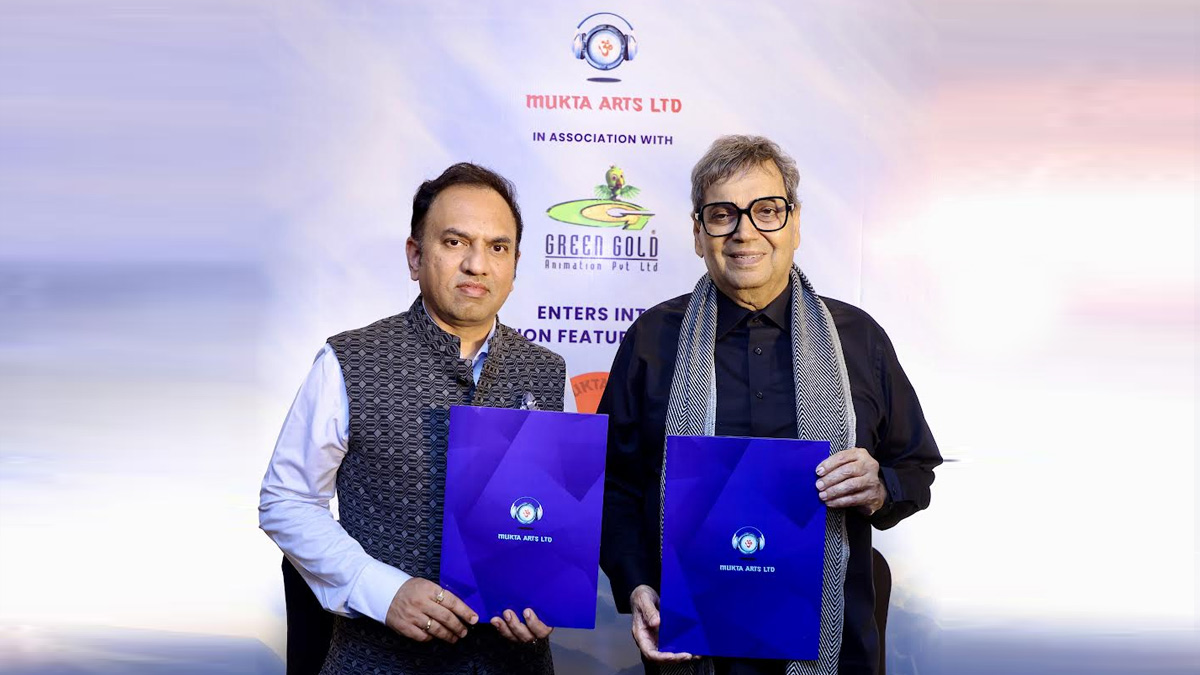
MUMBAI: When classic hindi movie meets animation, the result is a fresh reel of nostalgia with a cartoon twist. Mukta Arts Ltd. and Green Gold Animation have signed a Memorandum of Understanding (MOU) to collaborate on animated shows and feature films drawn from Mukta Arts’ four-decade treasure trove of iconic IPs. The partnership taps Mukta’s SGM Animation Studio launched in 2025 as its dedicated animation and games arm and Green Gold’s proven track record in building scalable, homegrown franchises. Creative teams from both sides have already kicked off discussions, with the first project currently in development.
The slate will draw inspiration from landmark Mukta films including Kalicharan, Karz, Hero, Karma, Ram Lakhan, Khalnayak, Saudagar and Iqbal, plus character-led spin-offs from those universes. The aim is to reimagine these stories for today’s young, global audiences while preserving their emotional core.
Green Gold Animation (home of Chhota Bheem) founder and CEO Rajiv Chilaka said, “This partnership with SGM Studios allows us to apply our experience in building long-lasting animation IPs to a truly iconic film catalogue. Together, we aim to create animated worlds that are rooted in these legendary stories, yet designed to connect with today’s young, global audiences.”
Mukta Arts Ltd. filmmaker and founder Subhash Ghai added, “Mukta Arts has always believed in creating stories with lasting emotional value. Through animation, we are extending our IP into a new medium for the next generation.”
In an industry where timeless tales never go out of fashion, this collaboration promises to bring beloved characters back to life with a modern, animated glow proving that some stories are too good to stay in live-action. Stay tuned for the first animated frame to drop.







