Hindi
‘Khoobsurat’….. Not really!

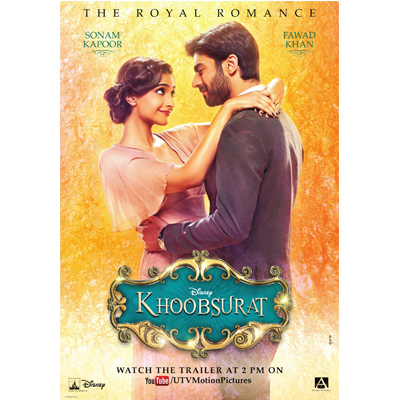
MUMBAI: Khoobsurat borrows its basic plot from the 1980 Hrishikesh Mukherjee film of the same name. Hrishikesh Mukherjee films were known for their simplicity and yet they appealed to all classes. His film was about a middleclass joint family where the matriarch of the house, Dina Pathak, runs her household with an iron fist and total domination. In the latest Khubsoorat, writer-director Shashanka Ghosh decides to give the simple Mukherjee film a ‘royal touch’ and massacres it royally.
Sonam Kapoor is a physiotherapist working with the Indian Premiere League helping the likes of Dhoni and Shehwag and some alien entity called Kapoor who is so much in pain, he refuses to go out to bat until this physiotherapist gives his leg an almost fatal jerk! Something that could have handicapped someone else has cured Mr Kapoor! He is fit enough to go out and hit the last winning six. One thought, each IPL team had its own physio, here, the ‘poor’ IPL has only one for all the teams.

Her credentials having been established and her reputation having travelled far and wide, she is invited to be an in-house physio to some ex-royal in Rajasthan. This ex-royal, Aamir Raza Hussain, has been wheelchair-bound since his accident ten years ago. He has so far dismissed about 40 physios trying to cure him. The fact is he doesn’t want to be cured. He holds himself responsible for the death of his 20-year-old-son, who died in a sports car crash that he had gifted him.
Sonam enters the house and falls in love with the palace, its opulence and the luxury of the room assigned to her. This is just the beginning as more falling in love is yet to happen; which is, falling in love with the prince, Fawad Afzal Khan. Towards this end, her mother, Kirron Kher, encourages her every day on their regular Skype chats; this film may have turned Mukherjee’s idea of Khoobsurat from middle-class to royal while, at the same time, trying to make it contemporary.
Sonam’s idea of physiotherapy for the reluctant royal is to take him around his gardens in a whirlwind wheelchair ride. The queen, Ratna Pathak, disapproves of her from day one and keeps making faces day after day. The prince Fawad keeps hovering around her despite being a very busy businessman. Earlier, it is established that he is engaged to be married to another royal, Aditi Rao Hydari.
While Aamir Raza is getting cured merely by wheeling at jet speed around his palace and Pathak keeps making same faces of disapproval for Sonam, Fawad, and Sonam keep getting attracted to each other until they graduate to their first kiss.
Comparing this film in any way to Mukherjee’s Khoobsurat is a sacrilege. The film and its makers have no sense of script, little sense of direction, and none for music. To sum it up, they have scant sense of filmmaking. The dialogue is pedestrian. Being a love story, the musical score needed to be strong but turns out to be poor and just one song, Naina…, is hummable. Editing is poor.
Sonam plays the lead in this, her home production. She is a let-down acting-wise, looks-wise and dressing-wise. The makeup makes her look much older. Her clumsy, loud character seems to have been built around My Fair Lady; she is uncouth, which she blames on being half Punjabi from her mother’s side! Fawad, otherwise, known to be a very natural and endearing actor from what one sees of him on TV, is wasted; he is made to carry just one-and-a-half expressions throughout the film. Fawad’s greatest asset, his smile, is at a premium here. Ratna’s casting, in a role her mother played in the 1980 original, is supposed to be the casting coup, but backfires with poor etching of her character. Aamir Raza is turned into caricatures.
Producers: Rhea Kapoor, Anil Kapoor, Sidharth Roy Kapoor
Director: Shashanka Ghosh.
Cast: Sonam Kapoor, Fawad Afzal Khan, Ratna Pathak, Aamir Raza Hussain.
‘Daawat-e-Ishq’: No thanks…
Yash Raj Films have been trying new subjects for some time now. With Daawat-e-Ishq, they try to bring back a Muslim background love story. But, this is a love story with an angle of dowry and getting back at dowry seekers. It also tries to juxtapose two prominent Muslim cultures, those of Hyderabad and Lucknow.
Parineeti Chopra is a shoe shop sales girl in Hyderabad even as she continues to study for she is a topper who wants to specialise in shoe designing. Her father, Anupam Kher, is a clerk in the high court two years short of retirement. He is honest and hence, of limited means.
It is time to look for a suitor for Parineeti. The problem for Anupam and Parineeti is that, her qualification does not count for anything to the boys’ families. The amount of dowry is what matters to them. This leads to a chain of rejections for her. Kher has a limit of 15 lakh but the gap is too much between what he can manage and what the boys’ parents demand. Since dowry is a bad word, one boy’s parents ask Kher to ‘help’ their son go to the US for further studies; all he needs is 80 lakh for that purpose.
Parineeti is an aggressive girl and keeps throwing out such parents. She decides that marriage is not for her and, instead, embarks on a mission to trap such families who demand dowries and have them sent to jail. Kher takes some convincing but finally agrees to the plan. Doing this in their native Hyderabad would be too risky so their choice falls on Lucknow.
The father daughter duo go for a total makeover, pose as millionaires from Dubai and check in at a five star Lucknow hotel. Next, they shortlist grooms from a marriage website and invite them for a meeting. A camera has been placed to record the proceedings of all such interviews. One of them happens to be Aditya Roy Kapur. He runs the city’s famous restaurant known for its kebabs, biryani etc with century old recipes inherited from his forefathers.
Kapur is a simple hearted only son of his parents, popular with his customers as well as all around the city. For wedding, his parents’ wish list would cost Kher a cool 40 lakh. Parineeti agrees to the proposal and decides the nikaah would take place in two days’ time. However, Kapur wants three days to meet and know Parineeti better. After all her idea is to marry and then file a complaint with the police and demand a huge sum to settle the matter.
The plan works, Kher and Parineetti walk off with a huge loot for Parineeti to pursue her dream of studying designing in the US. But, what she did not on count has happened. She has fallen in love with Kapur in those three days.
The problem with this film is that it takes over half an hour to come to the real story before it sets up the background for Parineeti’s plan of taking on a dowry seeker. And when it happens, there are no twists and turns and lacks in drama of any sort. The approach to direction and storytelling is lacklustre. There are no highlights. The film has a catchy musical score with a blend of old world charm. Dialogue is routine. There is little about performances that stays with a viewer. Parineeti is her usual self. Kapur is over the top, loud being his idea of projecting simplicity. Kher is okay.
Daawat-e-Ishq is a routine fare below expectations.
Producer: Aditya Chopra.
Director: Habib Faisal.
Cast: Parineeti Chopra, Aditya Roy Kapur, Anupam Kher.






Hindi
India’s telecom subscribers cross 1.32 billion in February 2026
Broadband base swells past 1.06 billion as Jio and Airtel tighten grip on the market.
MUMBAI: India’s telecom sector is ringing in steady growth once again adding millions of new connections every month while the race for broadband supremacy continues to heat up like a fiercely contested cricket match. According to the latest data released by the Telecom Regulatory Authority of India (TRAI) on 1 April 2026, the total telephone subscriber base in the country reached 1,321.31 million at the end of February 2026. This marked a net addition of 7.31 million subscribers during the month, translating into a monthly growth rate of 0.56 per cent.
Wireless subscribers (including mobile and Fixed Wireless Access) stood at 1,273.31 million, registering a net addition of 6.97 million and a growth rate of 0.55 per cent. Within this, urban wireless connections grew to 730.75 million (growth 0.70 per cent), while rural wireless subscribers reached 542.56 million (growth 0.35 per cent).
Wireline subscribers, though much smaller in scale, showed slightly faster growth. The total wireline base increased to 47.99 million, with a net addition of 0.34 million and a monthly growth rate of 0.70 per cent. Urban areas continued to dominate wireline connections with a share of 89.41 per cent.
Overall tele-density in India improved to 92.66 per cent. Urban tele-density stood at 150.68 per cent, while rural tele-density edged up to 60.02 per cent.
The broadband subscriber base crossed a significant milestone, reaching 1,059.05 million at the end of February 2026. This reflected a healthy net addition of 6.33 million subscribers and a monthly growth rate of 0.60 per cent from January’s figure of 1,052.72 million.
Segment-wise, mobile wireless access continued to drive the majority of growth with 996.52 million subscribers. Fixed Wireless Access (including 5G FWA) added 16.51 million, while wired broadband stood at 46.02 million.
Reliance Jio Infocomm Ltd. maintained its commanding lead with 519.64 million broadband subscribers. Bharti Airtel Ltd. followed with 364.14 million, Vodafone Idea Ltd. with 129.36 million, Bharat Sanchar Nigam Ltd. with 28.70 million, and Atria Convergence Technologies Ltd. with 2.38 million.
Together, these top five players command a massive 98.60 per cent share of the total broadband market.
In the wireless (mobile) segment, private operators continued to dominate with 92.59 per cent market share, leaving public sector undertakings (BSNL and MTNL) with just 7.41 per cent.
Out of the total 1,257.29 million wireless (mobile) subscribers, 1,177.60 million were active on the peak Visitor Location Register (VLR) date, representing an impressive 93.66 per cent activity rate. Bharti Airtel led in this metric with 99.42 per cent of its subscribers active.
Meanwhile, 14.47 million subscribers submitted requests for Mobile Number Portability (MNP) in February, indicating healthy competition and customer churn across zones.
While urban areas still lead in absolute numbers, rural connectivity is slowly catching up. Rural wireless tele-density stood at 59.46 per cent, compared with the much higher urban figure of 142.32 per cent.
Fixed Wireless Access using 5G technology also showed promising traction, growing to 11.93 million subscribers. Reliance Jio and Bharti Airtel are the primary players driving this segment.
The data paints a picture of a maturing yet still rapidly expanding telecom ecosystem. With total telephone subscribers now well past the 1.32 billion mark and broadband users comfortably above 1.06 billion, India continues to solidify its position as one of the world’s largest and most dynamic digital markets.
From bustling city streets to remote villages, more Indians are staying connected than ever before proving that when it comes to telecom, the country’s appetite for growth shows no signs of hanging up anytime soon.






