I&B Ministry
Javadekar condemns misuse of social media to create tensions

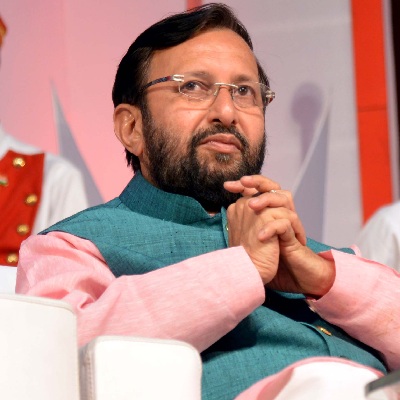
NEW DELHI: A day after airing his views on abolition of his own Ministry, Information and Broadcasting Minister Prakash Javadekar has said the government should not exercise control over media which should have its own mechanisms for this.
Addressing members of Indian Women Press Corps (IWPC), he also said: the biggest challenge for Prasar Bharti was how Doordarshan becomes the first choice for the viewer.

“In whichever model it works, we’ll choose that. We have given autonomy but result should also come,” he said.
Noting that freedom of press was the result of a long struggle, the Minister also stressed upon responsibility of the media.
The government is in favour of infrastructure augmentation in border areas where people get to hear the propaganda of other countries but the voice of Indian government at times does not reach.
Javadekar said while answering a question that social media fell under the Information Technology Act which was not administered by his Ministry, but added that the freedom afforded by social media should be used responsibly. He said misuse of social media to create tensions in society is condemnable and should not happen.
At one stage, Javadekar mentioned that his father had worked in a publication and that he had been a member of the Press Council which is often called a “toothless wonder”.
Javadekar said Prime Minister Narendra Modi had encouraged his ministers to be innovative. He said one innovative practice that the I&B and Environment ministries, which are both under him, will start is regarding advertisements they issue.
He said it had been decided that people would be asked to provide ideas and designs for advertisements and the Directorate of Advertising and Visual Publicity will only release them. “We will recognise and award the good designs that are selected,” he concluded.






I&B Ministry
CBFC speeds up film certification; average approval time cut to 22 days
Over 71,900 films cleared in five years as digital system shortens approval timelines
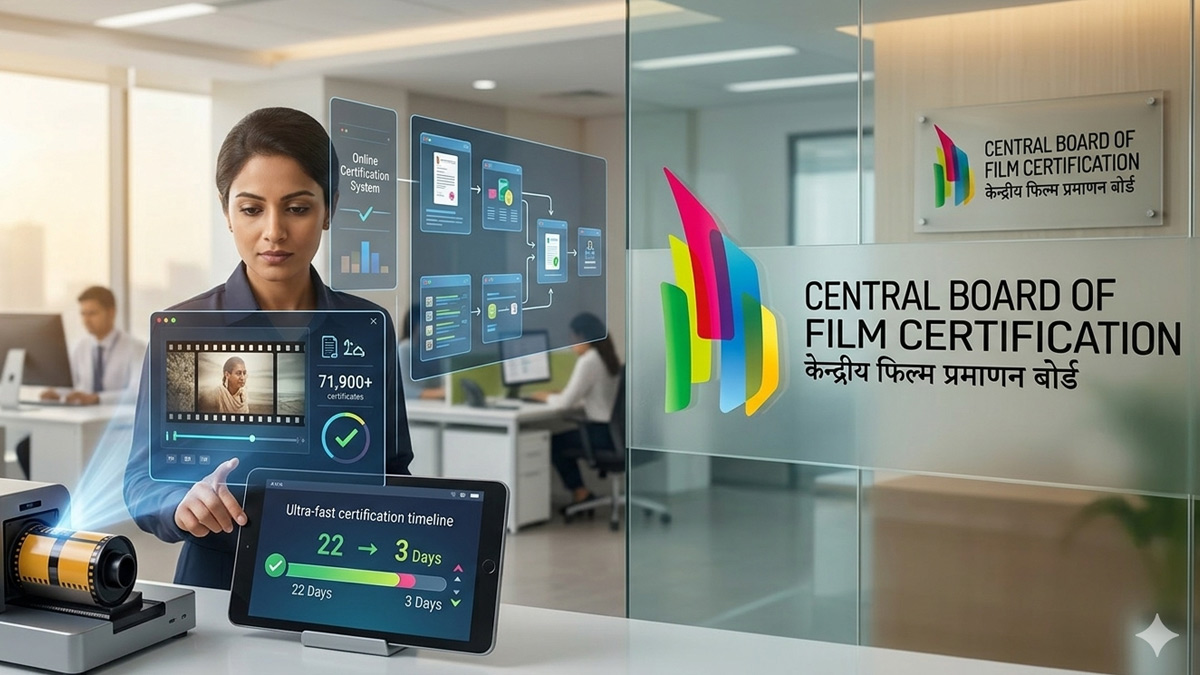
MUMBAI: The Central Board of Film Certification (CBFC) has significantly reduced the time taken to certify films, with the average approval timeline now down to 22 working days for feature films and just three days for short films.
Operating under the Ministry of Information and Broadcasting, the statutory body certifies films for public exhibition in line with the Cinematograph Act, 1952 and the Cinematograph (Certification) Rules, 2024. The rules prescribe a maximum certification period of 48 working days, though the adoption of the Online Certification System has sharply accelerated the process.
Over the past five years, from 2020-21 to 2024-25, the board certified a total of 71,963 films across formats. Of these, the majority fell under the U category with 41,817 titles, followed by UA with 28,268 films and A with 1,878 films. No films were certified under the S category during the period.
Film approvals have also steadily risen in recent years. The CBFC cleared 8,299 films in 2020-21, a figure that peaked at 18,070 in 2022-23 before settling at 15,444 films in 2024-25. During the same period, 11,064 films were certified with cuts or modifications.
Despite the high volume of certifications, outright refusals remain rare. Only three films were denied certification over the last five years, with one refusal recorded in 2022-23 and two in 2024-25.
The board may recommend cuts or modifications if a film violates statutory parameters relating to the sovereignty and integrity of India, security of the state, friendly relations with foreign states, public order, decency or morality, defamation, contempt of court or incitement to an offence.
Filmmakers can challenge CBFC decisions in court. Data shows that such disputes remain limited but have seen some fluctuation. Between 2021 and 2025, a total of 21 certification decisions were challenged before High Courts, with the number rising to 10 cases in 2025.
Responding to a question in the Rajya Sabha, minister of state for information and broadcasting L. Murugan shared the data. The question was raised by Mallikarjun Kharge.
With faster timelines and a largely digital workflow, the certification process appears to be moving at a far brisker pace, signalling a shift towards quicker clearances for India’s growing film output.







