Kids
Japanese kids’ content going strong despite home-grown onslaught


MUMBAI: The growth of Japanese anime in children’s television programming in India has been far more rapid and visible than other segments of television. It all started in 1990 when everyone grew up watching Rudyard Kipling’s original collection of series, The Jungle Book, which was a Japanese style animation series that couldn’t be missed on Sundays.
Since then, there has been no turning back; the fascination for Japanese content in India has grown by leaps and bounds. It didn’t stop with Kipling’s Mowgli series, instead, there was another manga series called Avatar: The Last Airbender. Manga are hand-drawn by artists. Naruto, Naruto: Shippûden were among the known manga series that grabbed more traction from their fans.
There was a time when Cartoon Network reigned supreme, which, for nine years, maintained its premier position by capitalising on the paucity of television entertainment for children. Animax India, a channel of Sony Entertainment, telecast Japanese anime shows before being shut down.

Shemaroo Entertainment head-animation business Smita Maroo says that even today Japanese shows gets the eyeballs whereas Indian content is still not the order of the day. “The broadcasters still bombard the channels with Doraemon, Shinchan and Ninja Hattori among others. It’s not that they are rushing towards Indian content,” she says.
Japanese animation made its entry in the programming line-up of channels with animation series such as Doraemon on Hungama, and Ninja Hattori on Nickelodeon. This was followed by a rush of animation series from Japan and the rest of Asia with shows such as Chibi Maruko Chan on Nickelodeon and Anpanman on Pogo (Nandi, 2012). Giving Doraemon a close competition is Crayon Shinchan, another manga-based anime. It’s among the top five shows for kids aged 2-14, competing with the likes of Chhota Bheem.
According to some media reports, the market for manga has expanded and Japanese publishing houses, which were earlier reluctant fearing piracy, are showing interest to license more titles.
Green Gold Animation VP-content sales Bharath Laxmipati said that Chhota Bheem, their original home-grown content was the game changer in the Indian industry because it gave confidence to the broadcasters that local shows can have a tremendous response. It broke the fascination for international shows that was also giving a wrong attitude. He says, “The core of a successful Indian show is the ability to tell stories. Japanese content is popular because they shared similar sentiments with Indians. But the difference is that Indian stories are written with the hero in mind but protagonists in Japanese content such as Doraemon, wherein the kid is not a hero but finds help from a robot, so the main character is the robot Doraemon. Oggy and the Cockroaches from France wasn’t famous until Shahrukh Khan, Sunny Deol and other Bollywood actors gave their voices to the show.”
He further adds that there are two ways of writing styles, where Chhota Bheem is all about courage, bravery, respect for elders, friendship and all the positive cultures that we have in our Indian culture. “Doraemon was created during the 70s and 80s and were picked up by the broadcasters because they had to fill in the programming, so there’s a different approach between theirs and ours,” he says.
Maroo says that kid’s content syndication is only for topical reasons but beyond that, the channels want to create their own content and focus on their 2-3 properties. She further added, “In terms of Chhota Bheem and Motu Patlu being famous nowadays, both the shows don’t come on the same channel, so the channel’s overall ratings still comes from other shows.
According to Maroo, acquiring Japanese content is definitely cheaper than production. Agreeing with Maroo, Laxmipati says, “Anything that is made for the own territory is far more expensive than syndicated content.”
According to the reports, animation production is expensive in comparison to a general entertainment channel show with the former requiring Rs 10-20 lakh an episode against Rs 7-8 lakh for the latter.
“Producing episodes for 2D and 3D for 11-22 minutes would cost Rs 10-20 lakh or even above, depending on the number of characters, background and many other factors. The initial episodes are way higher than even Rs 20 lakh,” adds a media professional.
Another media professional, however, gave a higher estimate. “Any top show’s production value is between Rs 30-50 lakh. Good content has to be produced at such cost. If we talk about producing for outside, the production cost will be up to Rs 1 crore per episode.”
The trend of today is to produce home-grown content. The concept of producing original content started in 2008 with Chhota Bheem. Later Nickelodeon India produced Motu Patlu as its home-grown IP show in 2012. Not only this, the year 2017 kick-started a new channel called Sony Yay that completely focused on producing its own IP shows.
The supply of India-produced shows is very limited compared to the unlimited growth of Japanese content and other foreign language cartoons. Since Japan has 15-20 years of headstart over India, its library is massive. In 2016, Cartoon Network had 91.61 per cent foreign shows; Pogo had 82.67 per cent while Disney had 60.61 per cent shows from abroad.
When asked whether it is easier to attract advertisers for syndicated content as opposed to original content, Maroo commented, “If syndicated content has already got a track record, it would be easier to pick advertisers, because new shows will take time to deliver.”
She further said that kids will like any content that the channels feed them. With the growth of digital, both TV and digital will co-exist and kids will shift their likeness towards a particular medium or content whatever they find interesting.
Also Read :
Original Indian kids’ animation content is the need of the hour
Kids today watch more animated content than ever






Kids
Mukta Arts and Green Gold ink MOU to animate iconic film IPs
Kalicharan, Karz, Hero, Karma, Ram Lakhan to spawn animated shows plus features.
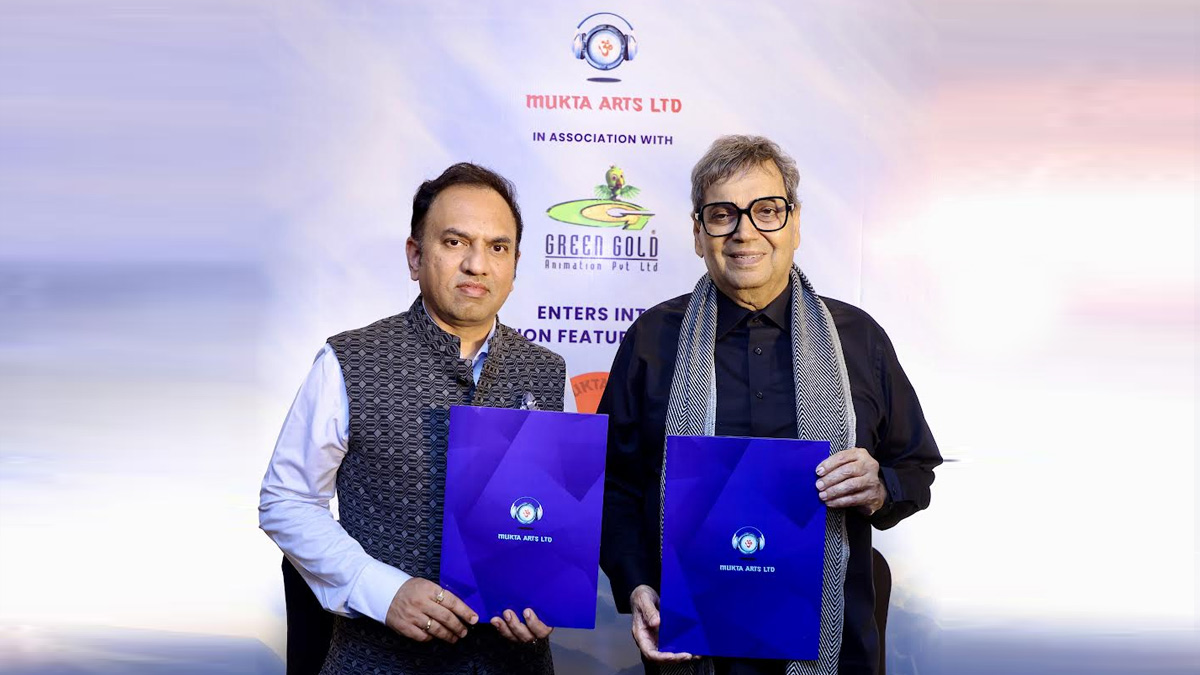
MUMBAI: When classic hindi movie meets animation, the result is a fresh reel of nostalgia with a cartoon twist. Mukta Arts Ltd. and Green Gold Animation have signed a Memorandum of Understanding (MOU) to collaborate on animated shows and feature films drawn from Mukta Arts’ four-decade treasure trove of iconic IPs. The partnership taps Mukta’s SGM Animation Studio launched in 2025 as its dedicated animation and games arm and Green Gold’s proven track record in building scalable, homegrown franchises. Creative teams from both sides have already kicked off discussions, with the first project currently in development.
The slate will draw inspiration from landmark Mukta films including Kalicharan, Karz, Hero, Karma, Ram Lakhan, Khalnayak, Saudagar and Iqbal, plus character-led spin-offs from those universes. The aim is to reimagine these stories for today’s young, global audiences while preserving their emotional core.
Green Gold Animation (home of Chhota Bheem) founder and CEO Rajiv Chilaka said, “This partnership with SGM Studios allows us to apply our experience in building long-lasting animation IPs to a truly iconic film catalogue. Together, we aim to create animated worlds that are rooted in these legendary stories, yet designed to connect with today’s young, global audiences.”
Mukta Arts Ltd. filmmaker and founder Subhash Ghai added, “Mukta Arts has always believed in creating stories with lasting emotional value. Through animation, we are extending our IP into a new medium for the next generation.”
In an industry where timeless tales never go out of fashion, this collaboration promises to bring beloved characters back to life with a modern, animated glow proving that some stories are too good to stay in live-action. Stay tuned for the first animated frame to drop.






