News Broadcasting
Italy relaxes media rules; critics cry foul


MUMBAI: Italy’s parliament has cleared a controversial media law that was earlier vetoed by president Carlo Azeglio Ciampi. Having undergone some minor alterations, the law was passed by the parliament on Thursday. Under Italian law, Ciampi cannot veto them again.
The new law will see prime minister Silvio Berlusconi’s firm Mediaset taking over 90 percent of Italy’s television broadcasts, and gives him freedom to acquire more newspapers and radio stations.
The long-in-the-works rules raise the cap on broadcast advertising and ease limits on how many stations each TV player can own. Besides putting a 20% cap on the total share of the media market revenue that a single company can hold — instead of a 30% cap placed solely on TV revenue — the new law will allow cross-ownership of webs and newspapers in 2010 and optimistically sees Italy shifting to terrestrial digital TV by 2006, say media reports.

The law also authorises a partial privatisation of pubcaster RAI starting next year. Critics suggest that the law will give Berlusconi an undue advantage that will see him dominating the country’s media.
Berlusconi’s $7.8 billion family holding firm Fininvest also owns Medusa Film, Mondadori publishing group and the Jumpy Internet portal.






News Broadcasting
UDF poised to return to power in Kerala, says Manorama-CVoter survey
Massive opinion poll projects shift in Kerala politics ahead of 2026 Assembly elections.
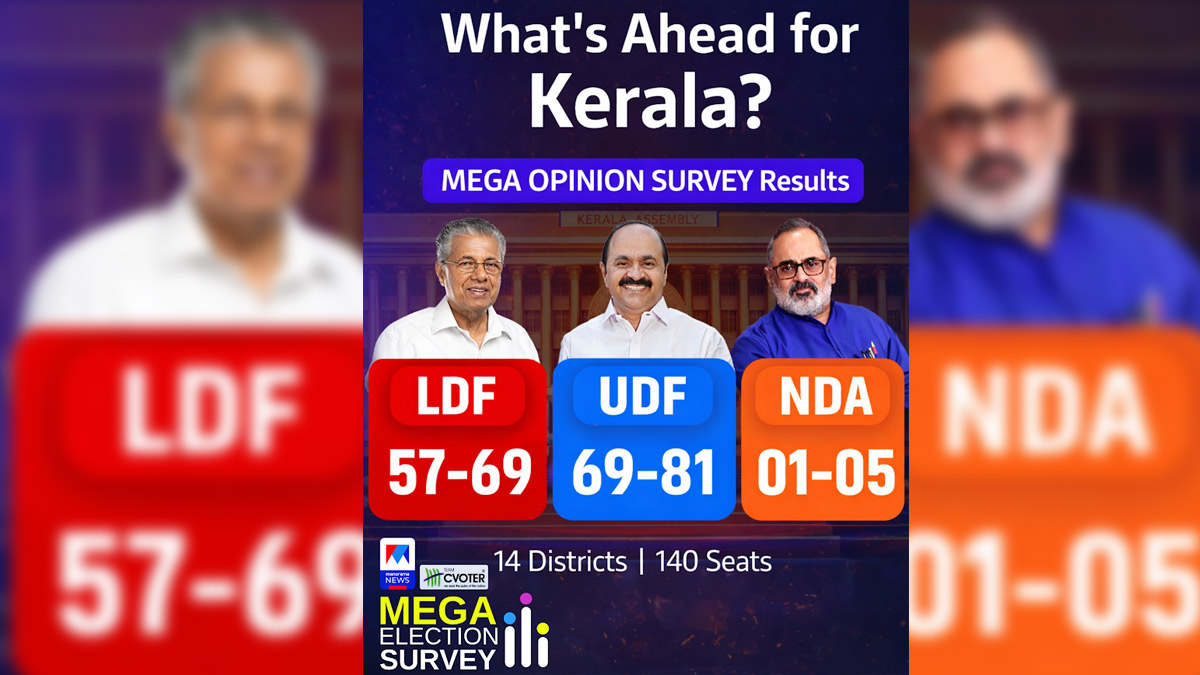
MUMBAI: The winds of change appear to be blowing through Kerala’s political landscape and this time, they seem to favour the United Democratic Front. A comprehensive mega opinion survey conducted by Manorama News in partnership with CVoter projects a potential comeback for the UDF in the upcoming Kerala Legislative Assembly Elections 2026. The survey, covering all 140 constituencies with a massive sample size of nearly 90,000 respondents, predicts the UDF could win between 69 and 81 seats.
The ruling Left Democratic Front (LDF) is expected to secure 57 to 69 seats, a significant drop from the 99 seats it won in the 2021 elections. This would mean the LDF losing 30 to 42 of its sitting seats. Meanwhile, the National Democratic Alliance (NDA), which drew a blank in 2021, is projected to open its account with 1 to 5 seats.
Region-wise, the UDF is expected to make strong gains in Malabar, winning 25 to 34 out of 48 seats, and in Central Kerala, where it could bag 29 to 33 out of 53 seats. In South Kerala, the LDF is likely to retain an edge with 21 to 25 seats, while the UDF may improve to 12 to 16 seats. The NDA could pick up 1 to 3 seats in the southern region.
The survey was conducted between 14 and 26 March 2026, with additional tracker and snap polls carried out from December 2025 to March 2026. A total of 89,693 respondents participated, ensuring representation across all demographics and social segments.
Manorama News has a strong track record of accuracy, with its previous projections closely matching the actual results of the 2019 and 2024 Lok Sabha elections as well as the 2021 Kerala Assembly polls.
In Kerala’s famously fierce political battles, this survey suggests the pendulum may be swinging back. Whether the final verdict matches these numbers or throws up another surprise, one thing is clear, the 2026 Assembly elections are shaping up to be one of the most keenly watched contests in the state’s history.






