News Broadcasting
Is IBF heading for a split?

NEW DELHI: The apex body of all broadcasting companies operating in India (pay as well as free to air channels), Indian Broadcasting Foundation, stands on the edge of being divided on the lines of pay versus free to air channels, which may just result in a split in the Foundation.
On Monday an IBF board meeting will discuss a show cause notice issued to Sahara TV president Mahesh Prasad for speaking his mind on conditional access in the task force (reported first by indiantelevision.com) — views that are not in tune with the broad IBF stand, as claimed. The grounds of the show cause to Prasad are similar to the one when earlier this week IBF president and Prasar Bharati CEO KS Sarma disagreed with an foundation presentation to the parliamentary standing committee on IT, telecom and convergence on one-city rollout of CAS.
Sarma is learnt to have asserted that an IBF sub-committee’s view on CAS, including a one-city rollout, cannot be regarded as the view of all the members of the foundation, a lot of who are for CAS in all the metros.

But an IBF source stated categorically that it is being made clear that there would be no difference of opinion in the foundation on issues that are vital for the industry like CAS.
Now, if Sarma quits as the president of the IBF and other members like Sahara TV and SABe TV also oppose a one-city rollout of CAS as a test case, as asserted by the IBF to the standing committee members, a situation is likely to arise when the free to air channels, led by Doordarshan, form a separate body.
As per information available, some talks in this regard have been held informally amongst some interested parties, inclusing some cable operators.
According to a representative of an FTA channel, the IBF seems to have been “hijacked” by those managing pay channels, which feel that their stakes in the game are bigger. A lack of adequate number of set top boxes in the metros post-14 July may lead to chaos that may effect the pay channels’ viewership and advertising revenue.
The government has mandated that all pay channels will have to be routed through a STB in a post CAS regime after July 14.
According to an IBF member today, “If there is a majority view at the IBF board meet that Sahara’s Prasad and foundation president Sarma have views that are contrary to others and that there would be difficulty with them around, then Sarma would have no option but to go since the president holds an ex-officio post and is elected by other members.”
When indiantelevision.com attempted to cross-check facts with Sarma, he refused to comment on the growing division within the IBF, saying, “Other things are confidential, but if the board of the IBF feels I have to go, then I will go.”
Cable operators are not the only unhappy lot. The way things relating to CAS have proceeded has also created a division amongst the broadcasters. The FTA channels feel that those managing pay channels have hijacked the task force on CAS and have been pushing their viewpoint, while discarding the interest of others.
In the forefront of this FTA vs. pay channels battle is the Subrata Roy-promoted Sahara TV whose president Mahesh Prasad has in the past said that the likes of ESPN, Zee and even Star have been soft-pedaling the real issues of the industry in a post CAS scenario. Prasad’s contention has been that the pay channels have an agenda of their own and that agenda doesn’t have place for free to air channels like Sahara, SABe TV and Aaj Tak.
However, when indiantelevision tried to get an official response from Prasad, he refused to say anything.
But if the likes of Sahara TV and Prasar Bharati have the guts to stand up for their own right and split from the IBF to form an association of the free to air channels, it would be nothing short of a coup.
This polarisation may get accentuated as the CAS rollout deadline draws near and the pay channels, cutting across bouquets and party lines, try forming super bouquets for subscribers. Already, a promo, created by Star featuring Tulsi from Ektaa kapoor’s popular soap, aimed at “educating” the consumer on CAS has started on other channels too, like HBO.
Can the FTA channels stand up against the pay channels? Will Sarma continue as the president of the IBF? Will Prasar Bharati continue to be a member of the IBF if Sarma is forced to quit? These are questions that can only get answered next week after the IBF board has met. So, keep tuned in till then.
A word of caution: there may be an anti-climax too, for the media if IBF manages to defuse the tension amongst members amicably.





News Broadcasting
Network18 channels lead YouTube news viewership in March 2026
CNN-News18, News18 India and CNBC channels top categories with record views
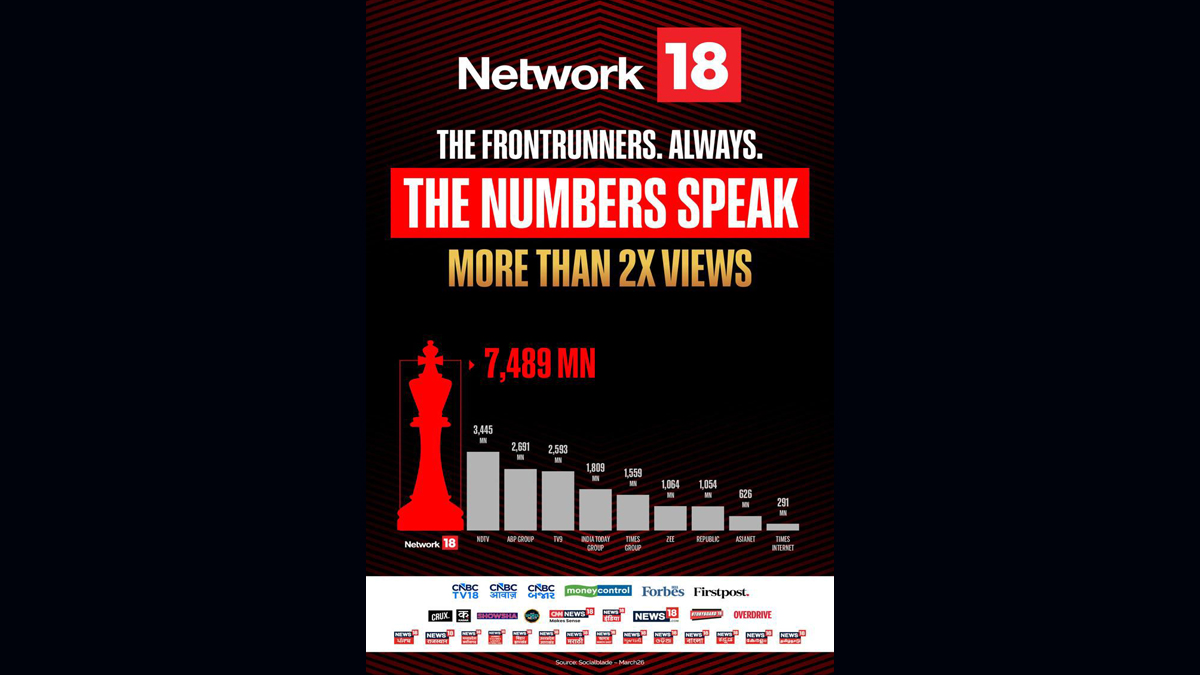
MUMBAI: When the world hit refresh on breaking news, Network18’s channels were already streaming ahead. As geopolitical tensions and war-driven headlines fuelled a surge in global news consumption, the network’s digital playbook delivered big clocking record Youtube viewership across English, Hindi and business news categories in March 2026.
At the forefront was CNN-News18, which emerged as the clear leader in the English news segment with 130 million live and video-on-demand views. The channel edged past competitors such as Times of India (126.5 million), Times Now (101.1 million), India Today (88.2 million) and NDTV (77.5 million), according to Databeings data for March.
In the Hindi news arena, News18 India delivered a commanding performance, racking up a staggering 3,297 million views on YouTube. The channel comfortably outpaced NDTV India, which recorded 3,119 million views, underlining its deep reach and consistent engagement with mass audiences, as per Playboard data.
The network’s dominance wasn’t confined to general news. In the Hindi business segment, CNBC Awaaz topped the charts with 92 million views, narrowly ahead of Zee Business (90 million) and well ahead of ET Now Swadesh (57 million). Meanwhile, its English counterpart CNBC-TV18 posted a strong 58 million views, reinforcing the network’s cross-category strength.
The spike in viewership reflects a broader shift in audience behaviour, with viewers increasingly turning to digital platforms particularly Youtube for real-time updates and in-depth coverage during high-intensity news cycles. For Network18, the numbers signal more than just scale; they underline the effectiveness of a multi-platform strategy that blends speed, credibility and continuous coverage.
In a month where the news never paused, it seems viewers chose to stay tuned where the stream never stopped.






