I&B Ministry
IPR Think Tank invites suggestions from stakeholders

NEW DELHI: The Think Tank constituted by the Department of Industrial Policy and Promotion to draft the National Intellectual Property Rights Policy has sought views from stakeholders for the first draft.
The group set up on 19 December headed by Justice (Retd) Prabha Sridevan to head and advice the Department of Industrial Policy and Promotion on IPR issues wants to receive comments on ipr@nic.in on or before 30 January.
Other members of the IPR Think Tank are: Senior Advocate Pratibha M Singh; advocate Punita Bhargava; Unnat Pandit of Cadila Pharmaceuticals; and Rajeev Srinivasan who is Director of Asian School of Business in Thiruvananthapuram. WIPO retired DDG Narendra K. Sabarwal will serve as Convener.
The IPR Think Tank will draft a National Intellectual Property Rights Policy; identify areas in the IPRs where study needs to be conducted and to furnish recommendations in this regard to the Ministry; provide views on the possible implications of demands placed by the negotiating partners; keep the Government regularly informed about the developments taking place in IPR cases which have an impact upon India`s IPR Policy; advise the Government on best practices to be followed in Trademark Offices, Patent Offices and other Government Offices dealing with IPR in order to create an efficient and transparent system of functioning in the said offices; prepare periodic reports on best practice followed in foreign countries; highlight anomalies in the present IPR legislations and to advice possible solutions to the Ministry; give suggestions on the steps that may be taken for improving infrastructure in IP offices and Tribunals; and examine the current issues raised by industry associations and those that may have appeared in media and to give suggestions to the Ministry on such issues.


I&B Ministry
Doordarshan, ICCR sign MoU to boost global reach of Indian culture
Pact taps TV, radio and digital platforms to take cultural content worldwide
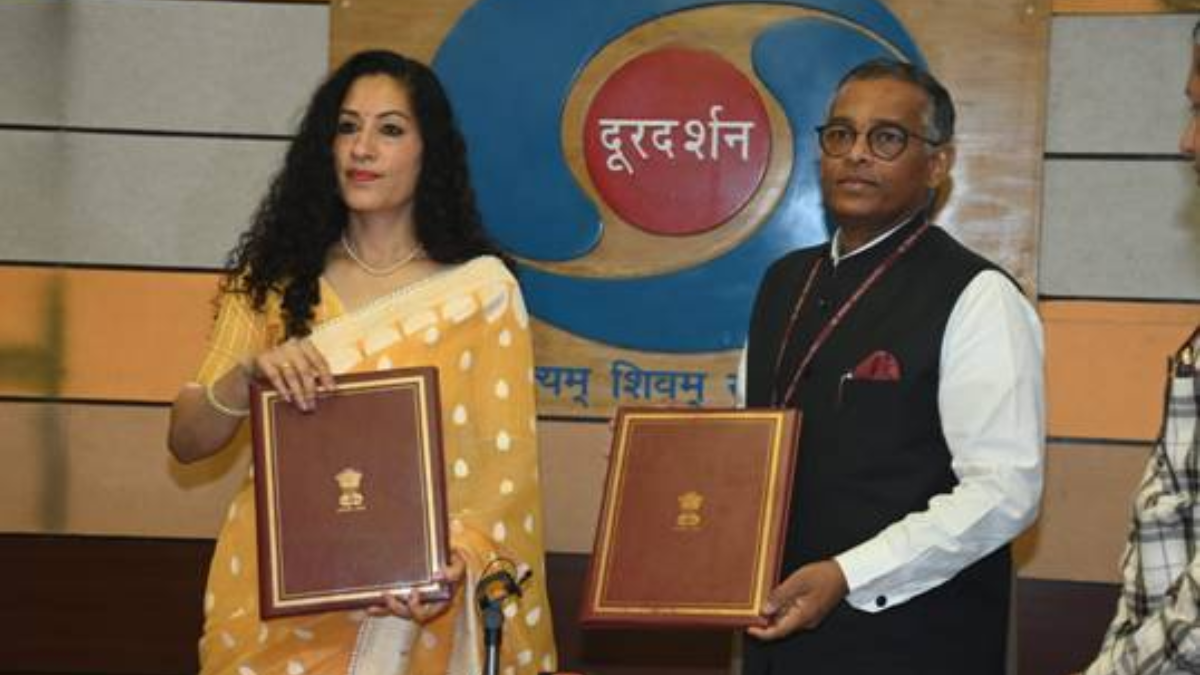
NEW DELHI: In a move aimed at taking India’s cultural story further across borders, Doordarshan under Prasar Bharati has signed a memorandum of understanding with the Indian Council for Cultural Relations to expand the global reach of Indian cultural content.
The agreement, signed on April 7 at Doordarshan Bhawan, brings together the content strength of ICCR and the wide broadcast network of Doordarshan, spanning television, radio and digital platforms.
Under the partnership, ICCR will provide a steady stream of cultural programming, including performances and events organised by Indian missions abroad such as embassies, consulates and cultural centres. Doordarshan will handle production, coverage and distribution, ensuring that these programmes find audiences not just in India but across the world.

The collaboration also opens the door for recorded cultural content from overseas missions to be aired across multiple platforms, including OTT and social media, making Indian art, music and heritage more accessible to global viewers.
A notable feature of the MoU is joint ownership of content rights in perpetuity, including digital rights. This allows both organisations to archive and reuse material over time, building a long-term cultural repository while maximising reach. Doordarshan will also support pre-event promotion and cross-platform visibility to drive engagement.
Speaking at the signing, Doordarshan director general K. Satish Nambudiripad and Indian Council for Cultural Relations director general K. Nandini Singla highlighted the potential of the partnership to strengthen India’s cultural diplomacy through modern media channels.
The agreement, initially valid for three years, also allows Doordarshan to explore monetisation opportunities from the content generated, adding a commercial layer to cultural broadcasting.
As India looks to blend tradition with technology, this partnership signals a clear intent to make its cultural voice not just heard, but seen and streamed across the globe.







