News Headline
Intelsat shoots for the stars – and lands squarely in India’s broadcast orbit

MUMBAI: Global satellite heavyweight Intelsat has scored a milestone regulatory victory in India — one that opens up the floodgates for cross-border broadcast services, new business, and deeper foreign participation in the subcontinent’s satellite economy.
In a landmark decision, the Indian National Space Promotion and Authorisation Centre (In-Space) has granted Intelsat permission to directly provide satellite bandwidth to Indian media and broadcast companies. The approval covers four of Intelsat’s geostationary satellites — IS-17, IS-20, IS-36 and IS-39 — all offering high-powered C-band coverage over India.
This isn’t just regulatory housekeeping — it’s India’s formal nod to a new satellite playbook, and Intelsat is among the first foreign players to officially get a seat at the table.

The green light gives Indian broadcasters access to Intelsat’s fleet for everything from live news uplinks and sports distribution to linear TV delivery and multi-region content sharing. It paves the way for enhanced scalability, quality, and coverage — especially important as India’s video consumption skyrockets across satellite, cable, and OTT.
The newly authorised satellites support high-capacity, high-reliability services, giving Indian broadcasters a powerful backup or replacement for ageing domestic satellite capacity. Intelsat’s C-band services are known for their robustness — particularly valuable in monsoon-prone regions where signal integrity can be patchy.
The approval has already translated into new revenue: three of India’s largest media networks — rumoured to include a mix of news, regional, and GEC (general entertainment channel) players — have signed contracts with Intelsat following the IIn-space go-ahead. The deals cover a mix of primary satellite carriage, content redistribution, and international footprint expansion.
While the names remain under wraps (JioStar is rumoured to have taken up six C-band transponders), industry watchers say this move could trigger a domino effect, with other players lining up for capacity.
This move also signals India’s growing openness to foreign satellite operators. Previously, non-Indian entities faced a labyrinth of regulatory hurdles — needing to lease capacity through Indian agencies or enter into convoluted sub-licensing arrangements. With In-Space actively streamlining permissions under India’s commercial space policy, the gates are now open for direct engagement, competitive pricing, and tech transfer.
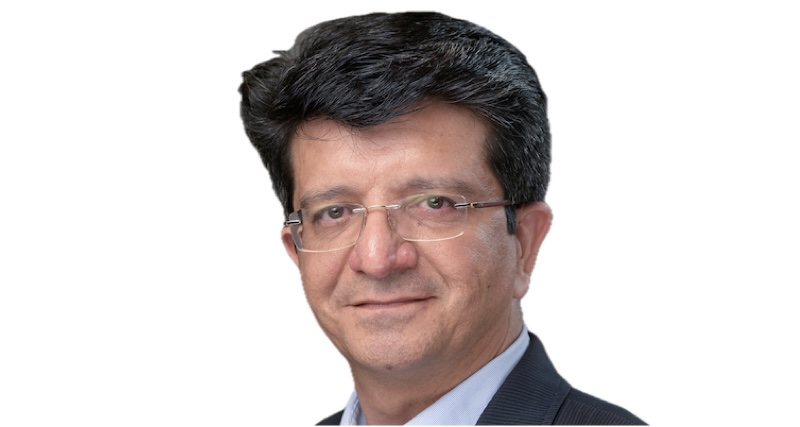
“This approval represents a significant step forward in Intelsat’s contribution to India’s space commerce sector, a source of great national pride,” said Intelsat regional vice-president for Asia Pacific Gaurav Kharod. “Our extensive satellite network with four satellites covering the region will provide Indian broadcasters with reliable, high-quality connectivity solutions that meet their evolving needs. This authorisation enables us to better serve our customers and contribute to India’s growing media landscape.”
India is now one of the fastest-growing video markets in the world, with over 900 TV channels, tens of thousands of cable and DTH operators, and an exploding OTT sector. Satellite remains a crucial backbone for content distribution, particularly in rural and remote geographies where fibre is limited and terrestrial networks are patchy.
For Intelsat — a company with a six-decade legacy and one of the largest integrated satellite-terrestrial networks globally — this opens up a vast new revenue corridor in south Asia. It also gives them pole position as Indian broadcasters look to upgrade infrastructure, meet rising bandwidth demands, and adopt cloud-connected satellite workflows.
The firm has long provided secure communications to governments, enterprises, and NGOs. But with this regulatory leap, India’s broadcast sector becomes its newest playground.
As India unlocks its space economy and media sector evolves beyond borders, Intelsat’s entry may just be the first of many new uplinks between Indian content and global audiences.




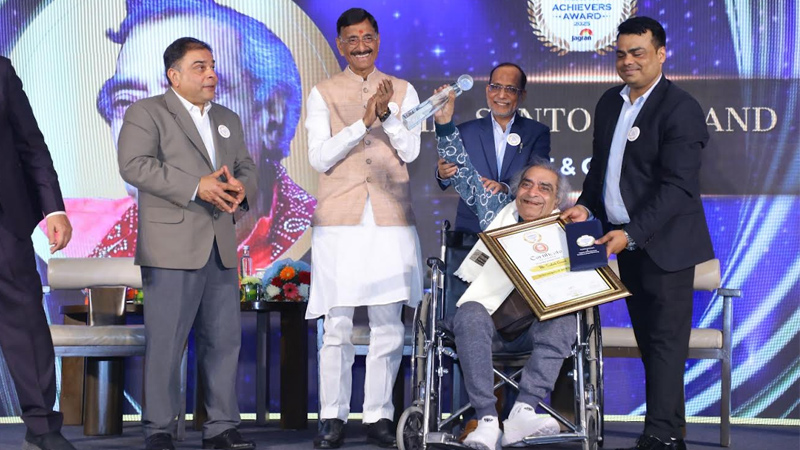
NEW DELHI: Hamdard Laboratories gathered a cross-section of India’s achievers in New Delhi on Friday, handing out the Hakeem Abdul Hameed Excellence Awards to figures who have left their mark across healthcare, education, sport, public service and the arts.
The ceremony, attended by minister of state for defence Sanjay Seth and senior officials from the ministry of Ayush, celebrated individuals whose work blends professional success with a sense of public purpose. It was as much a roll call of achievement as it was a reminder that influence is not measured only in profits or podiums, but in people reached and lives improved.
Among the headline awardees was Alakh Pandey, founder and chief executive of PhysicsWallah, recognised for turning affordable digital learning into a mass movement. On the sporting front, Arjuna Awardee and kabaddi player Sakshi Puniya was honoured for her contribution to the game and for pushing women’s participation onto bigger stages.
The cultural spotlight fell on veteran lyricist and poet Santosh Anand, whose songs have echoed across generations of Hindi cinema. At 97, Anand accepted the honour with characteristic humility, reflecting on a life shaped by perseverance and hope.
Healthcare honours spanned both modern and traditional systems. Manoj N. Nesari was recognised for strengthening Ayurveda’s place in national and global health frameworks. Padma shri Mohammed Abdul Waheed was honoured for his research-backed work in Unani medicine, while padma shri Mohsin Wali received recognition for his long-standing contribution to patient-centred care.
Education and social development also featured prominently. Padma shri Zahir Ishaq Kazi was honoured for decades of work in education, while former Meghalaya superintendent of Police T. C. Chacko was recognised for public service. Goonj founder Anshu Gupta received an award for his dignity-centred rural development initiatives, and the Hunar Shakti Foundation was honoured for empowering women and young girls through skill development.
The Lifetime Achievement Award went to former IAS officer Shailaja Chandra for her long career in public healthcare and governance, particularly in the traditional systems under Ayush.
Speaking at the event, Hamdard chairman Abdul Majeed said the awards were a tribute to those who combine excellence with empathy. “These awardees reflect Hakeem Sahib’s belief that healthcare, education and public service must ultimately serve humanity,” he said.
Minister Seth struck a forward-looking note, saying India’s young population gives the country a unique opportunity to become a global destination for learning, health and wellness by 2047.
The ceremony also featured the trailer launch of Unani Ki Kahaani, an upcoming documentary starring actor Jim Sarbh, set to premiere on Discovery on 11 February.
Instituted in memory of Unani scholar and educationist Hakeem Abdul Hameed, the awards have grown into a national platform that celebrates those building a more inclusive and resilient India. For one evening at least, the spotlight was not just on success, but on service with substance.






