News Headline
INSAT-3E placed near Geostationary Orbit

HASSAN: In the third and final stage of orbit-raising operation conducted on 1 October at Master Control Facility (MCF) in Hassan (Karnataka), INSAT-3E was placed near the Geostationary Orbit (GSO).
According to an official release, the manoeuvre was completed by firing the 440 Newton Liquid Apogee Motor on board the satellite for a duration of 3 mins, 6 secs. With this, the satellite has achieved an orbital period of 23 hours and 46 minutes and is continuously visible to MCF, Hassan. INSAT-3E is now moving towards its geostationary orbital slot with the planned drift rate of 2.3° per day. It is expected to reach its orbital slot of 55° east longitude in the next ten days, said the release.
The 440 Newton Liquid Apogee Motor (LAM), which was used to conduct INSAT-3E orbit raising manoeuvres, has performed well. It enabled taking the satellite from its Geosynchronous Transfer Orbit (GTO) of 649 km perigee and 36,000 km apogee with an orbital inclination of 7° with respect to the equatorial plane to its present near GSO orbit with zero degree inclination.
The LAM was fired for a total duration of 121 minutes in three phases on 29 and 30 September and 1 October. A total velocity of 1460 m/sec was added by LAM at the Apogee point of the orbit to take the satellite from GTO to GSO.
INSAT-3E had 1592 kg propellant at the time of its injection into GTO by Ariane-5 launch vehicle on 28 September. After orbit raising operations, it has 510 kg of propellant remaining that is sufficient to arrest the drift and park it at its orbital slot as well as maintain the satellite in its orbit and controlling its orientation during its design life of more than 12 years.
After the completion of the third apogee motor firing, the Solar Arrays and Antennae of INSAT-3E were deployed by commanding from MCF, Hassan.
In the first operation, the Solar Array on the south side of the satellite was deployed at 15:01 pm IST. Then, the antenna reflector on the west side of the satellite was deployed at 15:59 pm IST. This was followed by the deployment of the Solar Array on the north side at 17:26 pm and finally the antenna reflector on the east side was deployed at 18:03 pm IST.
The Sun tracking solar array of INSAT-3E has a total area of 29.6 sq. m and it is designed to generate 2.9 kW (BoL) of power in orbit. The satellite has two deployable antennas and one fixed antenna to carry out various transmit and receive functions.
The three axis stabilisation of INSAT-3E is successfully carried out today between 7 am and 9 am. In this, configuration spacecraft will be locked to Earth continuously through the optical sensors and will maintain the correct attitude to look at the Earth in a stable manner. The Momentum Wheels onboard the satellite are switched on, and stabilised to nominal speed of 4500 revolutions per minute to provide gyroscopic stiffness and provide three axis stabilisation.
Currently, the spacecraft is at 38° E longitude, and drifting towards its orbital slot of 55° E, at a rate of 2.3° per day. The communication payloads will be switched on after reaching the orbital slot, and in-orbit testing of the payloads will be carried out for a duration of three weeks. The satellite INSAT-3E is expected to be ready for service by the first week of November, added the report.
ISRO to launch four satellites
Faced with a huge demand for its transponder capacity and services, Indian Space Research Organisation (Isro) is gearing up to launch four satellites and three launch vehicles by the end of next year, Isro Satellite Centre Director P S Goel said yesterday.
“During the first half, the indigenous Geosychronous Satellite Launch Vehicle (GSLV) will put in space GSAT-3, which will have unique transponders dedicated for tele-education and IRS-P5 (Cartosat) with a 2.5 metre stereoscopic capability,” Goel said at the Master Control Facility (MCF) in Hassan.
“ISRO’s next mission was the IRS-P6 (RESOURCESAT) satellite slated for launch by the indigenous rocket Polar Satellite Launch Vehicle (PSLV) in third week of October,” said Isro Chairman G Madhavan Nair.
“The IRS-P5 has no equivalent in the world and IRS-P6 would provide us an unique capability in remote sensing and is being eagerly awaited,” Goel said.
He said that Isro would launch in the later half of next year, the INSAT-4A communication satellite, with a high power Ku band capability for direct to home (DTH) TV service covering the country.
“This is the real spacecraft for DTH operations. We have also doubled the power capability (3.2 KW to 6 KW),” Goel said, adding the ISRO was also building the Spacecraft Recovery Experiment (SRE) capsule.
There was delay in building components for INSAT-3D, the new generation meteorological satellite to be injected in the Geostationary Transfer Orbit (GTO), Goel said. The spacecraft was being built and was expected to be launched in the next “two and half years to three years.”
On GSAT-2, the experimental satellite launched by GSLV-D2 early this year, all the systems were working satisfactorily said Nair. The definition of the spacecraft for the unmanned moon mission project was completed and Isro was undertaking the engineering of the unit to be launched using PSLV rocket in 2008, he added.
He said a deep space tracking network would be set up in Bangalore for the lunar mission, where a large antenna and a tracking infrastructure was being set up.
Nair said that Isro was developing the GSLV-MK III launch vehicle to put four tonne class satellites into the GTO and at a cost of 50 per cent to 60 per cent cheaper than existing launches.
He said India had the capability to launch satellites using the GSLV and PSLV rockets for about 80 per cent of international costs.


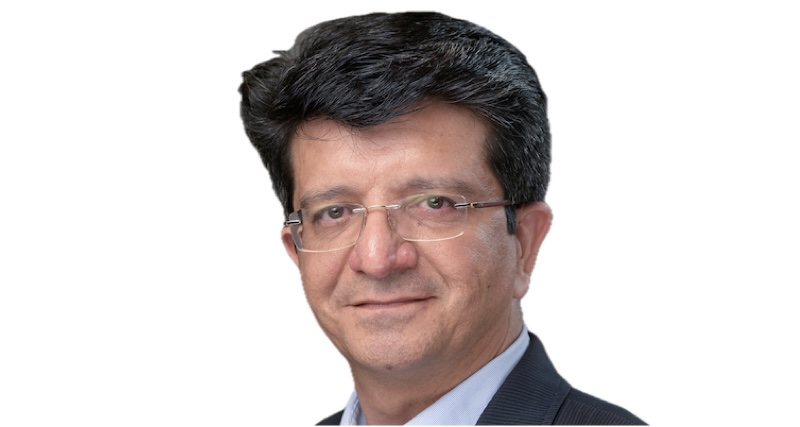

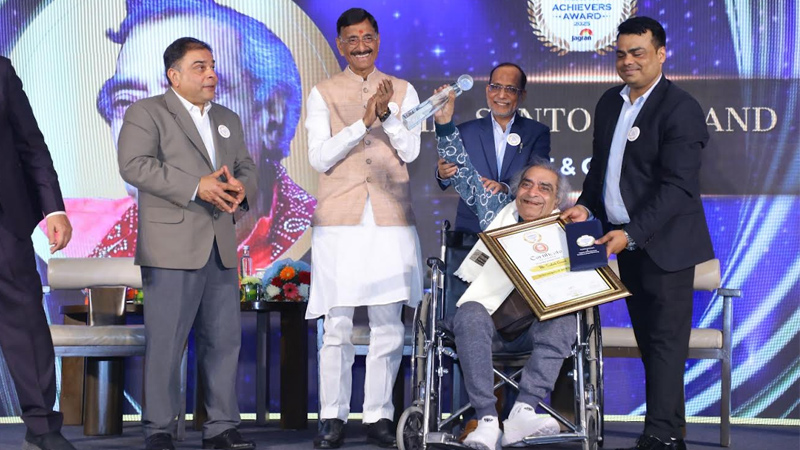
NEW DELHI: Hamdard Laboratories gathered a cross-section of India’s achievers in New Delhi on Friday, handing out the Hakeem Abdul Hameed Excellence Awards to figures who have left their mark across healthcare, education, sport, public service and the arts.
The ceremony, attended by minister of state for defence Sanjay Seth and senior officials from the ministry of Ayush, celebrated individuals whose work blends professional success with a sense of public purpose. It was as much a roll call of achievement as it was a reminder that influence is not measured only in profits or podiums, but in people reached and lives improved.
Among the headline awardees was Alakh Pandey, founder and chief executive of PhysicsWallah, recognised for turning affordable digital learning into a mass movement. On the sporting front, Arjuna Awardee and kabaddi player Sakshi Puniya was honoured for her contribution to the game and for pushing women’s participation onto bigger stages.

The cultural spotlight fell on veteran lyricist and poet Santosh Anand, whose songs have echoed across generations of Hindi cinema. At 97, Anand accepted the honour with characteristic humility, reflecting on a life shaped by perseverance and hope.
Healthcare honours spanned both modern and traditional systems. Manoj N. Nesari was recognised for strengthening Ayurveda’s place in national and global health frameworks. Padma shri Mohammed Abdul Waheed was honoured for his research-backed work in Unani medicine, while padma shri Mohsin Wali received recognition for his long-standing contribution to patient-centred care.
Education and social development also featured prominently. Padma shri Zahir Ishaq Kazi was honoured for decades of work in education, while former Meghalaya superintendent of Police T. C. Chacko was recognised for public service. Goonj founder Anshu Gupta received an award for his dignity-centred rural development initiatives, and the Hunar Shakti Foundation was honoured for empowering women and young girls through skill development.
The Lifetime Achievement Award went to former IAS officer Shailaja Chandra for her long career in public healthcare and governance, particularly in the traditional systems under Ayush.
Speaking at the event, Hamdard chairman Abdul Majeed said the awards were a tribute to those who combine excellence with empathy. “These awardees reflect Hakeem Sahib’s belief that healthcare, education and public service must ultimately serve humanity,” he said.
Minister Seth struck a forward-looking note, saying India’s young population gives the country a unique opportunity to become a global destination for learning, health and wellness by 2047.
The ceremony also featured the trailer launch of Unani Ki Kahaani, an upcoming documentary starring actor Jim Sarbh, set to premiere on Discovery on 11 February.
Instituted in memory of Unani scholar and educationist Hakeem Abdul Hameed, the awards have grown into a national platform that celebrates those building a more inclusive and resilient India. For one evening at least, the spotlight was not just on success, but on service with substance.








