News Headline
Insat-3B lofted successfully

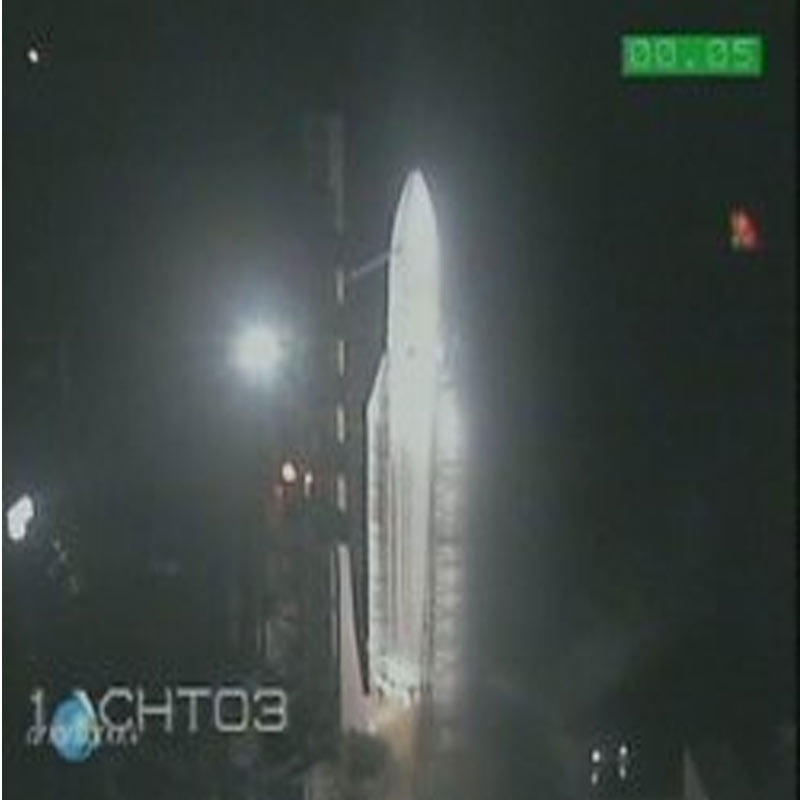
Arianespace and the Indian Space Research Organisation successfuly lifted the first in the third generation of Insat satellites on 22 March at 04:58 Indian time. The Arianespace-505 launcher had an additional payload in the Asiastar satellite which was launched for digital radio service, WorldSpace.
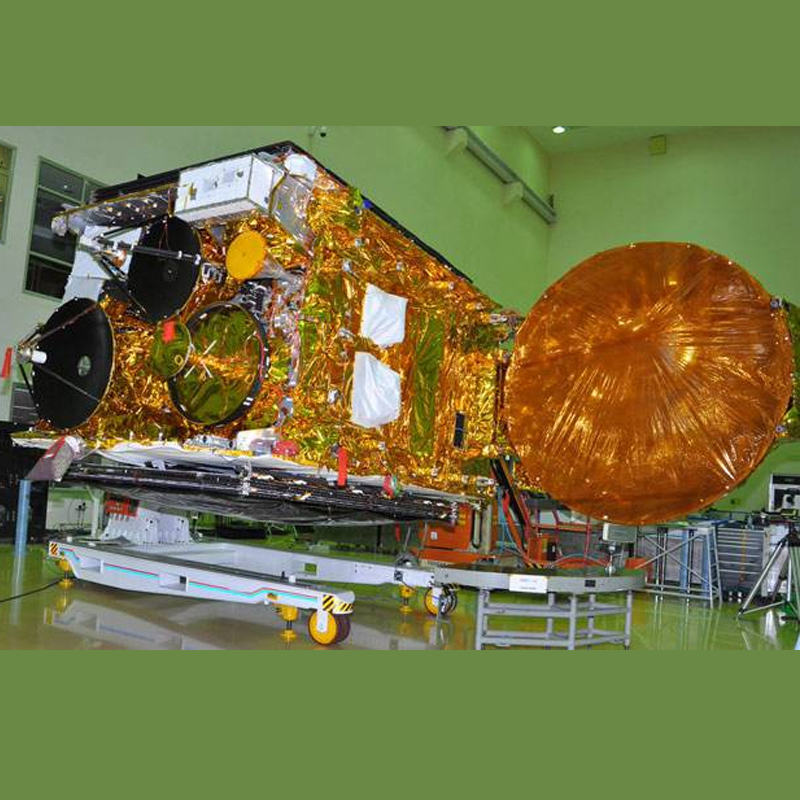
Asia Star was first injected into orbit 28 minutes after lift-off, and seven minutes later, INSAT-3B was injected (in a three-axis stabilised mode into a Geo-synchronous Transfer Orbit – GTO) with a perigee of 560 km and an apogee of 35,770 km and an inclination of 7 degree with respect to the equator.
The satellite is at present orbiting around the earth with a period of 10.64 hours. The Insat Master Control Control Facility (MCF) at Hassan in Karnataka acquired the telemetry signal from Insat-3B at 5.30 (IST) three minutes prior to its separation from the launcher.

On separation of the satellite from the composite adopter, satellite health checks were conducted and a series of commands issued from the MCF so as to orient its earth-viewing face towards earth. The outermost panel of the stowed solar array on the south side was also oriented towards the sun to start generating the electrical power required by the satellite during its transfer orbit phase.
The calibration of the gyros on board the satellite has also been carried out. The operations were completed in about (100 minutes). Insat-3B is being tracked, apart from MCF, Hassan, by INTELSAT Organisation’s ground stations at Perth (Australia), Fucino (Italy) and Lake Cowichan (Canada).
The satellite will go out of the visibility of MCF, Hassan at about 03:36 pm (IST) this afternoon and will come within the radio visibility of MCF, Hassan at 02:36 am tomorrow.
The satellite’s orbit is being precisely determined by continuous ranging from the participating TTC stations. The orbit raising operations on INSAT-3B will be carried out by firing the 440 Newton liquid apogee motor on board in stages till the satellite attains its final geostationary orbit, about 36,000 km above the equator.
The first Apogee Motor Firing (AMF-1) is planned during the third transfer orbit tomorrow (March 23, 2000) at about 07:30 am IST. The satellite has about 1,100 kg of propellant (Mono-Methyl Hydrazine – MMH and Mixed Oxides of Nitrogen – MON-3) for orbit raising operations as well as for station keeping and in-orbit attitude control for the duration of its designed life of 10 years.
When the satellite reaches near geo-stationary orbit, deployment of two solar panels and the two antennas will be carried out and the satellite put in its final three-axis stabilised mode. The payloads will be checked out before commissioning the satellite. The deployment of the solar array and the two antennas will be carried out after the satellite attains near geo-synchronous orbit.
Insat-3B will be collocated with INSAT-2E at 83 deg East longitude. It may be noted that Insat satellites now occupy four slots — Insat-2B and Insat-2C are collocated at 93.5 deg (E) longitude, INSAT-1D and INSAT-2A are collocated at 74 E longitude and Insat-2DT is located at 55 E longitude besides Insat-2E at 83 deg East longitude.
Insat-3B is primarily intended for business communication, developmental communication and mobile communication. The communication payload provides 12 extended C-band channels, each having a bandwidth of 36 MHz. The Ku-band payload provides three channels, having a bandwidth of 77/72 MHz. The Mobile Satellite Service transponders operate in C/S band frequencies. Compared to INSAT-2C/2D, the power of extended C-band transponders on board INSAT-3B has been increased from 10 W to 15 W and that of Ku-band from 20 W to 55 W.
Once commissioned, INSAT-3B is expected to further boost the Very Small Aperture Terminal (VSAT) services. The major VSAT users include banking and financial institutions, stock markets, white goods sector, fast moving consumer goods sector and medium to heavy engineering companies. Several public and private sector units have established dedicated closed-user group networks for their in-house applications. At present seven transponders from INSAT-2B and INSAT-2C are being used for these applications and INSAT-3B will almost double the transponder capacity for these services. For the first-time Ku-band frequencies will also be used for VSAT services, which enables use of smaller ground terminals.
INSAT-3B will provide the first set of transponders for Swaran Jayanti Vidya Vikas Antariksh Upagraha Yojana (Vidya Vahini) which had been announced by the Prime Minister on 15 August 15 1998. These transponders will be used exclusively for interactive training and developmental communication and will be a further extension of the present Training and Developmental Communication Channel of Insat that is being used by several agencies.
Tele-medicine is also expected to be introduced that will help in remote iagnostics and extension of super special hospital treatment to the rural population. INSAT-3B Mobile Satellite Service (MSS) has forward link channel in C X S band and return link in S X C band. MSS can support portable terminals and carry voice, fax or data. It also supports messaging service using reporting terminals.

NEW DELHI: Hamdard Laboratories gathered a cross-section of India’s achievers in New Delhi on Friday, handing out the Hakeem Abdul Hameed Excellence Awards to figures who have left their mark across healthcare, education, sport, public service and the arts.
The ceremony, attended by minister of state for defence Sanjay Seth and senior officials from the ministry of Ayush, celebrated individuals whose work blends professional success with a sense of public purpose. It was as much a roll call of achievement as it was a reminder that influence is not measured only in profits or podiums, but in people reached and lives improved.
Among the headline awardees was Alakh Pandey, founder and chief executive of PhysicsWallah, recognised for turning affordable digital learning into a mass movement. On the sporting front, Arjuna Awardee and kabaddi player Sakshi Puniya was honoured for her contribution to the game and for pushing women’s participation onto bigger stages.
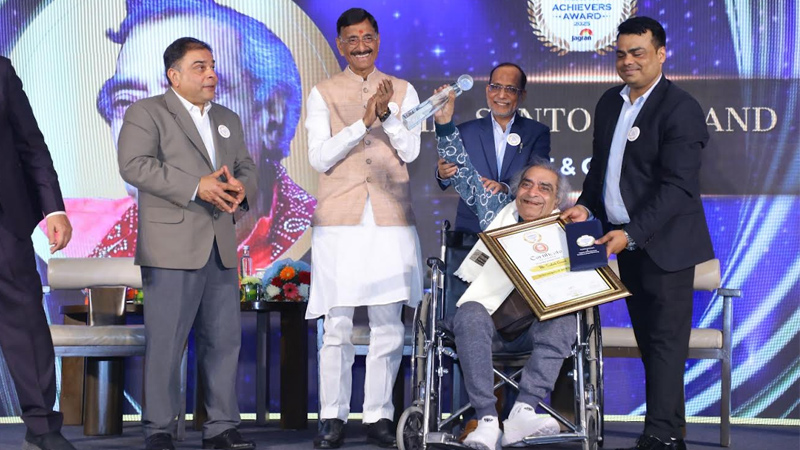
The cultural spotlight fell on veteran lyricist and poet Santosh Anand, whose songs have echoed across generations of Hindi cinema. At 97, Anand accepted the honour with characteristic humility, reflecting on a life shaped by perseverance and hope.
Healthcare honours spanned both modern and traditional systems. Manoj N. Nesari was recognised for strengthening Ayurveda’s place in national and global health frameworks. Padma shri Mohammed Abdul Waheed was honoured for his research-backed work in Unani medicine, while padma shri Mohsin Wali received recognition for his long-standing contribution to patient-centred care.
Education and social development also featured prominently. Padma shri Zahir Ishaq Kazi was honoured for decades of work in education, while former Meghalaya superintendent of Police T. C. Chacko was recognised for public service. Goonj founder Anshu Gupta received an award for his dignity-centred rural development initiatives, and the Hunar Shakti Foundation was honoured for empowering women and young girls through skill development.
The Lifetime Achievement Award went to former IAS officer Shailaja Chandra for her long career in public healthcare and governance, particularly in the traditional systems under Ayush.
Speaking at the event, Hamdard chairman Abdul Majeed said the awards were a tribute to those who combine excellence with empathy. “These awardees reflect Hakeem Sahib’s belief that healthcare, education and public service must ultimately serve humanity,” he said.
Minister Seth struck a forward-looking note, saying India’s young population gives the country a unique opportunity to become a global destination for learning, health and wellness by 2047.
The ceremony also featured the trailer launch of Unani Ki Kahaani, an upcoming documentary starring actor Jim Sarbh, set to premiere on Discovery on 11 February.
Instituted in memory of Unani scholar and educationist Hakeem Abdul Hameed, the awards have grown into a national platform that celebrates those building a more inclusive and resilient India. For one evening at least, the spotlight was not just on success, but on service with substance.






