News Broadcasting
Industry reaction mixed to CNBC report


Hours after business channel CNBC India put out a report casting doubts on the reliability of the ratings systems in India, reactions from the industry were mixed.
CNBC aired its story after its reporter Naomi Dutta got her hands on what CNBC claims is the full list of 627 households in Mumbai that had peoplemeters – the data source for television ratings points for both the market research agencies ORG Marg’s Intam as well as AC Nielsen’s Tam data.
If what the report says is true I would be very, very concerned. The implications are extremely disturbing, Andrey Purushottam, managing director, Starcom, said, when asked for his reaction to a scenario where confidentiality could not be guaranteed.

“TRP numbers are used to evaluate trends rather than snapshots,” Alex Kuruvilla, MD MTV India, said, adding that whatever the merits of the CNBC story, the ratings by and large reflect the prevailing reality.
Intam MD Gautam Mitra pointed out that while he still had to ascertain whether the list that CNBC had was a comprehensive one, it was not as if the system did not have checks and balances in place. Mitra also clarified that whatever may be the claims of the reporter about how she went about getting her list, getting hold of the names of homes which had people meters was not a very easy thing to do.
Mitra however, admitted that if CNBC actually did have the complete list of people meters in Mumbai, then it was an issue which would have to be looked into thoroughly.
Tam president GV Krishnan was extremely critical of CNBC for going public on the issue. “Unfortunately, when somebody succeeds (Star) the guns point at him. They have an industry body (Indian Broadcasting Foundation) and we were in regular discussions with them. They could have talked about it there rather than gone public with it. It’s an industry issue, not a public issue. Going to the public doesn’t make sense.”
“We were not told about this issue by CNBC,” Krishnan stressed. “Anyway, nowhere in the world is any metering system totally foolproof.” Krishnan added that if there were no TRPs channels would be able to charge what they want (to advertisers).
Advertising Agencies Association of India (AAAI) president Ramesh Narayan said the system in India was the same as is followed in the rest of the world so there was no need to get all worked up although he did admit that it was a wake up call to the industry.
Mitra said the way it worked was that as soon as the agencies got any inkling that anyone from their sample had been contacted then that person was immediately removed from their sample list.
Intam also carries out what Mitra called coincidental studies – where a completely different set of people were approached to get a proper perspective. “We also commission third-party agencies to carry out surveys.” Mitra said it was information culled from all these surveys that goes into making the research agency’s ratings charts.
One industry source dismissed the report as a storm in a teacup. “Everybody knows that there is always a possibility to manipulate people meters. Basically ratings are nothing more than a tool to gauge trends in viewership patterns. Nobody in the industry really believes that this is foolproof data. This report in no way compromises what the ratings system is all about.”




News Broadcasting
WITT Summit 2026 concludes in New Delhi
Babar Azam’s comical diving attempt goes viral as league introduces anti-dew measures.
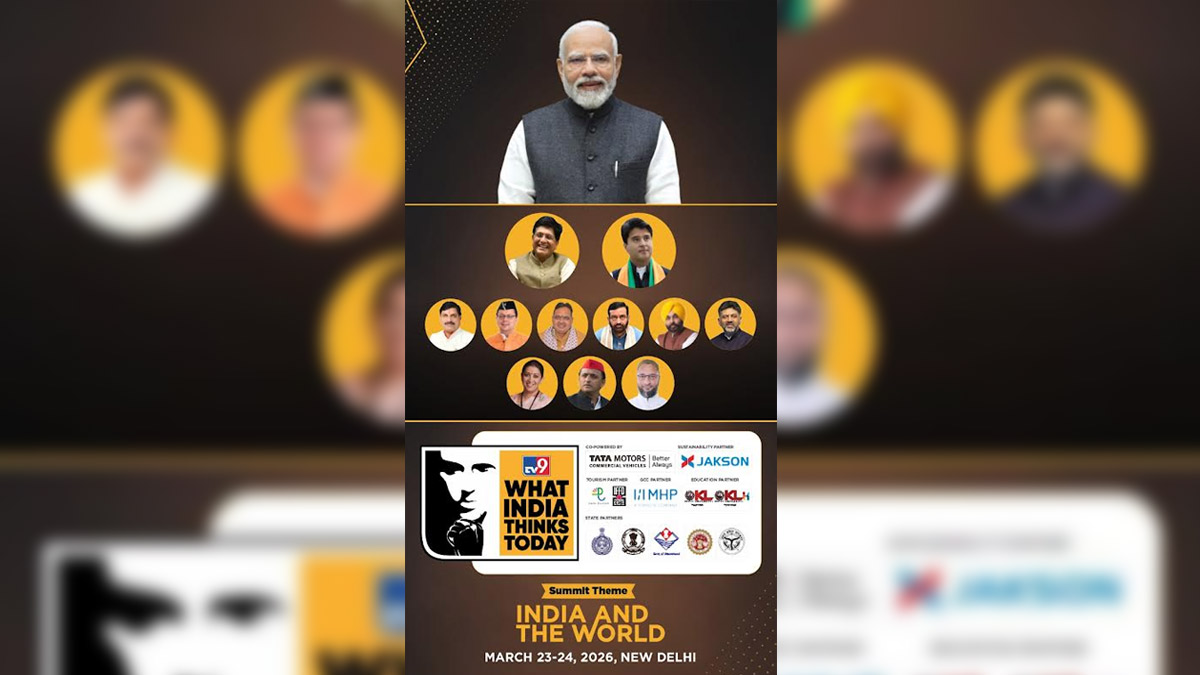
MUMBAI: The WITT Summit just wrapped up with enough big ideas to fill a policy playbook because when India’s leaders, thinkers and icons gather under one roof, even the conversations hit sixes. The eighth edition of TV9 Network’s flagship What India Thinks Today (WITT) Summit 2026 concluded on Saturday after two days of dynamic discussions at its New Delhi venue. India’s largest multi-domain public policy and culture summit brought together political leaders, policymakers, sports icons, artists and technology innovators to examine the forces shaping contemporary India and its global standing.
Prime minister Narendra Modi delivered the keynote address on the theme “India and the World” for the third consecutive year. In a wide-ranging speech, he addressed the ongoing conflict in West Asia, calling for restraint and compassion while highlighting India’s continued development trajectory despite global turmoil.
The summit featured candid conversations with state leaders. Telangana Chief Minister A. Revanth Reddy articulated a people-first governance model and contrasted it with other development approaches. Madhya Pradesh Chief Minister Mohan Yadav declared that Left-wing extremism had been effectively eliminated in his state and highlighted preparations for the upcoming Kumbh Mela. Punjab Chief Minister Bhagwant Mann defended his government’s record, citing the closure of 19 toll plazas and creation of the Sadak Suraksha Force. Karnataka Deputy Chief Minister D.K. Shivakumar expressed confidence in Congress prospects in Assam and addressed recent allegations against him.
On geopolitics and national security, Union Minister Jyotiraditya Scindia outlined India’s ambition to become a builder of trusted digital infrastructure for the world, citing the rapid 5G rollout and village-level 4G connectivity.
Cricket received significant attention. Former India captain Sourav Ganguly praised player freedom and trust as hallmarks of great leadership and named MS Dhoni as the greatest captain due to his World Cup successes. India women’s team bowling coach Aavishkar Salvi credited the BCCI and Women’s Premier League for building a pipeline of world-class talent behind the team’s recent ODI World Cup triumph.
The summit also hosted the inaugural AI² Awards 2026, celebrating the convergence of human creativity and machine intelligence in storytelling and content creation. Poet and kathavachak Kumar Vishwas delivered a nuanced take on India’s concept of Dharma and criticised the recent arrest of an 80-year-old Shankaracharya. Veteran lyricist Sameer Anjaan and storyteller Neelesh Misra reflected on changing music trends and artistic responsibility in the wake of a recent controversy involving Nora Fatehi.
In a country where conversations often run as deep as the Ganges, the WITT Summit proved once again that when leaders, thinkers and storytellers come together, the real winner is public discourse lively, layered and refreshingly unafraid to tackle the big questions shaping India’s tomorrow.








