News Broadcasting
Industry leaders foretell the future


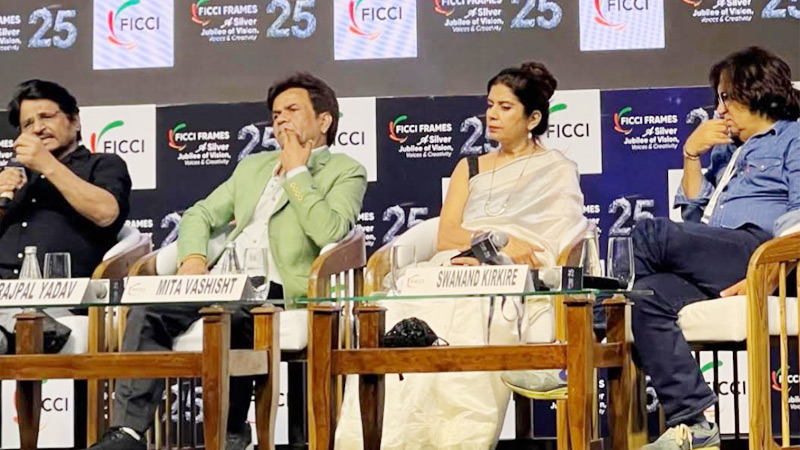
MUMBAI: The 15th edition of FICCI FRAMES witnessed a panel on ‘Television 3.1 Era’, where thought leaders discussed the future of the broadcast industry in terms of content, marketing and distribution in an era of convergence and multi-platform delivery mechanisms.
The panel was constituted by Celestial Tiger Entertainment CEO Todd Miller, Reliance Broadcast CEO Tarun Katial, NDTV Group CEO Vikram Chandra, MSO Alliance president Ashok Mansukhani, TV France International executive director Mathieu Bejot and Zee Entertainment chief content and creative officer Bharat Kumar Ranga.

Having been there in the cable industry for nearly two decades, Mansukhani said there was a need for the industry to start providing content at a time of the viewer’s choice, at a price of the viewer’s choice, and in a manner of the viewer’s choice. “The young generation watches television on the iPhone or iPad. There is one big change that needs to come in the entire industry, which is to start addressing the young consumer in terms of his/her technological needs, content needs and legal rights to access content in whichever way they want to,” he said.
Chandra said, “Years ago, we used to say that TV as we knew it will be gone forever. That trend is going to accelerate and linked to that is the crashing of price point of smart phone devices. We have to be prepared to change the way we are viewing our own models.”
He said monetization is a challenge because online in India is still not at a stage it is in say the US though it will get there.
According to Ranga, “We must not remain an India-based multi-national company, but we need to become a meta-national company. Every market in India, whether it is Tamil Nadu or Karnataka, we have to look at each market individually, closely, and work on it. The moment we do that, we will be able to call ourselves a meta-national company. That is a big change.”
Ranga further said that the understanding between the network and the consumer is all important. “Finally, consumer-ish understanding is important as compared to market-ish understanding,” he said and added that the first two things would add up to the value of off-screen talent going up and that would take India ahead.
Miller opined that while multi-screen content viewing would become fundamental in India in the next ten to fifteen years, it was a long road ahead. “TV viewing will still be the primary medium. So in India, HD is the thing and has a lot of room to grow,” he said.
On his part, Katial said, “India has to see content as the central issue. In this area, India is very much ahead of some other countries where companies are providing content specifically for digital or TV. India however does broadcast quality content for digital.”
Mansukhani drew attention to the fact that the youth will probably want to view more niche television. “There is a lot of international content that has to be made available. Also, regional content has to be customized. The value of local content cannot be ignored. A little more money for a little more valuable content can lead to better changes in the way we watch television,” he concluded.


News Broadcasting
India Today Group sweeps top honours at Ramnath Goenka Awards
Journalists recognised for fearless investigative and civic reporting.
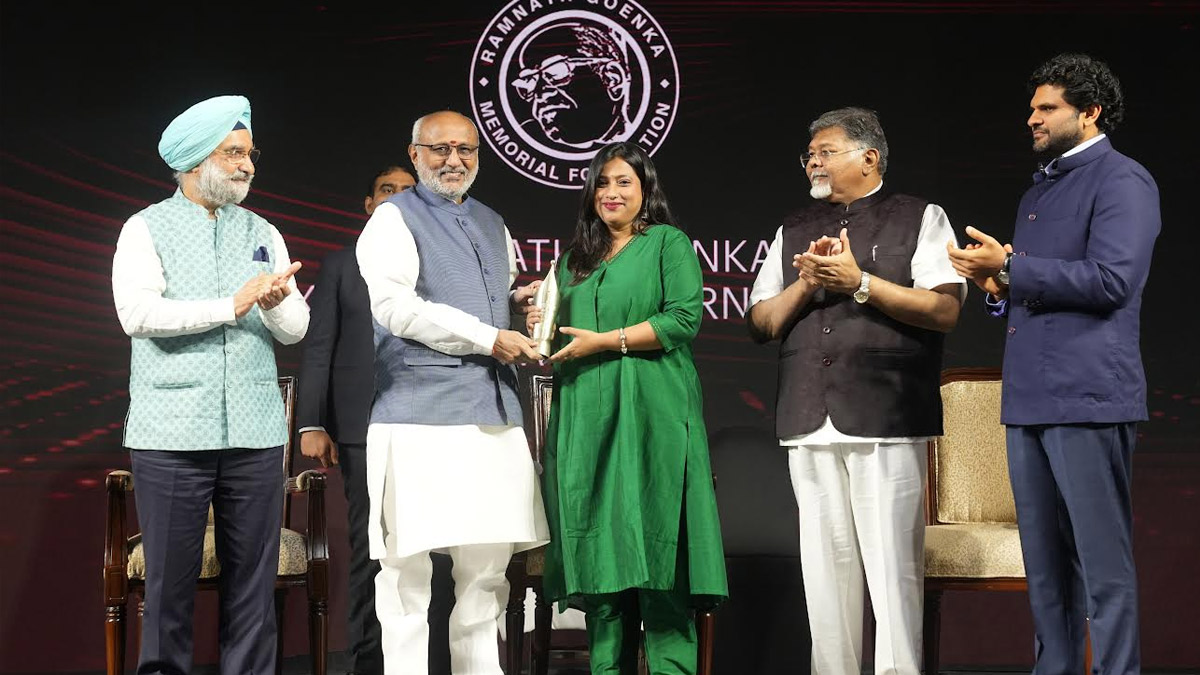
MUMBAI: India Today Group just turned the Ramnath Goenka Awards into its own trophy cabinet because when your reporters dig this deep, even the judges have to award a clean sweep. India Today Group journalists have secured multiple top honours at the latest edition of the prestigious Ramnath Goenka Excellence in Journalism Awards, reinforcing the network’s legacy as the gold standard of Indian journalism. The awards were conferred by vice president C. P. Radhakrishnan at a ceremony held on 27 March 2026.
Sreya Chatterjee won in the ‘Investigative Reporting – Broadcast’ category for her powerful India Today TV report ‘Operation Illegals: The Alarming Rise in Bangladeshi Infiltration Across India’s Fragile Eastern Frontier’. The investigation stood out for its depth, on-ground rigour and national relevance.
In the ‘Civic Journalism – Print/Digital’ category, Sreya Chatterjee along with Arvind Ojha were honoured for their indiatoday.in report on unregulated water extraction and the ‘Tanker Mafia’ in Delhi’s Bawana Industrial Area. The story exposed critical systemic gaps and environmental challenges affecting daily life.
Additionally, aajtak.in was recognised in the ‘Investigative Reporting – Print/Digital’ category for its hard-hitting exposé ‘The Surrogate Mother Market’, which highlighted the human, legal and ethical dimensions of the surrogacy ecosystem.
India Today Group emerged as the only network honoured in Investigative Journalism across both Print/Digital and Broadcast categories. The wins reflect the strength of its multi-platform newsroom and its unwavering commitment to credible, high-impact reporting that informs public discourse and drives accountability.
In an era when speed often trumps substance, these awards remind us that the most powerful stories are still the ones dug out with courage, told with clarity, and delivered with conscience, one fearless byline at a time.








