Event Coverage
Industry doing nothing to transform biz models for digital world: Uday Shankar

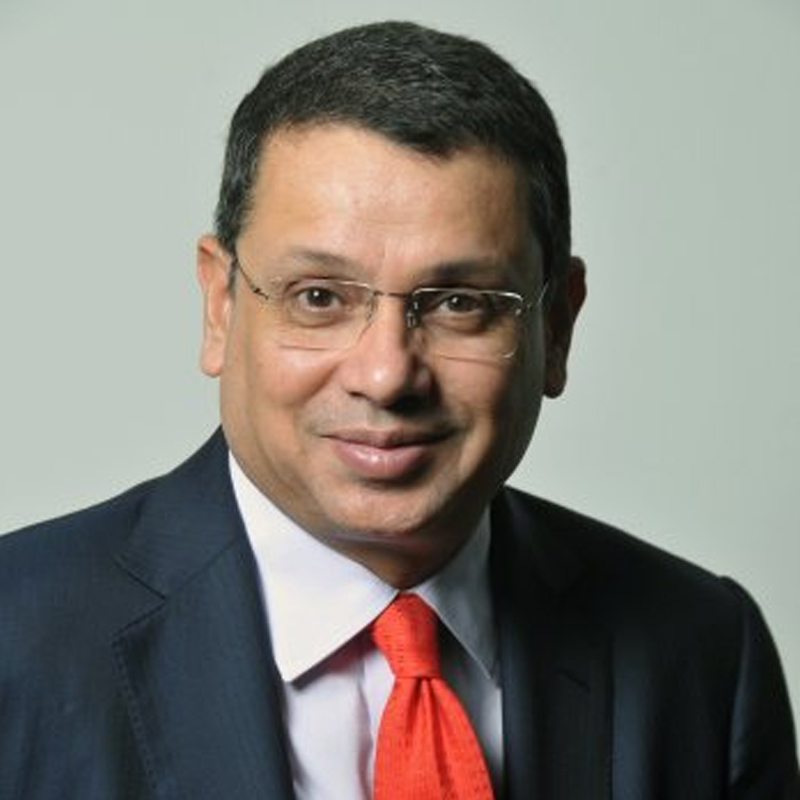
MUMBAI: Star India CEO and Ficci Broadcast Forum chairman Uday Shankar set the ball rolling at the inaugural of the 13th edition of the Ficci Frames by saying that the industry is at the cusp of what is set to completely transform broadcasting in India, forever.
Shankar was talking about the universal digitisation of television distribution. A subject that has dominated all discussions at all forums last year and which he presumed will continue to do so for a long time to come.
“Most of the discussions that I have participated in are still around whether digitisation will happen and if it indeed were to go through, how chaotic it would be. With all humility may I suggest that it is a meaningless discussion triggered by a bunch of retrograde interests who are living in denial,” he said.

The Cable Television Networks Amendment Act is not the beginning of digitisation. Digitisation of distribution is a big reality and the 40 – 45 million homes that have bought DTH boxes at some point or the other are a conclusive evidence of that. “In fact as we speak, India may just have overtaken the United States as the world’s largest DTH market,” he said.
Shankar added, “The critics and the cynics who are still wondering whether digitisation would happen, my answer is: Look around, it is already happening and the rest of it is bound to happen because even in this country it would be difficult to undo such a momentous shift. To those who wonder how chaotic it would be, my response is that there would be some chaos, but chaos is not necessarily bad if the alternative is status quo or regression.”
However, he also cautioned that his biggest concern now is a chaos of another kind that we are all set to create by our inaction. “Whether we like it or not, in a few years time, the vast majority of this country will receive its content through digital media – digital cable, DTH, 4G, wireless and Internet. But are we preparing for that? The answer is a big no,” he regretted.
He said that while we debate a digital future day-in-and –day-out, the industry is doing nothing to transform or find business models for a digital world. “Let’s face it. Universal digitisation is going to force us to change the way we do business and we are not ready for it. We often blame the cable operators and MSOs that they are not ready but I am afraid that even the broadcasters and the content creators are not ready for a digital world. Are we then setting ourselves up to become uncompetitive and irrelevant?,” he asked.
DTH has launched services like HD, Dolby sound and digital video recorder” and yet the broadcasters are doing nothing differently to service this segment. DTH has been around now for about six years and broadcasters or the content community have done nothing as an example of a strategy to exploit the new technology. This, he said, is despite an intuitive and an experiential understanding that the behaviour and the consumption patterns in DTH homes are significantly different from analogue homes. “The data also show that the average time spent on content in digital homes is much more and yet we do not treat them differently,” he said.
Shankar said that it is scary how “we have force-fitted an analogue broadcasting model into the digital domain.”
Is that what we are going to do even after cable goes digital, he asked. “I am afraid if the past behaviour is anything to go by, we are not ready to offer anything significantly different and therein lies the biggest crisis and risk of a chaos,” he said.
He said there is enough global experience to suggest that digitisation leads to decentralisation, regionalisation or localisation of content creation and distribution.
“Creatively, it is a huge catalyst for innovation and diversity. Essentially what it means is that with universal digitisation the business models of broadcasting, which are built on centralised creation and distribution of content and even a centralized advertising revenue model, may come under a huge pressure,” he cautioned.
Shankar said that the cable community is still busy lamenting the potential loss of carriage fees and not realising what an amazing opportunity it has to participate in the local economic boom that is sweeping most parts of this country.
“The first phase of digitisation that covers the 4 metros will be a huge unshackling of broadcasting and content opportunities. These are the cities that have crumbled under the weight of analogue frequency limitations. Just imagine the opportunities that these metros also our economic hotspots present when, from the first of July access to frequency will no longer be a constraint. So to my mind the MSOs and the cable operators may potentially become a powerful content creator that the traditional broadcasters have to contend with. There may be new creative talent ready to ride this technological transition. As the subsequent phases roll on, the decentralisation of broadcasting is bound to gain enormous momentum. However, I don’t see anyone trying to race ahead to take a pole position here,” he said.
He also pointed out that HD TV sets have been available in this country and while many people were buying them, their off-take was still low primarily because there was no HD content and nobody was willing to invest in HD content because there were not enough HD consumers. “It was the classic chicken and egg problem. However early last year, when we at Star launched 5 HD channels with Dolby 5.1 surround sounds, even we were surprised by the rapidity with which HD gained acceptance. Today, in less than a year there are around 25 HD channels. But, I have to admit with a touch of disappointment that I am yet to see an adequate recognition of the potential of HD and a superior sound possibility by my fraternity. It is a classic case of the old mindsets struggling with a new technology,” he rued.
Are we going to stay locked into this struggle or are we going to create a new generation of television which would be designed for the digital world?, he asked.
Shankar said he has been an admirer of the current information and broadcasting dispensation which he thinks has shown more vision than any other dispensation in his two decades of interaction with the broadcasting establishment. “However, let me point out that we still need a lot of official and legislative enablers to remove the bottlenecks on this expressway. For instance, a clear policy to enable multiplicity of beams and splits would be a powerful trigger for proliferation of content and revenue opportunities,” Shankar said.
He ended his keynote with the example of the latest Oscar success from Hollywood – The Artist – which is a portrayal of how a talented and accomplished artist from the silent era could become completely irrelevant because he refused to see that the times have changed.
“Let’s not try to thwart a revolution which people are crying for. We will only hurt ourselves. The question is whether we will lead the change or whether we will vacate the space for a new set of entrepreneurs and visionaries who will replace us. It is up to us to use it or lose it,” he said.





Event Coverage
Anime India announces Amazon MX Player as co-presenting partner for Anime India Kolkata 2026
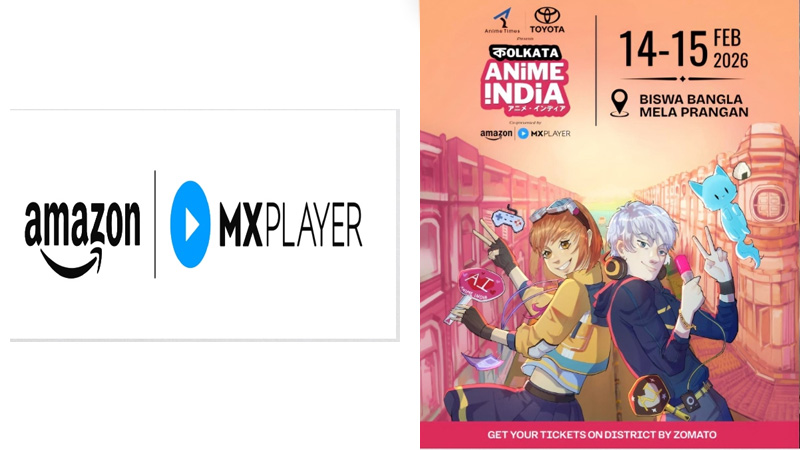
MUMBAI: Riding high on the success of its blockbuster Mumbai debut, Anime India is accelerating its nationwide expansion with the announcement of Amazon MX Player as the co-presenting partner for Anime India Kolkata. The partnership marks a significant step forward in the festival’s mission to deliver large-scale, accessible, and fan-first anime experiences across the country.
Scheduled for 14 and 15 February 2026 at the iconic Biswa Bangla Mela Prangan, Anime India Kolkata will launch the first regional chapter of what is set to be a year-long, multi-city tour. As the curtain-raiser for the 2026 circuit, the Kolkata edition aims to fuse the energy of global Japanese pop culture with India’s fast-growing community of anime, manga, and pop-culture fans.
A household name in digital entertainment, Amazon MX Player brings unmatched reach and cultural relevance to the Anime India platform. With its expanding focus on anime and youth-driven content, Amazon MX Player’s involvement as co-presenting partner reinforces Anime India’s vision of making anime culture more inclusive breaking barriers of language, geography, and accessibility to connect with fans nationwide.
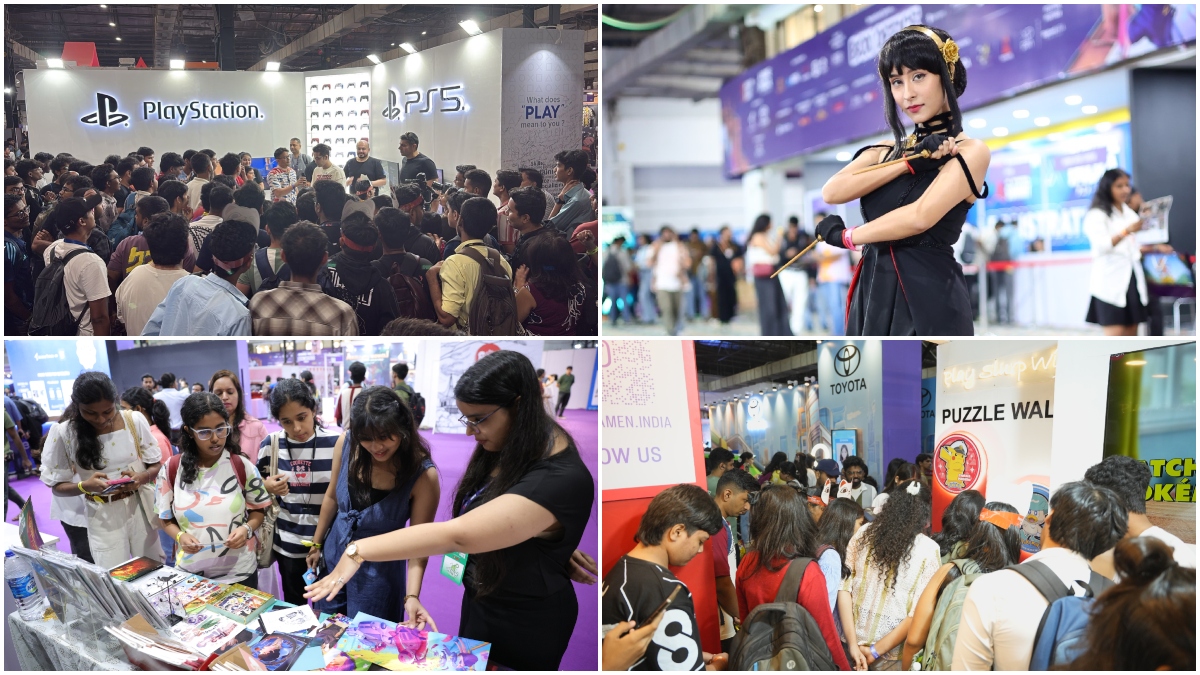
Anime India Kolkata 2026 will showcase cosplay competitions, interactive zones led by the Indian Gunpla Community, India-39 Vocaloid Community, The Japan Curry, and Adda-o-Otaku by The Otaku Guild. Fans can join tournaments across fighting games, Pokémon VGC, and more. Acclaimed Japanese director Susumu Mitsunaka (Haikyu!!) will attend as guest of honour, appearing in panels and live sessions. Positioned as an immersive celebration of fan culture and industry collaboration, the Kolkata edition marks the beginning of Anime India’s nationwide expansion.
Sharing their perspective on the partnership, Amazon MX Player director Aruna Daryanani expressed, “Anime in India has evolved from a niche interest into a mainstream cultural movement, driven by an increasingly engaged and passionate fanbase. At Amazon MX Player, our focus is on expanding access by bringing anime to audiences across the country for free and in multiple local languages. Our association with Anime India reflects our commitment to supporting the growth of anime in India and deepening connections with fans, while continuing to build Amazon MX Player as a trusted destination for free, high-quality entertainment.”
“Anime India Kolkata is a celebration of how anime has grown beyond entertainment into a powerful cultural and creative force. By bringing fans, creators, and industry leaders onto one shared platform, the festival is helping define the future of pop culture in India,” said Anime India co-founder and director Neha Mehta.
The debut edition of Anime India 2025 in Mumbai attracted over 29,000 fans, quickly cementing its status as a landmark celebration of anime and Japanese pop culture. Riding on this overwhelming response, the Kolkata chapter is projected to draw more than 40,000 visitors across two days, positioning it as one of the biggest anime conventions ever held in eastern India.
Anime India is focused on bringing together fans from across the country to create a truly pan-India celebration of anime, manga, cosplay, gaming, and Japanese culture. With plans to expand into four key metropolitan hubs in 2026—east (Kolkata), north (Delhi), west (Mumbai), and south (Hyderabad)—the festival seeks to deliver globally benchmarked experiences while supporting and uplifting creators, artists, and fan communities throughout India.







