Hindi
India’s ‘Masaan’ wins two awards at Cannes, including Un Certain Regard

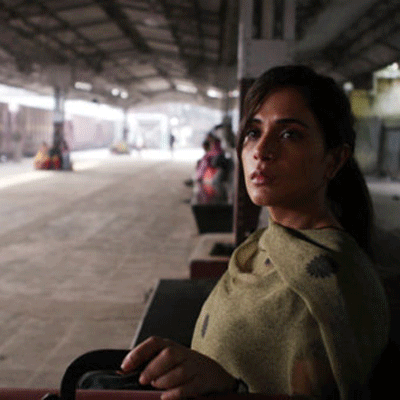
NEW DELHI: India’s Masaan by Neeraj Ghaywan became a big winner in the Un Certain Regard section of the 68th Cannes International Film Festival by bagging two awards, even as the top award in this category went to Rams, a drama set among farmers and their sheep in a remote Icelandic valley.
Masaan also received the Promising Future Prize, apart from bagging the International Federation of Film Critics (FIPRESCI) award.

Actress Richa Chadha, who features in a key role in the film, said the team feels “blessed.” “#MasaanAtCannes just got the FIPRESCI award. #blessed. Team, take a bow,” Chadha tweeted.
The film won a five-minute standing ovation post its screening, leaving Chadha and Ghaywan in tears of joy.
Ghaywan’s debut feature project, Masaan is set in Varanasi and follows the stories of four people from a small town and how they fit in to the moralities.
It also features Shweta Tripathi, Sanjay Mishra and Vicky Kaushal.
The film is an Indian-French co-production with names like Manish Mundra of Drishyam Films, Macassar Productions, Phantom Films, Sikhya Entertainment, Arte France Cinema and Pathe productions.
“I’m ecstatic to win these two awards for India and the team of Masaan more than myself. This was long overdue. We had a truly global team that was purely driven by passion and utmost honesty, which has gotten us this far. I can’t wait to show this film in India,” Ghaywan said.
Ghaywan also thanked filmmaker Anurag Kashyap with whom he had worked as assistant director on Gangs of Wasseypur and second unit director on Ugly.
Jury president Isabella Rossellini said Grimur Hakonarson’s film Rams was honoured for “treating in a masterful, tragicomic way the undeniable bond that links all humans to animals.”
Six of the 19 films in the Un Certain Regard competition, which honours new directors and more offbeat films than those up for Cannes’ main Palme d’Or prize, won prizes.
The second-place Jury Prize went to Croatian director Dalibor Matanic for Zvizdan (The High Sun), which explores love and ethnic hatred in the Balkans.
The jury bestowed the directing prize on Kiyoshi Kurosawa for Journey to the Shore, and gave the Talent award to Treasure, by Romania’s Corneliu Porumboiu, and the Special Jury award to Nahid by Iranian director Ida Panahandeh.
Actress-director Rossellini said serving on the jury had been “like taking a flight over the planet and seeing all its inhabitants and their emotions. I think we are the envy of every anthropologist,” she said.





Hindi
Remembering Gyan Sahay, the lens behind film, television and advertising
From a puppet rabbit selling poppadums to Hindi cinema, he framed it all.
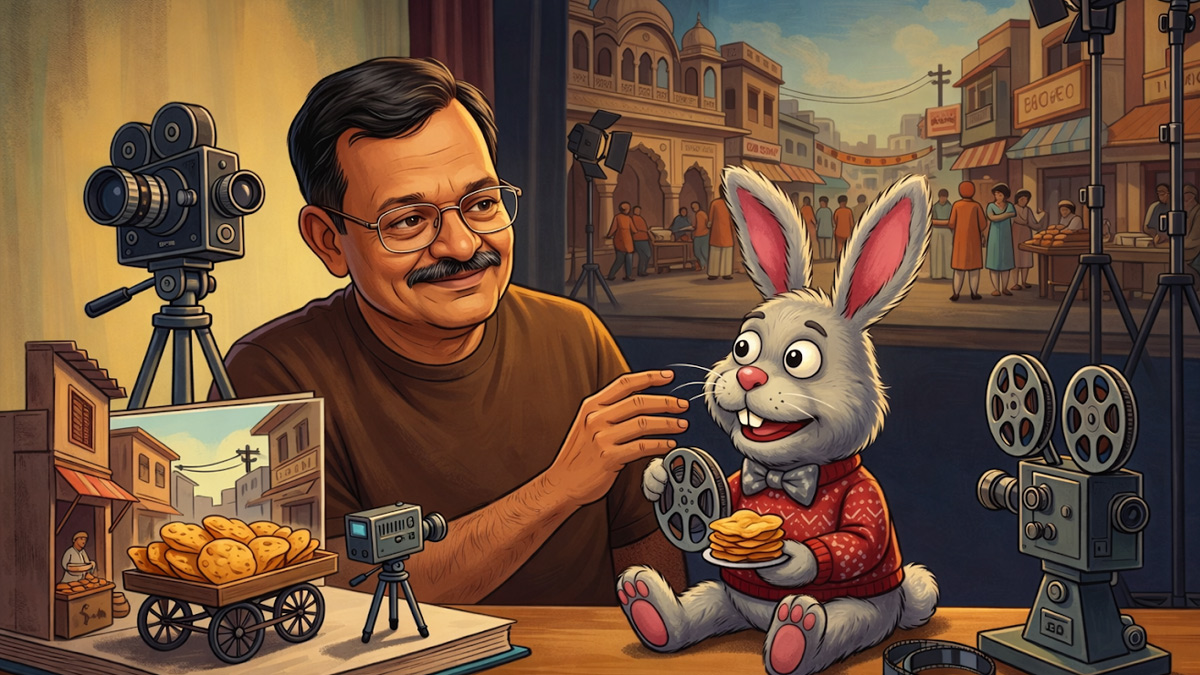
MUMBAI: There are careers, and then there are canvases. Gyan Sahay, the veteran cinematographer, director, and producer who passed away on 10 March 2026 in Mumbai, had one of the latter. Over several decades in the Indian film and television industry, he turned lenses, lights, and the occasional puppet rabbit into something approaching art.
A graduate of the Film and Television Institute of India (FTII) in Pune, Sahay built his reputation as a director of photography across a career that stretched from the early 1970s all the way to the digital age. He was the kind of craftsman who understood that a well-composed shot is not merely a technical achievement but a quiet act of storytelling.
For most Indians of a certain age, however, Sahay will forever be the man behind the rabbit. His direction of the iconic long-running television commercial for Lijjat Papad, featuring its now-legendary puppet bunny, gave the country one of its most cheerfully persistent advertising images. It was the sort of work that sneaks into the national subconscious and takes up permanent residence.
His big-screen credits as cinematographer include Anokhi Pehchan (1972), Pagli (1974), Pas de Deux (1981), and Hum Farishte Nahin (1988). In 1999, he stepped behind a different kind of camera altogether, making his directorial debut with Sar Ankhon Par, a drama that featured Vikas Bhalla and Shruti Ulfat, with a cameo by Shah Rukh Khan for good measure.
On television, Sahay was particularly prized for his command of multi-camera production setups, a skill that made him a go-to technician for large-scale shows and reality programmes. In an industry that has never been especially patient with complexity, he was the calm hand on the rig.
In later life, Sahay turned teacher. He participated regularly in masterclasses and Digi-Talks, often hosted by organisations such as Bharatiya Chitra Sadhna, sharing hard-won wisdom on cinematography, the comedy of timing in a shot, and the sweeping changes brought by the shift from celluloid to digital. He was also said to have been involved in a project concerning a biographical film on Infosys co-founder N.R. Narayana Murthy.
Tributes from the film industry poured in following the news of his passing, with colleagues remembering him as a senior cameraman who served as a rare bridge between two entirely different eras of Indian cinema. That is, perhaps, the finest thing one can say of any craftsman: he kept up, and he brought others along with him.







