iWorld
Indian OTT content has a huge potential to make money in overseas markets

MUMBAI: With every big and small player wanting a bite out of the OTT pie, it is critical to stop and think about the ground realities involved with this paradigm shift to prevent overzealousness getting the better of rationality. That is precisely why the thought leaders and stakeholders in the emerging space got together to discuss at length the OTT Opportunities and Strategies in India at the second edition of NexTv Series India 2016 conference organised by Dataxis
The organisers approached the topic in a more targeted way by splitting the panel into two parts – short form and long form content. The first panel comprising of Red Chillies VFX lead digital strategist Sidharth Iyer, Eros Now business head Zulfiqar Khan, CA Media Digital CEO Vivek Jain, and Vuclip global content and acquisition director Nikhil Naik discussing long form content on OTT platforms.
The panel started with each player laying down their perspective on what made the OTT sphere such a game changing one, and then went on to categorise the genres of long format content on OTT platforms that they thought would work.

After segregating the type of content that Bollywood is currently churning out, Iyer was quick to point out the potential for the booming kids’ content in India, especially in the digital space. Citing the example of Viacom18’s recently launched OTT arm VOOT and its separate kids’ library, Iyer emphasised that the kids’ genre was the next big thing in the content space, not just for its reach but because of its prolonged shelf life as well.
Seconding Iyer, Khan further reiterated the OTT mantra, “What works on TV doesn’t work on digital.”
The panellists also warned against stereotyping of content by constantly asking “what genre works on OTT”, as it could restrict creators from thinking out of the box and creating beneficial disruptions.
The overseas market for the emerging OTT platforms in India was the next big turning point in the discussion. Naik, backed by experience of operating in several south Asian markets, bet high on the revenue generation potential of Indian content in overseas markets. “Solving user problems is the right way to approach a new market, and this will show revenue growth for the players,” Naik suggested. Citing his own company’s experience from operating in the Asian market, Naik narrated how providing quick and quality subtitles along with simulcast options of popular Korean dramas won subscribers in its Malaysian operations.
Censorship was a mammoth issue that the panel addressed. Speaking from a digital content creator perspective, Iyer vouched for the creative liberty of creators, while Jain suggested targeted showcasing or distribution of content to deal with the censorship issue. Khan brought in a fresh perspective by calling censorship a ‘cultural issue rather than a policy one’. “We can’t judge how the entire nation thinks based on a few people here in a five star hotel in Mumbai say. Solving the censorship issue lies in understanding the value system of the country rather than ignoring it or forcing it to change. There is a huge gap in tier II and tier III cities between access rates and sensibility development. I suggest we take the example from the TV model and form an industry body and practice self-regulation. It’s high time we start talking about it.”
The second panel comprising of Alt Digital Media Entertainment CSO Eklavya Bhattacharya, Ditto TV business head Archana Anand, Zenga group MD Shabir Momin and Fame Digital SVP Shreyas Rao opened the floor with discussions about the challenges in creating short form content for the digital platform.
“Everyone diving into the OTT space is hedging their bets on the media given its nascent nature. It is leading to content creators becoming more and more possessive of their content, and pushing the prices upward,” Anand made a powerful point.
Steering away from the predictable ‘pricing’ issue for OTT platforms and digital content creators, Bhattacharya shared his thoughts on ‘convenience.’ “Video consumption is currently driven by convenience, and not taste and preference. Music saw a similar paradigm shift when cassettes disappeared and people asked where the artists and labels were going to make money from. And now T-Series on digital is one of the biggest revenue generators. This doesn’t mean that people didn’t chose the easy way out by downloading songs from sites like Songs.pk, but that it became easier to buy and listen to songs online. So whether people will pay or not ultimately boils down to convenience even for the OTT players.”
The panel also gave an interesting point of view on the David vs Goliath scenario that currently exists between the big label OTT players like VOOT, Hotstar and Sony Live; and the emerging content start-ups. “The larger players can play on their experience of content creation and their ready bank, but the newer players have the advantage of being agile and flexible. They will be the innovation drivers in content on OTT platforms and evangelise new genres playing on their social media and topicalty strengths.”
Anand however placed her bets on the OTT platforms operating under a larger broadcast umbrella like SPN, Viacon 18 or Star, as ultimately success in this emerging sphere would be a waiting game. “Those going for the AVOD model will have to build a critical viewership before they can rake in the revenues, and those who are opting for the subscription revenue model, will have to wait till the bandwidth issue gets resolved and Indians adopt to paying for their content, both needing a good two to three years. Thus to sustain these two to five years, the big players will have the funding advantage.”
The panellists further highlighted the potential for Indian content to travel overseas and make a market for itself. “Geo agnostic content is the future of OTT. No one really cares that a Swedish production house is making GOT. If the content is good, people are willing to pay for it. Between Pakistan, Sri Lanka, Bangladesh, that is, the Indian subcontinent, Indian content has a huge potential,” Bhattacharya shared. “There is a huge market out there amongst the large population of the Indian diaspora sitting outside the country who are also in a situation to pay for the content.”
Bhattacharya further added that there was a scope to create content that would appeal to the regional markets, and the diaspora that related to that content outside the country. “For years content creators were creating content so that broadcasters could monetise it for advertisers so a lot of the content was very specific. Who is creating content for that Tamil guy sitting in Singapore? Give them good content they will pay for it for certain.”
The panel concluded with discussions on a need for a new type advertisement creative that wasn’t intrusive and moved away from the traditional way of slapping advertisements on audiences. Cleverly and creatively done branded content was an alternative offered by the panel.






iWorld
Prime Video bets big on India with global originals, films and franchise expansion
Execs highlight scale, travelability and new IP bets as India anchors global strategy
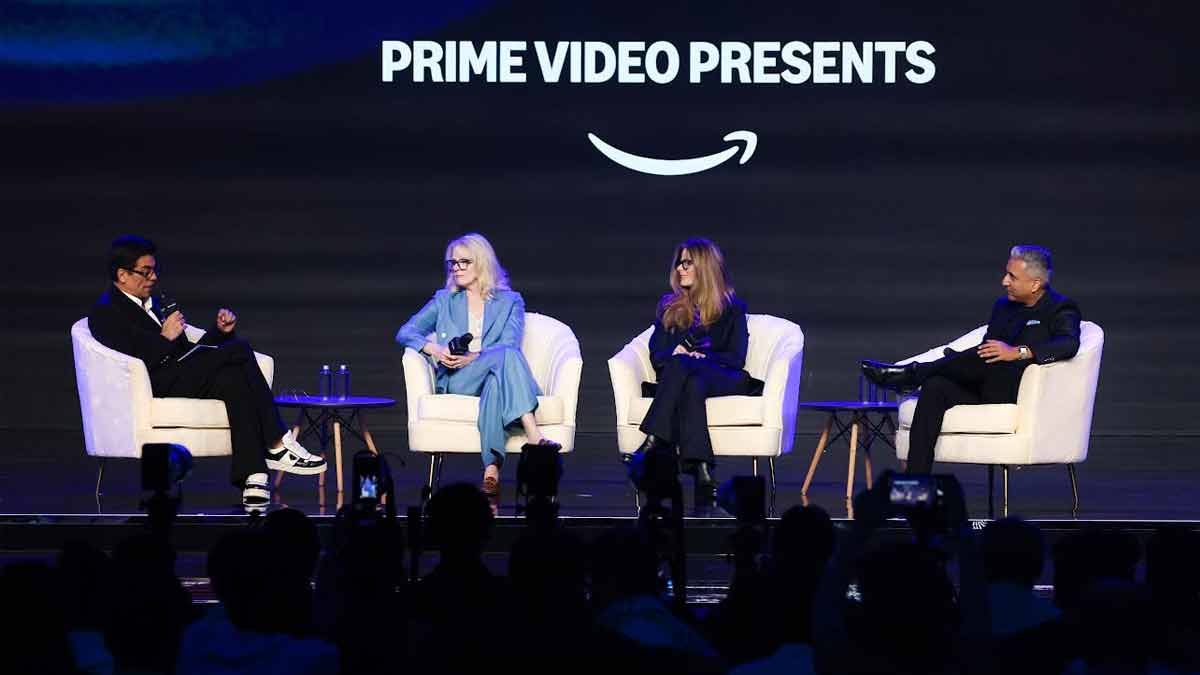
MUMBAI: At Prime Video Presents 2026, the message was clear and confident. India is not just part of the plan, it is central to it.
In a lively fireside chat hosted by filmmaker Karan Johar, Kelly Day, vice president of prime video and amazon mgm studios international, Nicole Clemens, vice president of international originals, and Gaurav Gandhi, vice president for Apac and Anz, laid out an ambitious roadmap. Think bigger stories, wider reach and a sharper focus on building franchises that travel.
Kelly Day, a regular visitor to India, set the tone early. Calling the country “one of the most important markets globally”, she pointed to the sheer scale and diversity of audiences as a driving force behind Prime Video’s growth. Indian Originals, she said, are not just local hits but global engines powering subscriptions and engagement.
That global appeal is already visible. According to Clemens, around 25 percent of viewership for Indian content now comes from outside the country. Shows rooted deeply in local culture are finding fans worldwide, proving that specificity, when paired with universal themes, travels well. From gritty dramas to sharp thrillers, Indian storytelling is increasingly crossing borders with ease.
Clemens, who joined recently to lead international originals, was particularly upbeat about India’s creative range. She highlighted a growing slate of over 100 shows in development and production, with more than 60 percent returning for multiple seasons. For her, the formula is simple. Authentic stories, told well, resonate everywhere.
Adding to the buzz, she teased new and returning titles, alongside a fresh superhero universe, the Kalyug Warriors. It signals a push into new genres while doubling down on familiar fan favourites.
If content is king, distribution is the clever courtier. Day outlined Prime Video’s layered business model in India, which blends subscription, rentals, add on channels and ad supported viewing through Amazon MX Player. The idea is straightforward. Give viewers choice, whether they want premium, free or pay per view.
India, she noted, has also become a testing ground for innovation. Tiered pricing, mobile only plans and language diversity have all been sharpened here before being exported to other markets. In many ways, the India playbook is now influencing global strategy.
For Gaurav Gandhi, the next chapter is about scale with intent. He outlined four priorities. Making Prime Video more accessible, pushing Indian content globally, building stronger franchises and supercharging the films business.
On films, the platform is moving beyond licensing into co productions and now theatrical releases in partnership with amazon mgm studios. These films will eventually stream on Prime Video, creating a full circle from cinema halls to living rooms across 240 countries.
Franchise building remains another key pillar. With hits like The Family Man, Mirzapur and Panchayat already enjoying multi season success, the focus is now on creating the next wave of enduring IP. Newer titles are already lining up for second seasons, signalling a steady pipeline.
What stood out through the conversation was a shared belief. Streaming in India is still in its early innings, and the runway is long. With a mix of local flavour and global ambition, Prime Video is betting that stories from India will not just stay at home, but travel far and wide.
Or as the executives seemed to suggest, the world is watching and India has plenty more to show.