I&B Ministry
Indian govt presents Waves 2025 to 100 ambassadors and high commissioners

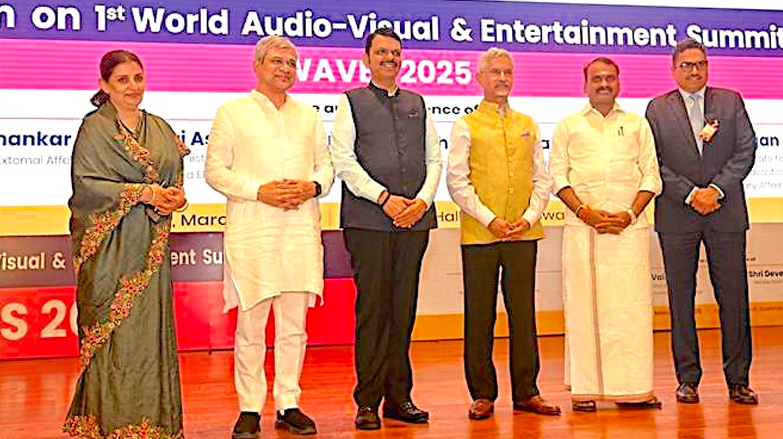
MUMBAI: In a glitzy push to make India the hotbed of global media action, the government rolled out the red carpet for its ambitious World Audio Visual & Entertainment Summit (Waves) 2025 today at Sushma Swaraj Bhawan in New Delhi in the presence of 100 ambassadors and high commissioners. MIB officials made a hard sales pitch to prod them and make them realise that the Indian government is extremely serious about Waves 2025 and they in turn should carry this message back to their national governments and ensure robust participation from their respective countries.
Waves 2025—set to make a splash in Mumbai from 1 to 4 May 2025—promises to be a star-studded affair that will see the worlds of tech, media and entertainment collide in spectacular fashion.
Union minister for external affairs S. Jaishankar didn’t mince words about the summit’s significance: “Economic and political rebalancing is moving towards cultural balancing. We are not truly global if we are not truly local. Waves 2025 captures the spirit of this endeavour.”

He urged the ambassadors and high commissioners to familiarise their governments regarding the opportunities of global collaborations courtesy the Waves 2025 initiative.
Meanwhile, information & broadcasting minister Ashwini Vaishnaw turned up the heat, declaring that “the intersection of creativity, media and technology is transforming the media landscape of the world and reaching a new level of convergence.” He teased that “some of the biggest names” in the industry would be gracing the Mumbai bash.
Not to be outdone, Maharashtra chief minister Devendra Fadnavis jumped into the fray, drumming up Mumbai’s credentials as the “financial and entertainment capital of India” that serves as the “perfect backdrop” for the summit.
“Waves 2025 is a movement,” Fadnavis proclaimed, while welcoming the establishment of the Indian Institute of Creative Technology which the government has committed to set up in Mumbai with Rs 391 crore being allocated for it. He expressed hope that “media will continue to be a force for good,” in a world where technology and creativity are increasingly getting into bed together.
Minister of state for information & broadcasting, L. Murugan effusively stepped up to say that Waves 2025 will open the door “to joint ventures, co-productions, and business expansion, enabling global media companies to engage with India’s creative sector. We remain steadfast in creating a conducive environment for the M&E industry, supporting ease of doing business, content localisation, and infrastructure development.”
Information & broadcasting secretary Sanjay Jaju revealed that the four-day extravaganza will feature multiple tracks designed to make waves across the industry:
* A global media dialogue featuring ministers and policymakers
* Thought leaders Track with knowledge-sharing sessions
* Waves exhibition showcasing storytelling innovations
* Bharat pavilion highlighting India’s media heritage
* Waves Bazaar to facilitate business networking
* WaveXcelerator to back media startups with mentorship and moolah
* Waves Culturals featuring performances that blend Indian and international talent
Also present was Maharashtra government chief secretary Sujata Sauni who exchanged a memorandum of understanding relating to Waves 2025 with Jaju.
The organisers are also playing up Waves 2025’s integration with the orange economy, positioning the summit as a catalyst for economic growth and job creation through creative industries.
With Mumbai ready to throw open its doors to thought leaders grappling with issues from AI to streaming revolutions, intellectual property rights, misinformation, and media sustainability, Waves 2025 is gearing up to be the first summit of its kind to tackle these hot-button issues by promoting cultural diversity, innovation, and equitable access to media platforms.
As the countdown begins, all eyes are now on whether this media matrimony can truly deliver on its lofty promise of becoming “the biggest unifying factor between country to country, people to people and culture to culture in the digital age.”




I&B Ministry
Digital radio, D2M tech set to reshape broadcasting and public messaging
Govt pushes next-gen delivery while TRAI tightens grip on spam ecosystem
NEW DELHI: India’s broadcasting and telecom landscape is undergoing a quiet but significant upgrade, with digital radio and Direct-to-Mobile (D2M) technologies emerging as powerful tools for mass communication, while regulators step up efforts to tackle spam calls.
According to the Ministry of Information and Broadcasting, digital radio and D2M are poised to transform how content reaches audiences by making more efficient use of spectrum. In simple terms, multiple channels can now be delivered over a single frequency, opening the door to a wider range of free-to-air content.
D2M technology takes this a step further by enabling video, audio and data to be broadcast directly to mobile handsets without relying on SIM cards or mobile data. The result is a resilient and cost-effective data pipe that can deliver everything from entertainment and education to critical emergency alerts, even in low-connectivity scenarios.
At the same time, the Telecom Regulatory Authority of India is tightening its grip on unsolicited commercial communication, better known as spam calls. The regulator has deployed a distributed ledger technology platform to bring transparency and accountability into the system.
Through this blockchain-based setup, consumers can register their preferences on receiving promotional messages, while businesses and telemarketers must also sign up and operate within defined rules. The platform also includes a complaint mechanism that allows users to report spam, with complaints shared across telecom operators for coordinated action.
The government’s broader push is being supported by infrastructure upgrades under the Broadcasting Infrastructure and Network Development scheme. Implemented through Prasar Bharati, the initiative focuses on modernising networks such as Akashvani and Doordarshan, including digitisation and adoption of next-generation broadcast equipment.
In a written reply in the Lok Sabha, Ministry of Information and Broadcasting minister of state for information and broadcasting L. Murugan said these steps are part of a larger effort to promote emerging technologies and strengthen the country’s broadcasting backbone. The response came to a query raised by member of Parliament Rao Rajendra Singh.
Together, these developments point to a dual-track strategy: expanding access to reliable, low-cost content while cleaning up the communication ecosystem. As digital pipes get smarter and spam filters sharper, India’s airwaves may soon feel a lot less noisy and far more useful.






