Hindi
Indian films need to up revenues to attract funding

MUMBAI: Indian films will need to scale up revenues if they are to attract investors to a high-risk business.
Independent filmmakers will also have to think of themselves as entrepreneurs and present viable projects.
“I don’t think funding is a problem as there are enough people out there to finance film projects. But the filmmakers should think of themselves as entrepreneurs, come up with a solid business plan and then approach investors,” said Banknet Group chairman and MD Anurag Khanna.

Khanna cautioned that filmmakers should do their homework properly before approaching investors as it is the first impression that counts.
“We at Six Sigma Films get five to six applications every month and some of the applications that come to us are general stating they want to make a film, the budget is Rs 100 million and the film will be a super-hit. The point is that independent filmmakers should treat a project as a startup,” he elaborated.
The Indian filmmakers need to learn from Hollywood. “If you look at Hollywood, they are very structured. The Indian filmmakers need to become more professional in order to attract investors,” Khanna said, while speaking at the International Conference on Film Financing, organised by Banknet Group.
Khanna admitted that film finance is still considered a risky investment by most investors, despite the Indian film industry coming of age.
Technicolor India country head Biren Ghose bemoaned the fact that the Indian film industry had not caught the fancy of the investors.
“The Indian film industry needs to have a growth of at least 2.5 x 3X in order to become a viable proposition. The issue that we need to figure out is how do we create business out of films. If you look at growth projections for the film industry, in the best case scenario it is a CAGR of 10 per cent which means that after adjusting for inflation we are pretty much treading on the same path as we were in 2006,” he contended.
The film industry has also not been able to create iconic brands. “Why we have not being able to create brands? The television industry has done a much better job of creating brands and franchises. Nothing new happens around the brand Sholay or Don. I also don’t see any IP creation in the way we make movies,” Ghose averred.
According to Reliance Entertainment CFO Shibasish Sarkar, corporates are willing to put money into a venture only if there is an assurance of earning profits. He also said that fiscal discipline is of paramount importance for the success of a film.
Sarkar sees growth opportunities in the regional space as well. While creativity and passion is important in film making, the film planning process from scripting to casting and budgeting is also important. The budgeting stage of a movie decides the viability of the project,” he said.
Flick the Switch Founder/CEO Sheena Morjaria said that digitalisation and Internet are changing the structure of finance, marketing and distribution.
She also pointed out that crowd funding (collective funding by a network of individuals) is becoming a popular form of capital raising vehicle outside traditional domains like soft money, pre-sales, deferred payments, equity and debt financing.





Hindi
Remembering Gyan Sahay, the lens behind film, television and advertising
From a puppet rabbit selling poppadums to Hindi cinema, he framed it all.
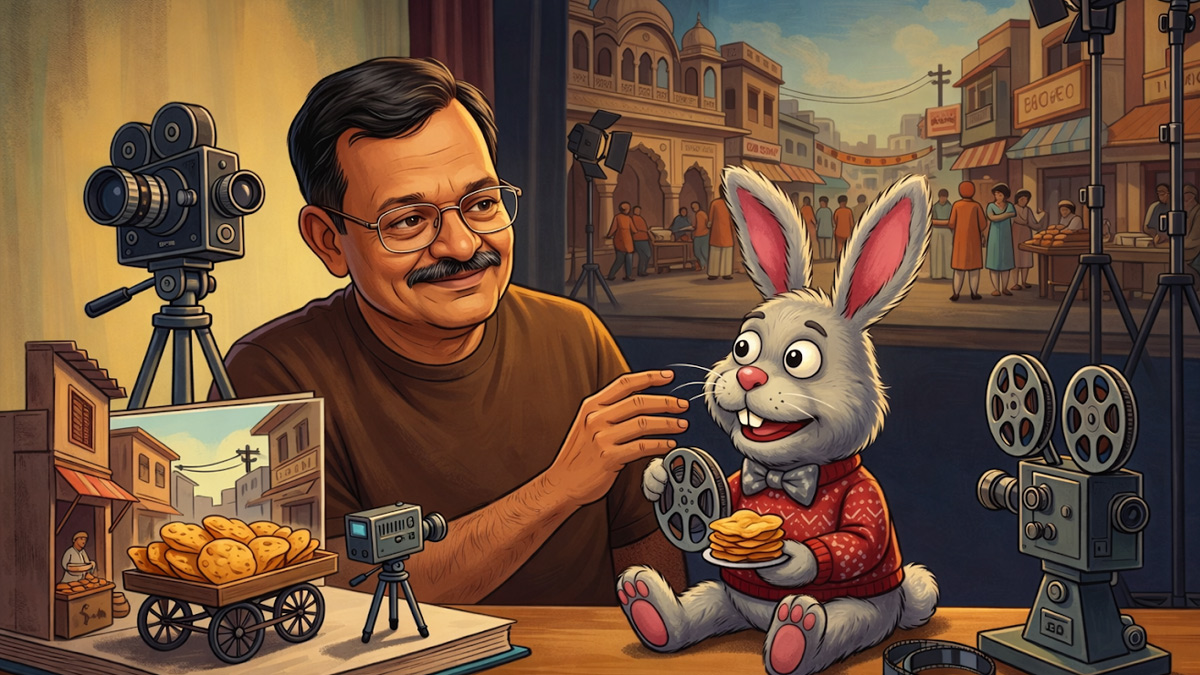
MUMBAI: There are careers, and then there are canvases. Gyan Sahay, the veteran cinematographer, director, and producer who passed away on 10 March 2026 in Mumbai, had one of the latter. Over several decades in the Indian film and television industry, he turned lenses, lights, and the occasional puppet rabbit into something approaching art.
A graduate of the Film and Television Institute of India (FTII) in Pune, Sahay built his reputation as a director of photography across a career that stretched from the early 1970s all the way to the digital age. He was the kind of craftsman who understood that a well-composed shot is not merely a technical achievement but a quiet act of storytelling.
For most Indians of a certain age, however, Sahay will forever be the man behind the rabbit. His direction of the iconic long-running television commercial for Lijjat Papad, featuring its now-legendary puppet bunny, gave the country one of its most cheerfully persistent advertising images. It was the sort of work that sneaks into the national subconscious and takes up permanent residence.
His big-screen credits as cinematographer include Anokhi Pehchan (1972), Pagli (1974), Pas de Deux (1981), and Hum Farishte Nahin (1988). In 1999, he stepped behind a different kind of camera altogether, making his directorial debut with Sar Ankhon Par, a drama that featured Vikas Bhalla and Shruti Ulfat, with a cameo by Shah Rukh Khan for good measure.
On television, Sahay was particularly prized for his command of multi-camera production setups, a skill that made him a go-to technician for large-scale shows and reality programmes. In an industry that has never been especially patient with complexity, he was the calm hand on the rig.
In later life, Sahay turned teacher. He participated regularly in masterclasses and Digi-Talks, often hosted by organisations such as Bharatiya Chitra Sadhna, sharing hard-won wisdom on cinematography, the comedy of timing in a shot, and the sweeping changes brought by the shift from celluloid to digital. He was also said to have been involved in a project concerning a biographical film on Infosys co-founder N.R. Narayana Murthy.
Tributes from the film industry poured in following the news of his passing, with colleagues remembering him as a senior cameraman who served as a rare bridge between two entirely different eras of Indian cinema. That is, perhaps, the finest thing one can say of any craftsman: he kept up, and he brought others along with him.







