News Broadcasting
India Today Television & Twitter partner to launch Town Halls


MUMBAI: India Today Television has joined hands with Twitter in an exclusive partnership for conducting Town Halls on the social media platform.
The Twitter Town Halls will give an opportunity to followers on Twitter to engage with news makers, opinion makers and other eminent personalities.
Twitter followers can tweet their questions and the personality/guest will respond to the same during the Town Hall. This will be aired on India Today Television. The partnership also extends to the group’s Hindi news channel AajTak for relevant guests.

The India Today Group and Twitter have already aired Town Halls with Shah Rukh Khan and Kamal Hassan. The third episode in the series featuring Sri Sri Ravi Shankar will be aired this week-end.
India Today Group group editorial director – broadcast & new media Kalli Purie said, “Our sole objective through social media is to engage our followers and viewers in a dialogue on issues of national and global importance. Twitter Town Hall is a great format to ideate, debate and celebrate the spirit of freedom of expression. We trust that our social media followers are equally well informed to ask the right questions of their leaders. We will be rolling out many such templates to empower our end users.”
Twitter vice president – media for Asia-Pacific, Middle East and North Africa Rishi Jaitly added, “Twitter Town Halls have been used by global business and political leaders to connect with their followers and audiences at large for some time now. Twitter is the only platform in the world that is public, conversational, and real-time. The beauty of the platform is that it allows users to engage with influential personalities from different walks of life, and gives them a voice to be heard. This Twitter Town Hall will give users a chance to talk to and engage with influential icons and leaders from different walks of life for the first time.”
The India Today Group has over 6.26 million Twitter followers across its news handles.





News Broadcasting
Network18 channels lead YouTube news viewership in March 2026
CNN-News18, News18 India and CNBC channels top categories with record views
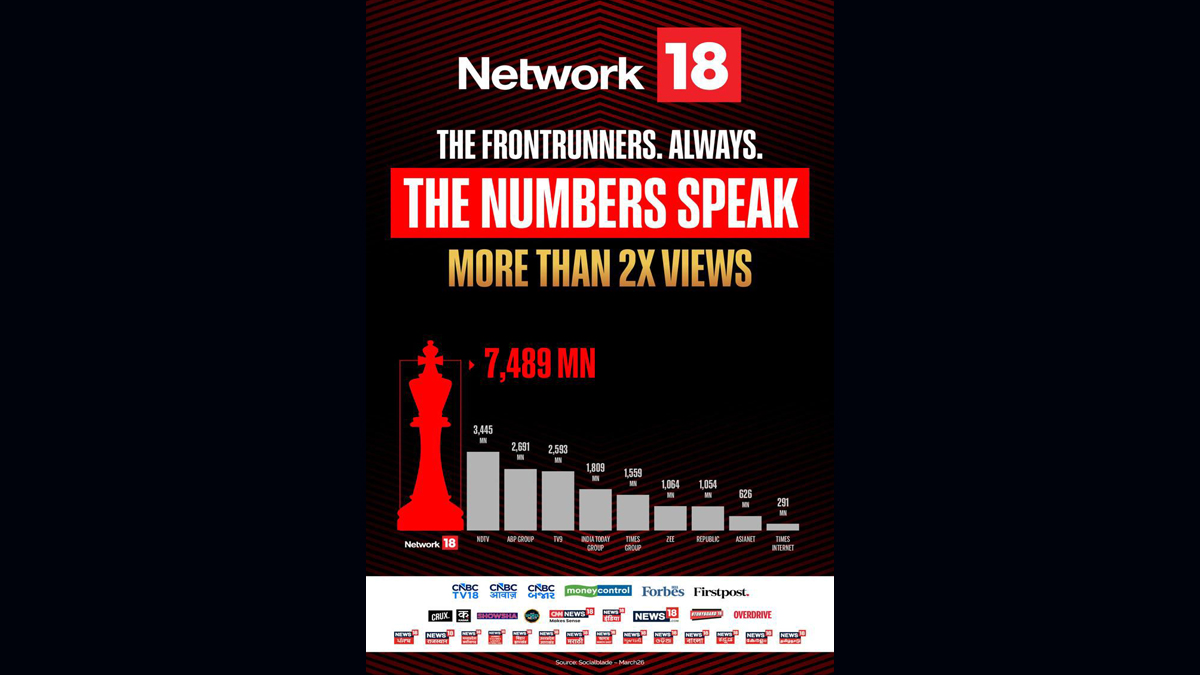
MUMBAI: When the world hit refresh on breaking news, Network18’s channels were already streaming ahead. As geopolitical tensions and war-driven headlines fuelled a surge in global news consumption, the network’s digital playbook delivered big clocking record Youtube viewership across English, Hindi and business news categories in March 2026.
At the forefront was CNN-News18, which emerged as the clear leader in the English news segment with 130 million live and video-on-demand views. The channel edged past competitors such as Times of India (126.5 million), Times Now (101.1 million), India Today (88.2 million) and NDTV (77.5 million), according to Databeings data for March.
In the Hindi news arena, News18 India delivered a commanding performance, racking up a staggering 3,297 million views on YouTube. The channel comfortably outpaced NDTV India, which recorded 3,119 million views, underlining its deep reach and consistent engagement with mass audiences, as per Playboard data.
The network’s dominance wasn’t confined to general news. In the Hindi business segment, CNBC Awaaz topped the charts with 92 million views, narrowly ahead of Zee Business (90 million) and well ahead of ET Now Swadesh (57 million). Meanwhile, its English counterpart CNBC-TV18 posted a strong 58 million views, reinforcing the network’s cross-category strength.
The spike in viewership reflects a broader shift in audience behaviour, with viewers increasingly turning to digital platforms particularly Youtube for real-time updates and in-depth coverage during high-intensity news cycles. For Network18, the numbers signal more than just scale; they underline the effectiveness of a multi-platform strategy that blends speed, credibility and continuous coverage.
In a month where the news never paused, it seems viewers chose to stay tuned where the stream never stopped.






