News Broadcasting
In-film placement in Indian movies scoffed at Frames


MUMBAI: The opening statement, “It’s a win-win situation for advertisers if they pitch in their products in films,” set the tone of the session: ‘Untapping Opportunities between Movies and Marketing.’ The point that came forth was that brand placements are surprisingly far lesser than what the potential of the market really is.
The session was hosted by Businessworld Senior Editor-Media Vanita Kohli and the panel comprised Mindshare Fulcrum Central Asia MD Vikram Sakuja, Reliance Infocomm head marketing Kaushik Roy and Leo Entertainment general manager Sanjay Bhutiani.
The need was highlighted by stressing that advertisements on television need not necessarily work, because the viewers invariably switch over channels or mute the sound when commercials crop up during shows and even cricket matches. On the other hand, a viewer is glued to his theatre seat no matter what the situation in the film.

Through the session it was opined that India has not come a long way in brand placements in films. Considering that one of the successful placements – Rajdoot GTS came in Raj Kapoor’s Bobby, way back in the early 70s. Questions that were dwelled on were that how could we make a laughing stock of ourselves in a film like Yaadein by showing Jackie Shroff dancing with a Coke can in his hand? Does anybody hold a Coke can and start dancing for ten minutes, it was queried.
Some movies where successful in film placements would have worked were Baghban and Jism. Clever thought process could have brought a placement ad of ICICI Life Insurance when Amitabh Bachchan and Hema Malini walk on the beach with sadness in their eyes, hand in hand, their sons having deserted them. A condoms ad could have been well placed in a movie like Jism, it was argued.
There could be certain barriers in such cases, because of uncertainties whether a film would run or not, unrealistic pricing, exaggerated expectations from the advertiser and lack of professionalism (like scenes being written at the eleventh hour, delay in release, etc). But if both – filmmakers and advertisers – take one step towards each other and realise that this relationship could be symbiotic, it would make a lot of sense.
Realising the win-win situation, if film-makers can allow
subtle advertising in their projects, there is no need why this
market would not flourish in Bollywood – like it does in Hollywood.
A slow beginning has been made in films like Khakee (Thums Up), Baghban (ICICI), Road (Tata Safari), but a long journey remains to be traversed.
Bollywood and brands can create magic, the panel concluded.




News Broadcasting
Network18 channels lead YouTube news viewership in March 2026
CNN-News18, News18 India and CNBC channels top categories with record views
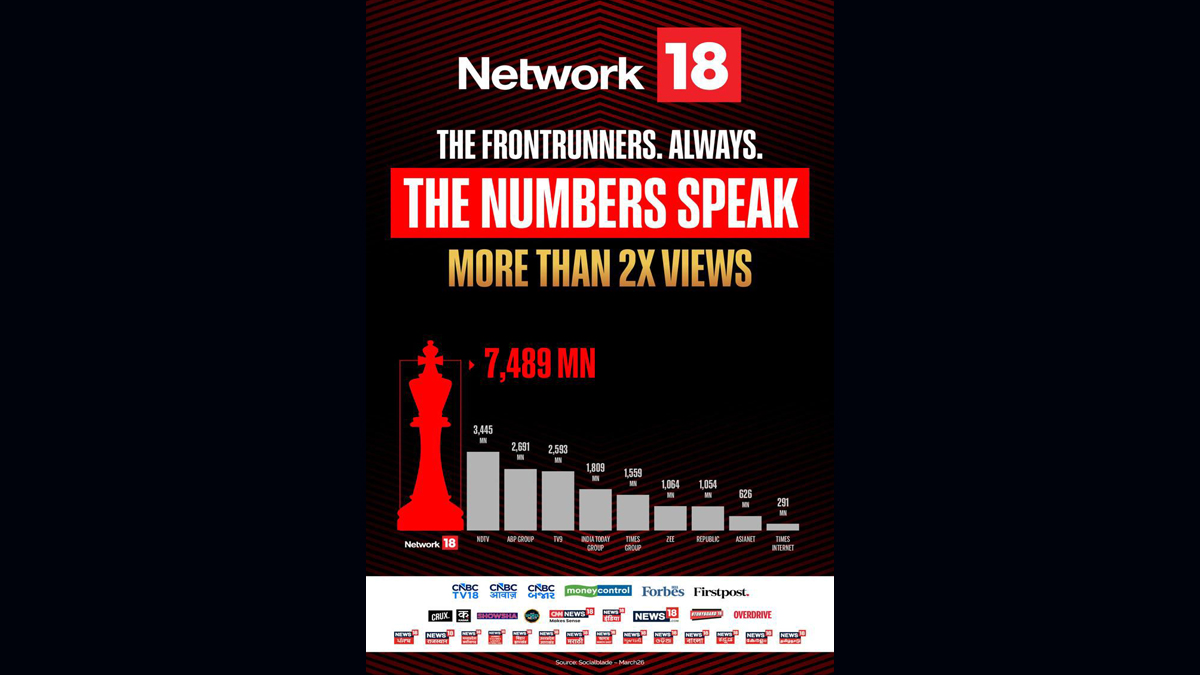
MUMBAI: When the world hit refresh on breaking news, Network18’s channels were already streaming ahead. As geopolitical tensions and war-driven headlines fuelled a surge in global news consumption, the network’s digital playbook delivered big clocking record Youtube viewership across English, Hindi and business news categories in March 2026.
At the forefront was CNN-News18, which emerged as the clear leader in the English news segment with 130 million live and video-on-demand views. The channel edged past competitors such as Times of India (126.5 million), Times Now (101.1 million), India Today (88.2 million) and NDTV (77.5 million), according to Databeings data for March.
In the Hindi news arena, News18 India delivered a commanding performance, racking up a staggering 3,297 million views on YouTube. The channel comfortably outpaced NDTV India, which recorded 3,119 million views, underlining its deep reach and consistent engagement with mass audiences, as per Playboard data.
The network’s dominance wasn’t confined to general news. In the Hindi business segment, CNBC Awaaz topped the charts with 92 million views, narrowly ahead of Zee Business (90 million) and well ahead of ET Now Swadesh (57 million). Meanwhile, its English counterpart CNBC-TV18 posted a strong 58 million views, reinforcing the network’s cross-category strength.
The spike in viewership reflects a broader shift in audience behaviour, with viewers increasingly turning to digital platforms particularly Youtube for real-time updates and in-depth coverage during high-intensity news cycles. For Network18, the numbers signal more than just scale; they underline the effectiveness of a multi-platform strategy that blends speed, credibility and continuous coverage.
In a month where the news never paused, it seems viewers chose to stay tuned where the stream never stopped.






