News Broadcasting
Importance of SMS stressed at SCaT Workshop


MUMBAI: “Subscriber management doesnt have to be boring. But it needs to be the best”.
At the ongoing ScaT workshop in Mumbai, a large gathering from the cable and satellite fraternity heard these words from Great Lakes Data Systems president Laura Rosado. Rosado dwelt on the features of a Subscriber Management System and the different kinds available.
” For operators, cash flow is paramount. If billing costs are controlled, profits will rise. So they have to constantly balance time, features of the system and costs. When choosing a system, operators have to keep in mind implementation time, system features, overall costs, conditional access, size/scalability and support and reliability. A SMS can help operators turn CAS into CASH” Rosado said.

Some essential SMS features are –
1. Subscriber Management Database – It has to store essential subscriber data while also providing contact information like email address. The financial history should also be on hand and there should be searchable criteria for subscribers.
2. Accounting functions – These include the ability to track and report revenue, report on earned income, cash receipts/ cash control.
3. Customer Relationship Management – It should track work orders and service call history of each subscriber. The operator needs to treat the subscriber as a human being and not just as a number and so the system must support critical alerts that the subscriber makes.
4. Scheduling and workforce management – The system should enable the operator to keep abreast of both finished work as well as orders which are pending. This should be done by technician, area, work type. There shouldnt be hassles when it comes to reassigning or rescheduling a particular task. Reports must also be maintained on technician productivity.
5. Security and data protection – The database should be securely encrypted. User-defined group level access and multi level security log ons also need to be present.
6. Addressable/ conditional access control – For the operator, this is a crucial function. The SMS should support instant authorisation or de-authorisation of services. Expensive service calls should be eliminated. The system should support both analogue and digital types. Digital addressable interfaces are provided by Scientific Atlanta, Motorola, WS Net. Analogue ones are provided by Scientific Atlanta, Zenith, Tocom, Pacific Monolithics, Pioneer. The system must also allow for future technological expansion in the form of Video-on-demand, modems
Rosado continued explaining the need for a SMS thus – The question now arises ‘Cant I just authorise CAS manually?’ The problem is that most manufacturers do not support this. It is extremely labour intensive. Auditing and reporting problems can happen due to human error. A subscriber wouldnt like to be billed for a service he is not receiving.”
There are three system options, which are custom software, license mainframe software and license in-house software. While the first option is tailored to an individual operators needs, it is also the most expensive to maintain. While you can access subscriber data whenever you want, in the event of a system breakdown or failure, no outside help is available.
You have to figure out the problem on your own. Mainframe software is ideal for very large systems but it takes a longer time to implement. The connectivity costs are high and you have limited access to data. Delays in batch processing are also not uncommon. In house- software is the one that Rosados company works on. It can work on any system regardless of size. It can be implemented in a time span of two months. There are little or no connectivity costs, Rosado said.
As far as the system architecture is concerned, the hardware as well as maintenance needs to be affordable. There must be a Graphical user Interface as well as a robust and reliable SAQ database like Microsoft Windows.
Great Lakes Data Systems claims to be the leading PC billing software since 1980. It was the first major software company with all Motorola certified digital interfaces.






News Broadcasting
UDF poised to return to power in Kerala, says Manorama-CVoter survey
Massive opinion poll projects shift in Kerala politics ahead of 2026 Assembly elections.
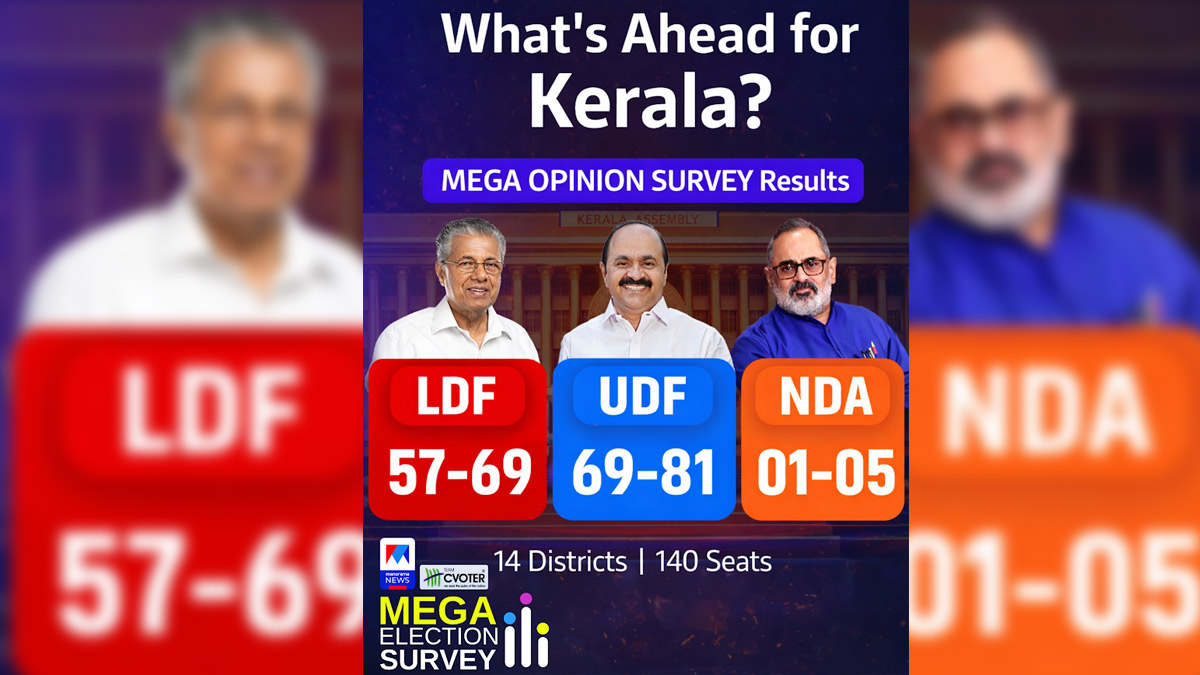
MUMBAI: The winds of change appear to be blowing through Kerala’s political landscape and this time, they seem to favour the United Democratic Front. A comprehensive mega opinion survey conducted by Manorama News in partnership with CVoter projects a potential comeback for the UDF in the upcoming Kerala Legislative Assembly Elections 2026. The survey, covering all 140 constituencies with a massive sample size of nearly 90,000 respondents, predicts the UDF could win between 69 and 81 seats.
The ruling Left Democratic Front (LDF) is expected to secure 57 to 69 seats, a significant drop from the 99 seats it won in the 2021 elections. This would mean the LDF losing 30 to 42 of its sitting seats. Meanwhile, the National Democratic Alliance (NDA), which drew a blank in 2021, is projected to open its account with 1 to 5 seats.
Region-wise, the UDF is expected to make strong gains in Malabar, winning 25 to 34 out of 48 seats, and in Central Kerala, where it could bag 29 to 33 out of 53 seats. In South Kerala, the LDF is likely to retain an edge with 21 to 25 seats, while the UDF may improve to 12 to 16 seats. The NDA could pick up 1 to 3 seats in the southern region.
The survey was conducted between 14 and 26 March 2026, with additional tracker and snap polls carried out from December 2025 to March 2026. A total of 89,693 respondents participated, ensuring representation across all demographics and social segments.
Manorama News has a strong track record of accuracy, with its previous projections closely matching the actual results of the 2019 and 2024 Lok Sabha elections as well as the 2021 Kerala Assembly polls.
In Kerala’s famously fierce political battles, this survey suggests the pendulum may be swinging back. Whether the final verdict matches these numbers or throws up another surprise, one thing is clear, the 2026 Assembly elections are shaping up to be one of the most keenly watched contests in the state’s history.






