News Broadcasting
IHC and the NGC invites entries for ‘Award for Habitat Young Visionary 2007’


MUMBAI: India Habitat Centre in association with National Geographic Channel has invited entries for the fourth annual ‘Award for Habitat Young Visionary 2007’ to be held on 30 January 2007.
The undergraduate students from across the country can participate in the award.
The Habitat Young Visionary Award encourages the youth to ‘Think again’ about the world they live in and share their horizons with cross sections of civil society on the IHC platform. This programme is open to all undergraduate students across India and hopes to be the first step in catalyzing the process of vision formation amongst youth.

The Habitat Young Visionary Award involves submission of a 1500 words essay in English or Hindi on specified topics in the first stage. Based on the essay, fifteen participants will be short listed for the semifinals and would be required to elaborate and defend their vision before a panel of eminent judges. Out of this, five participants will be chosen for the finale.
The idea of the award is not to test the oratorical aptitude of the participants but to identify cogent and novel solutions germinating in their minds to the issues faced by our country. The last date for submission of entries is 30 October 2006.
Speaking about the unique initiative, VP – Marketing, National Geographic Channel India, Rajesh Sheshadri, said, “Through this unique effort of the India Habitat Centre, and our partnership with them, we want to reach out to the youth, which is the think tank for our future and inspire a spirit of creativity and innovative thinking”.
“This award is a part of our conscious effort to initiate a process wherein young minds while engaged in the pursuit of academic excellence, need to dwell on the concerns of the country as a part of their perspective. With our partners, the National Geographic Channel, we look forward to encourage the youth to initiate the thought process for the change they can lead for a better society”, commented IHC Director Raj Liberhan.
The gratification that comes with the award is also in true ‘Think again’ style and provides the finalists, unique opportunities that can shape their future. The winner of the award will get to attend a fully paid summer programme sponsored by the India Habitat Centre at the Cambridge University. The first runner-up will get a unique internship opportunity with the National Geographic Channel and the other three finalists will get a chance to intern with an established NGO.
Participation and Selection Procedure
Stage 1:
Write a 1500 words essay in English or Hindi on any one of the given topics:
1) What I do for a living is more important than how much I earn
2) The future is ugly, we need to act now
3) Our strengths today will shape a better tomorrow
4) Mediocrity to excellence – Way to get there
5) India – 60 years young and ready to go
The essay should be the synopsis of a larger, realistic and practical vision. All entries should be typed in double space or A4 size paper. The participant is also required to enclose his / her CV in about 250 words and a bonafide certificate from the institution / college.
Entries should reach before October 30, 2006 at the following address: Director’s office, 6th Floor, Core 5A, India Habitat Centre, Lodhi Road, New Delhi – 110003 or can be e-mailed at: ihc@vsnl.com
Stage 2:
Fifteen participants will be short listed for the semifinals to be held on December 4, 2006 in Delhi. The semifinalists will be asked to elaborate and defend their vision before a reputed panel of judges.
Stage 3:
Five participants will be short listed for the finals to be held on January 30, 2007 at India Habitat Centre, Delhi.







News Broadcasting
News18 India launches Command Centre war explainer with Arya
New show shifts from debates to decoding global conflicts and impacts
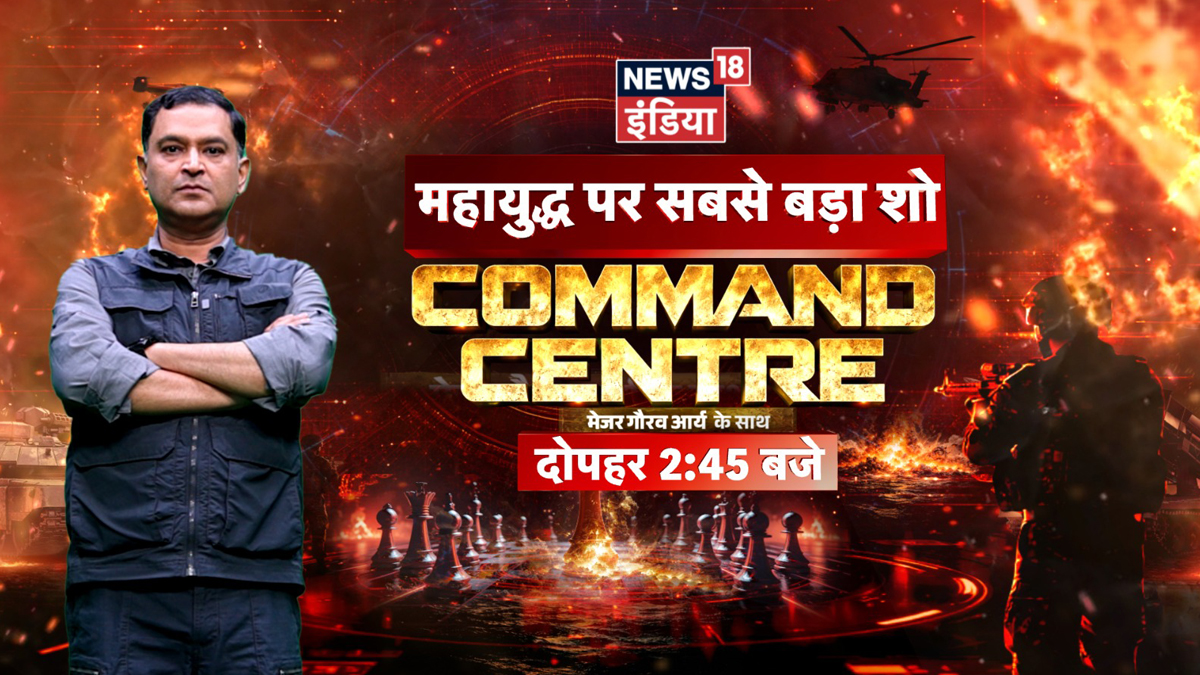
MUMBAI: News18 India has rolled out a new war-focused programme, Command Centre, featuring Gaurav Arya, as it looks to offer viewers a sharper, more grounded take on global conflicts amid rising tensions in West Asia.
Positioned as an “insider war room”, the show moves away from conventional panel debates and instead focuses on explaining military developments, decoding strategy and connecting global events to their everyday impact, from fuel prices to economic shifts.
The format leans heavily on visuals and data. The studio has been designed like a command hub, complete with large LED war maps, real-time graphics and an alert system to track developments as they unfold.
At the centre of it all is Arya, who brings his military background to simplify complex war strategies for viewers. His signature line, “Seedhi baat samjhiye”, anchors the show’s promise of clarity over noise.
News18 India managing editor Jyoti Kamal said, “Command Centre, featuring Major Gaurav Arya is designed to deliver accurate insights and a clear perspective on how evolving conflicts impact everyday life, from household budgets to national security. With expert voices analysing every development in real time, the show goes beyond headlines to decode what’s happening now, what it means, and what could come next.”
Echoing the intent, Gaurav Arya added, “In times of war, confusion is the biggest threat. With News18 India’s Command Centre, we are bringing viewers inside the war room, decoding strategies, tracking every escalation, and explaining, in the simplest terms, what it means for India and for every household. Seedhi baat samjhiye, this is where you understand not just what is happening, but what happens next.”
The weekday show will air in the afternoon slot and will also feature Gaurav Shukla, adding to its editorial depth.
With its mix of analysis, visuals and a clear focus on impact, the show reflects a broader shift in news consumption. Viewers are no longer just watching events unfold, they are looking to understand what those events mean for them.






