Hindi
IFFI to pay tribute to Pran

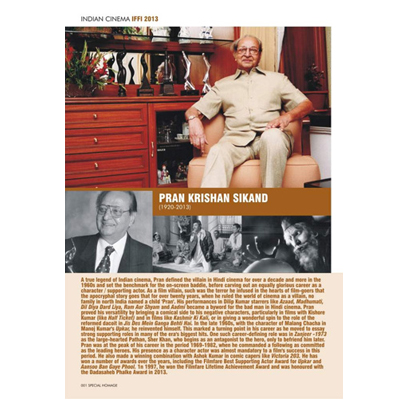
MUMBAI: The 44th International Film Festival of India (IFFI) to be held in Goa from 20-30 November will pay tribute to the veteran actor Pran. The legendary Bollywood villain passed away in July this year. The festival will witness the screening of three of his most popular films – Jis Desh Main Ganga Behti Hai, Madhumati and Zanjeer.
A true legend of Indian cinema, Pran defined the villain in Hindi cinema for over a decade and more in the 1960s and set the benchmark for the on-screen baddie, before carving out an equally glorious career as a character/supporting actor. As a film villain, such was the terror he infused in the hearts of film-goers that the apocryphal story goes that for over twenty years, when he ruled the world of cinema as a villain, no family in north India named a child ‘Pran’.

Pran’s son Sunil Sikand and daughter Pinky Bhalla will be present for the screening. The film will be screened on the third and fourth day of the festival. Pran’s wife Shukla Sikand is also slated to attend the screening.
IFFI director Shankar Mohan says, “As per the festival’s tradition, IFFI pays tribute to noted film personalities who passed away in the year preceding the festival. IFFI invites their family members, friends and well-wishers to attend the screenings of the artiste’s best works.”
Last year, a special homage was paid to Yash Chopra at the festival.






Hindi
Government backs film production through DCDFC, co-production push
Scheme funds cinema, WAVES 2025 boosts global ties and industry growth.
MUMBAI: Lights, camera… policy action. As India’s screens glow brighter at home and abroad, the government is quietly scripting a bigger role behind the scenes funding films, fuelling collaborations and nudging the country closer to its “create for the world” ambition. At the centre of this effort is the Development, Communication & Dissemination of Filmic Content (DCDFC) scheme, a 100 per cent centrally funded initiative designed to support film production across the country. Through this scheme, the government provides direct financial backing to projects, aiming to strengthen both mainstream and alternative storytelling ecosystems while encouraging cinematic excellence.
The implementation runs through the National Film Development Corporation (NFDC), which plays a key role in facilitating film production, including regional cinema and documentaries. Beyond the screen, the scheme also feeds into the broader economy creating jobs for local technicians, artists and service providers, and strengthening grassroots production networks across states.
The push, however, is not limited to funding alone. India’s ambition to position itself as a global content powerhouse was on display at the World Audio Visual & Entertainment Summit 2025 held in Mumbai, which brought together creators, producers, startups and global stakeholders from over 100 countries. The summit acted as a convergence point for Indian storytelling and international capital, with OTT platforms, investors and technology leaders exploring partnerships in a rapidly evolving content economy.
Complementing this is the government’s focus on audio-visual co-production agreements, which effectively operate on a public-private partnership model. By enabling Indian and international producers to collaborate, these agreements are designed to bring in investment, global expertise and advanced filmmaking practices while also giving Indian stories a wider global footprint.
Support also extends to film culture and preservation. Grants are provided for domestic film festivals recommended by state governments, alongside curated film packages, masterclasses and workshops to nurture talent and audience engagement. The NFDC further collaborates with State Film Development Corporations, offering technical expertise across the filmmaking value chain and supporting the preservation of local film heritage.
Many states, in parallel, are encouraging the development of film infrastructure including production studios often through public-private partnership models, signalling a coordinated push to build a more robust audiovisual ecosystem.
The update was shared in Parliament by Ashwini Vaishnaw in response to a query from Thirumaavalavan Tholkappiyan, outlining a multi-layered approach that blends funding, infrastructure, policy and global outreach.
Taken together, the message is clear: India is not just telling more stories, it is building the machinery to tell them bigger, better and to the world.






