News Broadcasting
ICRA rerates Network18 and TV18


MUMBAI: Barely a week after independent and professional investment and credit rating agency ICRA revised ratings for Network 18 media and investments (N18) and TV 18 Broadcast (TV18), it has once again upgraded the two companies ratings for enhanced amounts.
Note: Short Term Instruments (All instruments with original maturity within one year) with ICRA A1 rating are considered to have very strong degree of safety regarding timely payment of financial obligations. Such instruments carry lowest credit risk. Modifiers {“+” (plus) / “-“(minus)} can be used with the rating symbols for the categories [ICRA]AA(SO) to [ICRA]C(SO). The modifiers reflect the comparative standing within the category.

N18
The short- term rating for Rs 230 crore of ICRA A1+ and long-term rating for Rs 10 crore of ICRA A on enhanced banking facilities of Rs 240 crore (up from Rs 140 crore) has been assigned to N18. The outlook on the long-term rating is ‘positive’.
Additionally, N18’s commercial paper of Rs 100 crore has been assigned as ICRA A1+. The assigned ratings take into account the strong growth in operating profits of N18 (consolidated) in 2013-14 over the previous year, significant reduction in net losses by virtue of favourable impact of cable digitisation, internal cost compression measures and more than halving of interest costs.
The rating agency says “ICRA draws comfort from the diversified offerings of the broadcasting business across genres and expects that the addition of ETV regional channels, post the recent acquisition, will further strengthen the overall operational profile of the company on a consolidated basis. ICRA notes that the Network18’s non-broadcasting businesses continue to experience weak profitability/ losses while some of its existing bouquet of channels may also continue to face profitability pressures arising from rising competitive intensity. Also, in the broadcasting business, there is likely to be recurring need to fund gestation losses in select new channels as also additional investments that may have to be put in for the ETV bouquet of channels.”
TV18
The Rs 200 crore commercial paper programme of TV18 Broadcast has been assigned short-term rating of ICRA A1+.
The assigned ratings take into account the strong growth in operating profits of TV18 (consolidated) in 2013-14 over the previous year, increase in net profits to Rs 85.6 crore in 2013-14 from a net loss of Rs 42.2 crore in 2012-13 by virtue of favourable impact of cable digitisation, internal cost compression measures and more than halving of interest costs. The ratings continue to draw support from the diversified offerings of the company’s content bouquet across genres and strong market position of the key news and entertainment channels.
Says the rating agency, “ICRA expects that the recent addition of ETVs regional channels into TV18’s content bouquet will further strengthen the overall operational profile of the company. TV18 (consolidated) currently derives a large proportion of its revenues through advertisement income, a revenue stream that tends to be volatile and is a function of economic environment and corporate advertisement budgets. However, the enactment of regulatory framework for digitisation of cable TV Systems in India is expected to increase the quantum and proportion of the relatively more stable subscription income for TV18, going forward. Already, TV18 (consolidated) has seen a strong positive traction in net distribution income having increased to Rs 178 crore in 2013-14 (excluding ETV channels) from minus (-) Rs 102 crore in 2011-12.”
It also states that while TV18’s (consolidated) cash generation is likely to be supported by higher subscription revenues and lower carriage costs by virtue of cable digitisation, it expects continued profitability pressures arising from rising competitive intensity in key business segments, the need to fund gestation losses in select new channels as also additional investments that may have to be put in for the ETV bouquet of channels.







News Broadcasting
Network18 channels lead YouTube news viewership in March 2026
CNN-News18, News18 India and CNBC channels top categories with record views
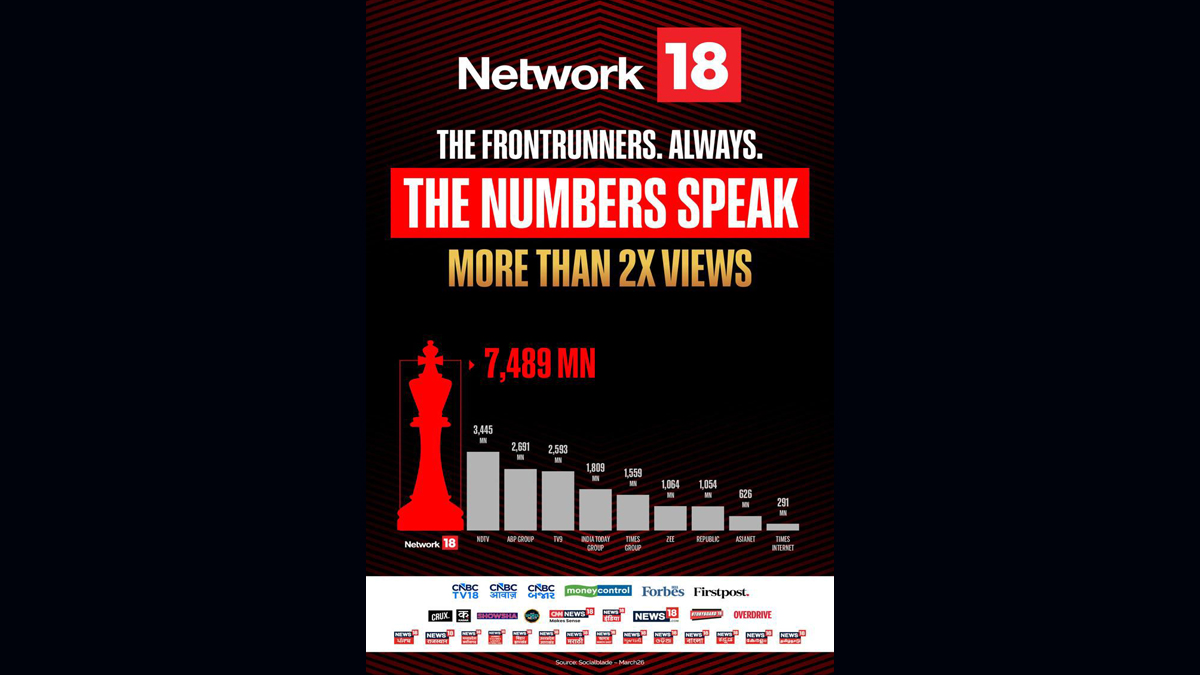
MUMBAI: When the world hit refresh on breaking news, Network18’s channels were already streaming ahead. As geopolitical tensions and war-driven headlines fuelled a surge in global news consumption, the network’s digital playbook delivered big clocking record Youtube viewership across English, Hindi and business news categories in March 2026.
At the forefront was CNN-News18, which emerged as the clear leader in the English news segment with 130 million live and video-on-demand views. The channel edged past competitors such as Times of India (126.5 million), Times Now (101.1 million), India Today (88.2 million) and NDTV (77.5 million), according to Databeings data for March.
In the Hindi news arena, News18 India delivered a commanding performance, racking up a staggering 3,297 million views on YouTube. The channel comfortably outpaced NDTV India, which recorded 3,119 million views, underlining its deep reach and consistent engagement with mass audiences, as per Playboard data.
The network’s dominance wasn’t confined to general news. In the Hindi business segment, CNBC Awaaz topped the charts with 92 million views, narrowly ahead of Zee Business (90 million) and well ahead of ET Now Swadesh (57 million). Meanwhile, its English counterpart CNBC-TV18 posted a strong 58 million views, reinforcing the network’s cross-category strength.
The spike in viewership reflects a broader shift in audience behaviour, with viewers increasingly turning to digital platforms particularly Youtube for real-time updates and in-depth coverage during high-intensity news cycles. For Network18, the numbers signal more than just scale; they underline the effectiveness of a multi-platform strategy that blends speed, credibility and continuous coverage.
In a month where the news never paused, it seems viewers chose to stay tuned where the stream never stopped.






