News Broadcasting
IBN7 to enter entertainment space with ‘Bhabhi Tera Devar Deewana’ from 23 May


MUMBAI: The role of a news channel in today’s era is not just limited to reporting events accurately as they happen. Many channels have now started to break free from this ideology and have entered the entertainment space with various programmes. One such player invading into this space is IBN7. The channel is all geared up to air a unique entertainment show titled Bhabhi Tera Devar Deewana in their afternoon slot every weekday. The show will attract viewers through aspirational stories and will have different segments.
BTDD has been created internally and at the helm of everything from the idea to planning to execution to conceiving is the feature editor of the channel Manoj Kumar Singh.
Starting from 23 May at 2 pm, the 60 minute long show will be narrated from the unique perspective of a male character unlike the other majority of the shows which have female anchors. Differentiating from others, the channel will have a male host who will be referred as ‘desh ka devar’. With a vision to supply new appetite to the viewers, the channel is aimed at replacing TV news with an entertaining ‘tadkedaar’ content.

“Every viewer is important for us. News content consumption slows down during noon and this is the ideal time to show different aspects of TV industry. The show has been planned and executed after a period of 5 months. We cannot reveal the name of the anchor as our USP is the Desh ka Devar. We are extremely confident about this show”, says IBN7 deputy managing editor Sumit Awasthi.
“BTDD is the brainchild of Manoj. He and the team has worked hard behind this show which the audience will surely enjoy as it hits the tv sets”, adds Awasthi.
The channel has not locked any deals with advertisers yet and is in talks with various brands “There are several on-going conversations with potential advertisers from across various sectors. We can clearly discern significant interest in the show amongst advertisers, amongst the trade etc., given that what we are trying to do is disrupt how entertainment news is typically shown”, he further adds.
Targeting the female audience at large, the channel has planned an extensive marketing plan to push the show. Apart from the various promos, the channel also circulates 20-25 teasers every day which stars A-list TV actors who also are their brand ambassadors. The actors negate the ‘desh ka devar’ character creating buzz amongst the audiences.
The show will also be promoted on social media platforms like Facebook, Twitter, Instagram, etc., and will also be pushed on the News18 website.
“We will effectively utilize and leverage our Network which we believe will help us establish the show. Additionally we will use an effective mix of digital, OOH and other media to maximize the reach of the show”, concludes Awasthi.






News Broadcasting
Network18 channels lead YouTube news viewership in March 2026
CNN-News18, News18 India and CNBC channels top categories with record views
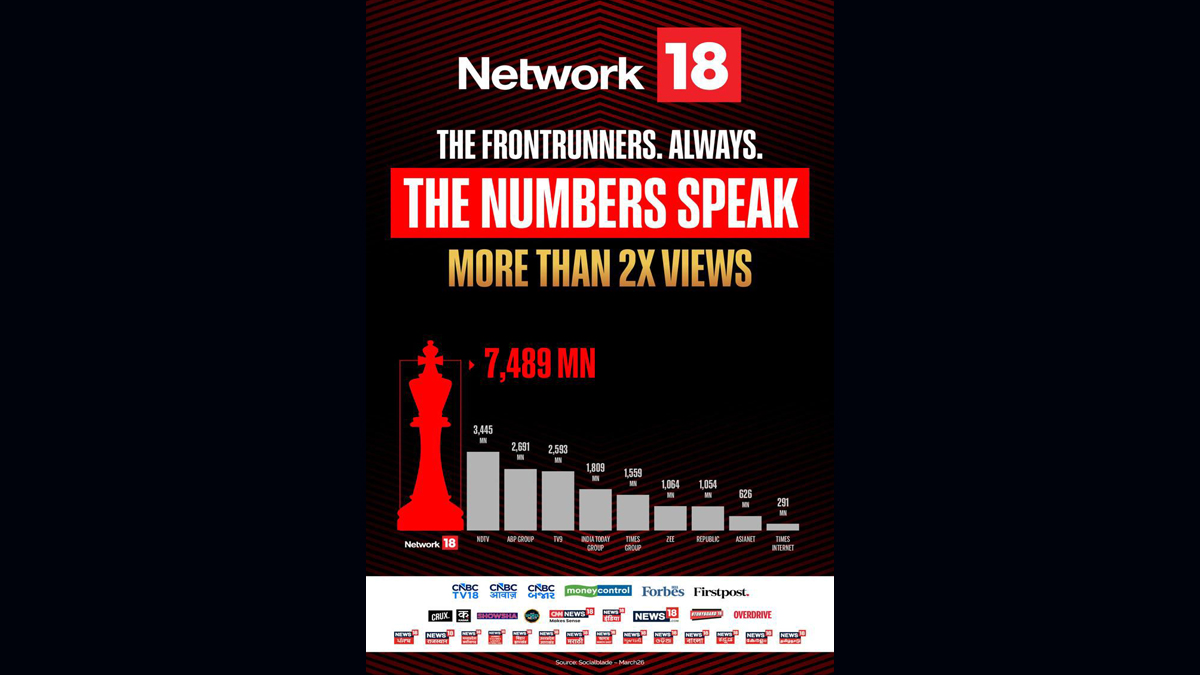
MUMBAI: When the world hit refresh on breaking news, Network18’s channels were already streaming ahead. As geopolitical tensions and war-driven headlines fuelled a surge in global news consumption, the network’s digital playbook delivered big clocking record Youtube viewership across English, Hindi and business news categories in March 2026.
At the forefront was CNN-News18, which emerged as the clear leader in the English news segment with 130 million live and video-on-demand views. The channel edged past competitors such as Times of India (126.5 million), Times Now (101.1 million), India Today (88.2 million) and NDTV (77.5 million), according to Databeings data for March.
In the Hindi news arena, News18 India delivered a commanding performance, racking up a staggering 3,297 million views on YouTube. The channel comfortably outpaced NDTV India, which recorded 3,119 million views, underlining its deep reach and consistent engagement with mass audiences, as per Playboard data.
The network’s dominance wasn’t confined to general news. In the Hindi business segment, CNBC Awaaz topped the charts with 92 million views, narrowly ahead of Zee Business (90 million) and well ahead of ET Now Swadesh (57 million). Meanwhile, its English counterpart CNBC-TV18 posted a strong 58 million views, reinforcing the network’s cross-category strength.
The spike in viewership reflects a broader shift in audience behaviour, with viewers increasingly turning to digital platforms particularly Youtube for real-time updates and in-depth coverage during high-intensity news cycles. For Network18, the numbers signal more than just scale; they underline the effectiveness of a multi-platform strategy that blends speed, credibility and continuous coverage.
In a month where the news never paused, it seems viewers chose to stay tuned where the stream never stopped.






