News Broadcasting
IBF says no to TRAI legal challenge; sets up subcommittee


NEW DELHI: The Indian Broadcasting Foundation (IBF) has dropped the idea of going head to head and legally challenging the newly appointed broadcasting regulator the Telecom Regulatory Authority of India (TRAI) on its directive freezing cable TV rates. Instead it has decided to take a softer line – that of approaching it to “explain the ground realities of the industry.”
A senior member of the IBF confirmed to indiantelevision.com today that a member had floated the idea of legally challenging the TRAI. But after reading the finer print of the TRAI Act, the path of confrontation was abandoned.
“Instead of going the legal way, we, as an industry, should work with the regulator and if there is some confusion, then we should seek clarifications in a civil manner,” the IBF member stressed.

Towards this end, the IBF, at its board meeting today, decided to form a sub-committee to go into the issues raised by TRAI in its consultation paper and has also sought time from the regulator.
The sub-committee would be headed by Zee Telefilms vice-chairman Jawahar Goel and includes ESPN India head R C Venkateish, Ten Sports India MD Sharmista Rijhwani and Sahara TV president Mahesh Prasad.
According to a draft of a letter that is to be sent to TRAI, the IBF secretary-general has said that the Foundation “should be given a fair chance to present our views and explain the ground realities of the industry.”
Referring to the 15 January, 2004, TRAI notification announcing a ceiling on charges payable by subscribers, MSOs and cable operators, the IBF has contended, “This order was issued without consultation with the broadcasting industry and, hence, this order has created utter confusion in the industry. Further, TRAI’s notification included non-CAS areas which were free of these problems so far.”
IBF sources said members did bring up valid points that point towards confusion. For example, would the TRAI order on price freeze mean that a free to air channel cannot convert into a pay service? Till the time, TRAI comes out with a final view on various issues, would the order also mean that no new pay channel can be launched?
Sometime back, the government, through a notification, had mandated TRAI as the regulator for the broadcast and cable services. It could do this on account of an amendment that had been carried out in the TRAI Act last year. Subsequently earlier this month, TRAI came out with an order freezing the cable TV rates as on 26 December and issued a consultation paper.






News Broadcasting
News18 India launches Command Centre war explainer with Arya
New show shifts from debates to decoding global conflicts and impacts
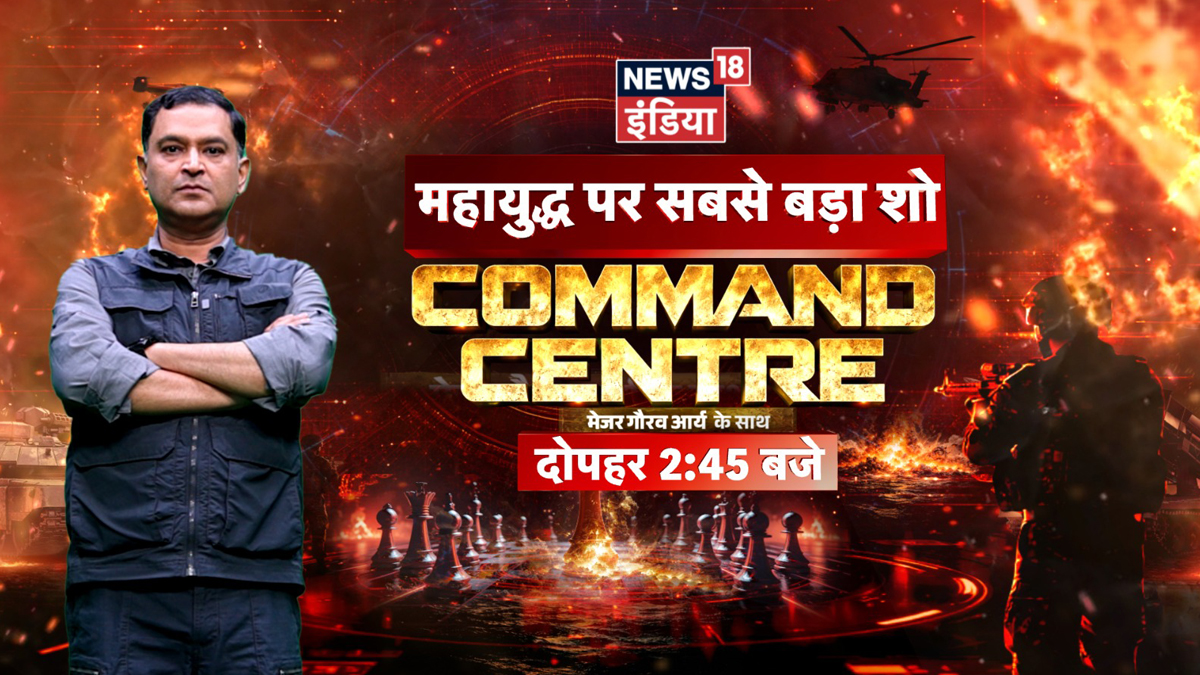
MUMBAI: News18 India has rolled out a new war-focused programme, Command Centre, featuring Gaurav Arya, as it looks to offer viewers a sharper, more grounded take on global conflicts amid rising tensions in West Asia.
Positioned as an “insider war room”, the show moves away from conventional panel debates and instead focuses on explaining military developments, decoding strategy and connecting global events to their everyday impact, from fuel prices to economic shifts.
The format leans heavily on visuals and data. The studio has been designed like a command hub, complete with large LED war maps, real-time graphics and an alert system to track developments as they unfold.
At the centre of it all is Arya, who brings his military background to simplify complex war strategies for viewers. His signature line, “Seedhi baat samjhiye”, anchors the show’s promise of clarity over noise.
News18 India managing editor Jyoti Kamal said, “Command Centre, featuring Major Gaurav Arya is designed to deliver accurate insights and a clear perspective on how evolving conflicts impact everyday life, from household budgets to national security. With expert voices analysing every development in real time, the show goes beyond headlines to decode what’s happening now, what it means, and what could come next.”
Echoing the intent, Gaurav Arya added, “In times of war, confusion is the biggest threat. With News18 India’s Command Centre, we are bringing viewers inside the war room, decoding strategies, tracking every escalation, and explaining, in the simplest terms, what it means for India and for every household. Seedhi baat samjhiye, this is where you understand not just what is happening, but what happens next.”
The weekday show will air in the afternoon slot and will also feature Gaurav Shukla, adding to its editorial depth.
With its mix of analysis, visuals and a clear focus on impact, the show reflects a broader shift in news consumption. Viewers are no longer just watching events unfold, they are looking to understand what those events mean for them.







