News Broadcasting
IBF member suggests separate panels for pay, FTA channels

NEW DELHI: Pay broadcasters who are members of Indian Broadcasting Foundation (IBF) want that the organization should have separate panels for free to air channels and pay channels in order to avoid lack of consensus on controversial issues like conditional access and the proposed limitation of advertising time on pay channels
This is one of the compromise formulae that is being touted in the wake of differences in the business interests of pay and FTA channels. It is seen as a practical way to allow the IBF to be able to fairly represent the interests of both pay and FTA broadcasters. The matter came to the fore last year with a show cause notice being issued to a representative of an FTA channel for taking a stand different from that of the collective wisdom of the IBF.
A broadcaster-member of the IBF, which controls some of the most paying pay channels in India and has also been described as the biggest media company in India at various points of time, is understood to have written to the IBF secretariat on the need to have panels with separate agendas for various type of broadcasters operating in India.

It has been pointed out by a senior representative of this broadcasting organization that on some key issues, the viewpoint of pay and FTA channels are unlikely to match. Hence, there should be two panels or sub-committees in the IBF looking after the interest of these broadcasters separately.
It has also been suggested that when representations and submissions are made to the government and the sector regulator, Telecom Regulatory Authority of India (Trai), these two separate panels would be useful in putting across the respective viewpoints more forcefully without attempting to seek an across the board consensus, which is seldom achieved or when achieved, the arguments get diluted.
However, it is not clear to indiantelevision.com at this point of time whether this issue is likely to be discussed in a board meeting of the IBF, slated to be held on 10 August, a day when the board of Prasar Bharati, too, is meeting to take up some important issues. Though not directly related, it may be worth noting that a finance panel of the Board of Control for Cricket in India will also be holding its own meeting on 10 August.
The member of the IBF that has mooted the proposal of having two separate sub-panels within the IBF has also argued that it is necessary to have such a set-up as, for example, it would be difficult to slot some of the members like Indian pubcaster Doordarshan. Is DD a pay broadcaster or a free to air one?
Questions like these have started haunting the IBF because of conflicting business interests of broadcasters.





News Broadcasting
News18 India launches Command Centre war explainer with Arya
New show shifts from debates to decoding global conflicts and impacts
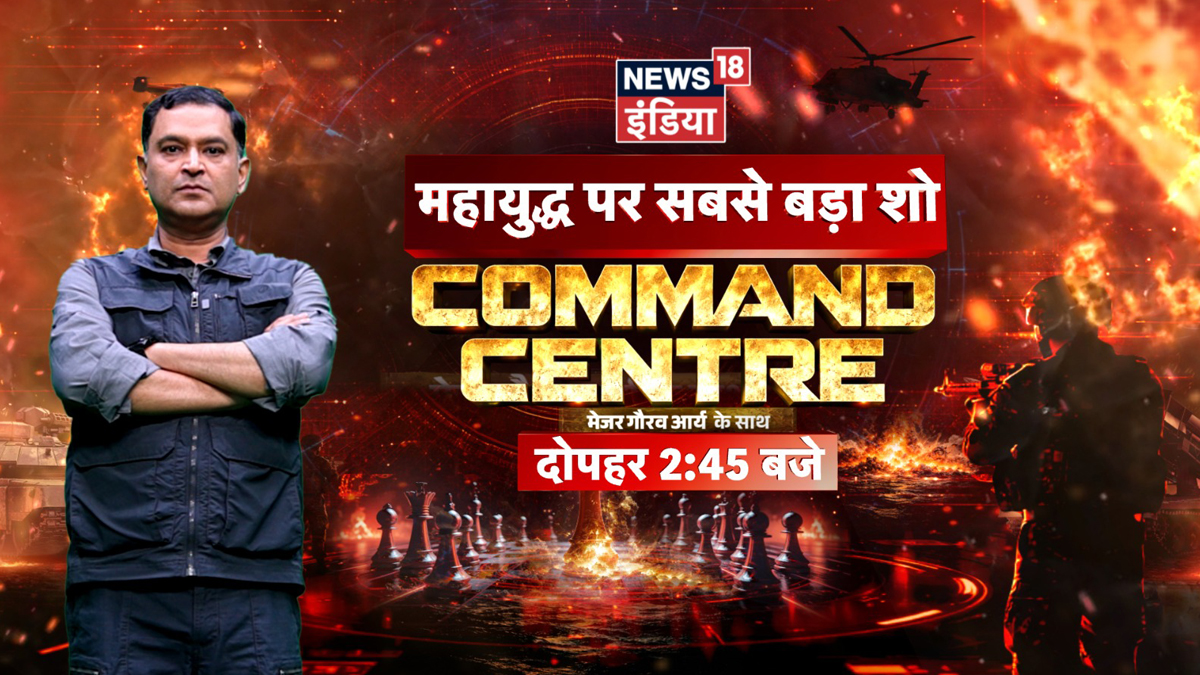
MUMBAI: News18 India has rolled out a new war-focused programme, Command Centre, featuring Gaurav Arya, as it looks to offer viewers a sharper, more grounded take on global conflicts amid rising tensions in West Asia.
Positioned as an “insider war room”, the show moves away from conventional panel debates and instead focuses on explaining military developments, decoding strategy and connecting global events to their everyday impact, from fuel prices to economic shifts.
The format leans heavily on visuals and data. The studio has been designed like a command hub, complete with large LED war maps, real-time graphics and an alert system to track developments as they unfold.
At the centre of it all is Arya, who brings his military background to simplify complex war strategies for viewers. His signature line, “Seedhi baat samjhiye”, anchors the show’s promise of clarity over noise.
News18 India managing editor Jyoti Kamal said, “Command Centre, featuring Major Gaurav Arya is designed to deliver accurate insights and a clear perspective on how evolving conflicts impact everyday life, from household budgets to national security. With expert voices analysing every development in real time, the show goes beyond headlines to decode what’s happening now, what it means, and what could come next.”
Echoing the intent, Gaurav Arya added, “In times of war, confusion is the biggest threat. With News18 India’s Command Centre, we are bringing viewers inside the war room, decoding strategies, tracking every escalation, and explaining, in the simplest terms, what it means for India and for every household. Seedhi baat samjhiye, this is where you understand not just what is happening, but what happens next.”
The weekday show will air in the afternoon slot and will also feature Gaurav Shukla, adding to its editorial depth.
With its mix of analysis, visuals and a clear focus on impact, the show reflects a broader shift in news consumption. Viewers are no longer just watching events unfold, they are looking to understand what those events mean for them.







