News Broadcasting
IBF for one city CAS rollout initially


NEW DELHI: A delegation of the Indian Broadcasting Foundation (IBF) today made a strong pitch for some relaxation in the government-mandated deadline for implementation of conditional access (July 14) in front of some policy makers some of whom, however, felt that the foundation itself is divided over the issue of CAS.
The broadcasters’ meeting with the Left party Member of Parliament Somnath Chatterjee-chaired Standing committee on IT, Telecom and convergence, it seems, did not have the impact that some would have liked to have.
That some of the parliamentarians felt that IBF is a divided house may be the result of the presence of Zee Telefilms chairman and managing director Subhash Chandra who is reported to have conveyed to the Standing Committee members that though India, at present, does not have the capacity to manufacture set top boxes needed to access pay channels in a post-CAS regime, but the boxes could be had from some S.E Asian countries at reasonable prices of about $ 48 a piece.
Some of the broadcasters like Sony, Star and ESPN Star Sports have been maintaining that lack of adequate number of STBs in the country from July 14 would lead to widespread chaos and confusion in Indian cable homes in the metros.

At the moment, that stand seems to carry some weight as despite Zee’s assertions on the easy availability of boxes at reasonable prices, quite contrary most multi-system operators have not finalised the orders for the boxes yet, which is likely to frustrate cable consumers post July 14.
According to political sources, the members of the parliamentary panel heard the broadcasters’ viewpoints and reserved taking any stand till its next meeting when the information and broadcasting ministry secretary is scheduled to appear before the policy makers and give the government’s viewpoint on CAS and related issues like availability of boxes.
The three-point agenda of today’s meeting included seeking reduction in duties on import of STBs, get some relaxation in the rollout of CAS, which can be probably restricted to one city (probably Chennai) instead of the four metros and that more than 30 channels should be part of the basic tier of free to air channels that should be made mandatory all over the country.
At one point, according to the sources, SET India CEO Kunal Dasgupta is understood to have said that if CAS is implemented in an orderly and phased manner, then down the line six months later even Sony may look at manufacturing STBs in India. SET is part of the Japan-based Sony group.
One of the MPs, who attended today’s meeting, later said: “The lobbies and counter lobbies for CAS seems to indicate that this is all a game of advertising revenue and the impact of CAS on such revenue.”
Another parliamentarian felt that the broadcasters looked a divided lot; a clear division that can be seen as a battle between the Indian broadcasters and their foreign-owned counterparts.
Those who attended today’s meeting included Prasar Bharati CEO K.S. Sarma, Chandra and his brother Jawahar Goel, Star India CEO Peter Mukerjea and IBF secretariat’s Bhuwan Lall.
Sahara TV president Mahesh Prasad did not attend the meeting with the Standing Committee as, according to sources close to him, he did not want to be a mute participant in a process where he had fundamental disagreements.
The IBF is slated to meet on Monday to further discuss the issue of CAS as also a show cause notice that has been issued to Prasad.
But the big question is: whether petitioning before the Standing Committee would bear some results? Simply because the panel on its own constitutionally cannot take up any issue (like deferment of CAS) , which have to be referred to it by Parliament.
Will Parliament awaken to the impending chaos that may result post July 14? Intezaar kare kuch samay.







News Broadcasting
Network18 channels lead YouTube news viewership in March 2026
CNN-News18, News18 India and CNBC channels top categories with record views
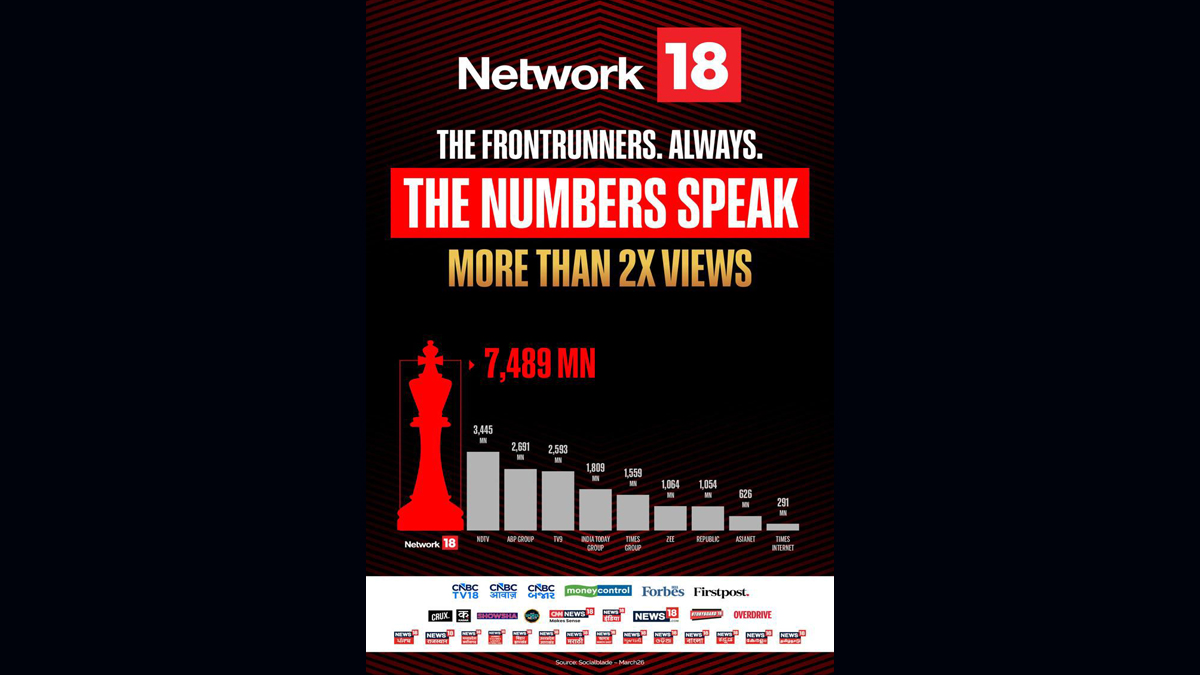
MUMBAI: When the world hit refresh on breaking news, Network18’s channels were already streaming ahead. As geopolitical tensions and war-driven headlines fuelled a surge in global news consumption, the network’s digital playbook delivered big clocking record Youtube viewership across English, Hindi and business news categories in March 2026.
At the forefront was CNN-News18, which emerged as the clear leader in the English news segment with 130 million live and video-on-demand views. The channel edged past competitors such as Times of India (126.5 million), Times Now (101.1 million), India Today (88.2 million) and NDTV (77.5 million), according to Databeings data for March.
In the Hindi news arena, News18 India delivered a commanding performance, racking up a staggering 3,297 million views on YouTube. The channel comfortably outpaced NDTV India, which recorded 3,119 million views, underlining its deep reach and consistent engagement with mass audiences, as per Playboard data.
The network’s dominance wasn’t confined to general news. In the Hindi business segment, CNBC Awaaz topped the charts with 92 million views, narrowly ahead of Zee Business (90 million) and well ahead of ET Now Swadesh (57 million). Meanwhile, its English counterpart CNBC-TV18 posted a strong 58 million views, reinforcing the network’s cross-category strength.
The spike in viewership reflects a broader shift in audience behaviour, with viewers increasingly turning to digital platforms particularly Youtube for real-time updates and in-depth coverage during high-intensity news cycles. For Network18, the numbers signal more than just scale; they underline the effectiveness of a multi-platform strategy that blends speed, credibility and continuous coverage.
In a month where the news never paused, it seems viewers chose to stay tuned where the stream never stopped.






