News Broadcasting
I&B steps up content regulation with directive on horrow show timings

NEW DELHI: Rapped by the government, the Indian Broadcasting Foundation (IBF), an apex body of broadcasters operating in India, has formed a panel which will look into the slotting of horror shows on private satellite channels so that such shows are not easily accessible to children.
Reason: a missive from the Information and Broadcasting ministry on the issue of horror shows and their effect on children. The formation of the panel on horror shows – comprising Star India chief executive Peter Mukerjea, SET India chief executive Kunal Dasgupta and Sri Adhikari Brothers’ vice-chairman Markand Adhikari – also coincides with certain steps on content regulation that the Indian government proposes to take.
The Parliamentary Consultative Committee attached to the I & B ministry will be meeting tomorrow to discuss ways which can possibly give the government powers to control what it feels is undesirable programming on TV channels.

Broadcasting industry sources confirmed that the IBF has formed a panel to look into the issue of horror shows as it received a letter from the I&B ministry saying various representations have been made to it on rampant airing of horror and thriller shows during prime time which can have negative effects on children.
The sources indicated that the IBF panel might look at shifting such programming on to late night slots or at times when children are not likely to be watching television.
Programmes like Aahat and Achanak on Sony, Shhh…Koi Hai on Star Plus and Khauff on Sabe TV usually air at 9 pm or 10 pm on weekends currently.
The parliamentary panel tomorrow will discuss ways on how the government can enforce a control on content being put out on television channels, including commercials that have been termed objectionable like the Fair & Lovely cream ad – which, as per a petition to the I&B ministry by a human rights commission, promoted colour prejudice and is biased against the dark skinned girl child.
According to government sources, the move to get some hold over content on television also comes in the wake of frequent objections raised by members of Parliament on un-Indian like programming on the small screen.
Meanwhile, the Indian Broadcasting Foundation (IBF) is close to finalising a programming code that is to be followed by the member-broadcasters.
According to early information available with indiantelevision.com, the IBF programming code, aimed at self-regulation, is a lengthy document running into almost 100 pages. It will be put up for the board’s approval once it is finalised.







News Broadcasting
Network18 channels lead YouTube news viewership in March 2026
CNN-News18, News18 India and CNBC channels top categories with record views
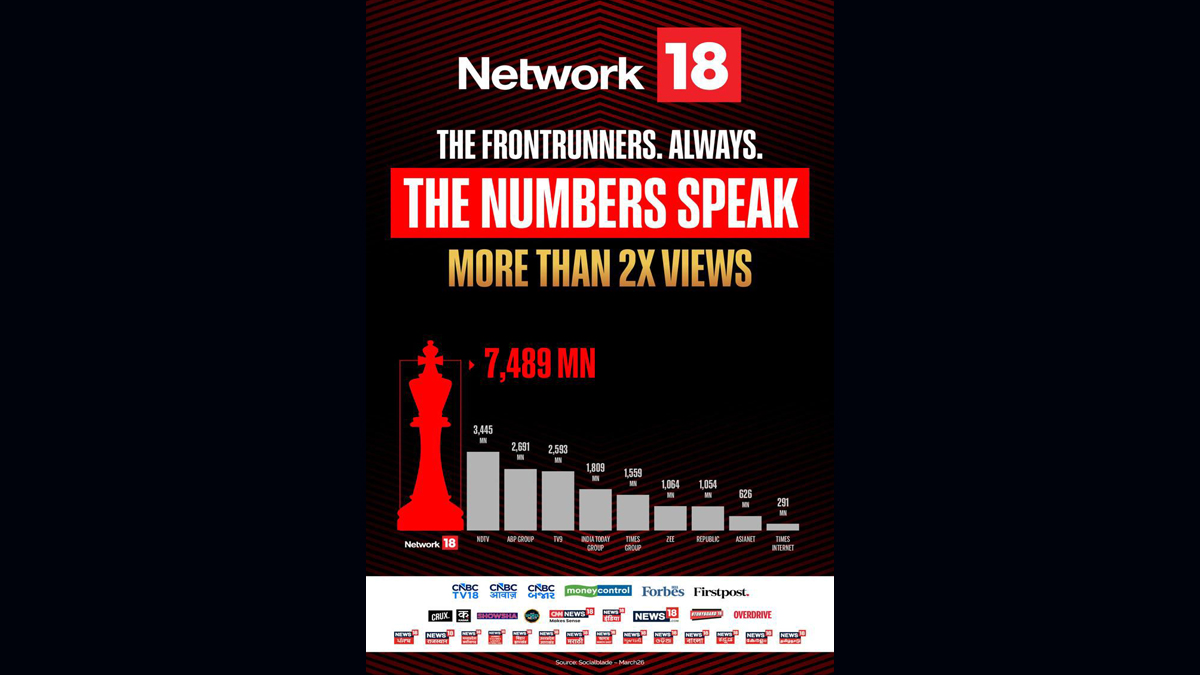
MUMBAI: When the world hit refresh on breaking news, Network18’s channels were already streaming ahead. As geopolitical tensions and war-driven headlines fuelled a surge in global news consumption, the network’s digital playbook delivered big clocking record Youtube viewership across English, Hindi and business news categories in March 2026.
At the forefront was CNN-News18, which emerged as the clear leader in the English news segment with 130 million live and video-on-demand views. The channel edged past competitors such as Times of India (126.5 million), Times Now (101.1 million), India Today (88.2 million) and NDTV (77.5 million), according to Databeings data for March.
In the Hindi news arena, News18 India delivered a commanding performance, racking up a staggering 3,297 million views on YouTube. The channel comfortably outpaced NDTV India, which recorded 3,119 million views, underlining its deep reach and consistent engagement with mass audiences, as per Playboard data.
The network’s dominance wasn’t confined to general news. In the Hindi business segment, CNBC Awaaz topped the charts with 92 million views, narrowly ahead of Zee Business (90 million) and well ahead of ET Now Swadesh (57 million). Meanwhile, its English counterpart CNBC-TV18 posted a strong 58 million views, reinforcing the network’s cross-category strength.
The spike in viewership reflects a broader shift in audience behaviour, with viewers increasingly turning to digital platforms particularly Youtube for real-time updates and in-depth coverage during high-intensity news cycles. For Network18, the numbers signal more than just scale; they underline the effectiveness of a multi-platform strategy that blends speed, credibility and continuous coverage.
In a month where the news never paused, it seems viewers chose to stay tuned where the stream never stopped.






