I&B Ministry
I&B releases public interest ads for CAS in Mumbai

MUMBAI: The ministry of information and broadcasting seems to be pretty serious about the new conditional access system (CAS) deadline.
The ministry has released 25*4 col cms ads in all the major newspapers in Mumbai. The copy says “from 1 September 2003, every cable operator will transmit/re-transmit every pay channel through a set top box (STB) in the areas of metro city of Mumbai. Introduction of CAS will protect viewers from arbitrary and frequent hikes, as was being observed earlier with the monthly subscription rates.”
The ad says that no STB will be required to watch free-to-air channels as these channels will be received in the manner signals are received in the pre-CAS era. It also adds that FTA channels will be receivable within a maximum price of Rs 72 plus taxes.
The ad urges viewers to demand the details of the pay TV prices and schemes for STBs from their cable operators. It also counsels the viewers that STBs will give them a choice of viewing a pay channel so that they choose the channel they wish to watch after knowing its price. “The STB will empower you to shut out the content that you don not wish your family to watch,” it informs viewers.
The ad also gives the following contact details of MSO Helplines:
* SitiCable – 56936343 www.info@galaxy.com
* INCableNet – 1-600-223456 www.incablenet.com
* Hathway – 22885866 www.hathway.net
The Greater Mumbai municipal council areas that have been specified in the notification include:
the area to the west of the mainline of central railway between Chhatrapati Shivaji Terminus (CST) and Sion railway station; the area from Navy Nagar in the south of Mumbai to CST railway station in the north including Ballard Estate, Colaba, RC Church, World Trade Centre, Nariman Point, Cuffe Parade, Bombay Stock Exchange area, Fort, Fountain, Horniman Circle, Prince of Wales museum, Reserve Bank of India, Churchgate, Shahid Bhagat Singh road, Town Hall, Madam Cama Road, Veer Nariman road, Mahatma Gandhi road, Dr Dadabhai Nauroji road, Marine Lines, Charni Road, Kalbadevi, Thakurdwar, Girgaum, Walkeshwar, Napean sea Road, Cumbala Hill, Malabar Hill, Grant Road, Khetwadi, Breach Candy, Peddar road, Haji Ali, Mahalaxmi, Worli, Tardeo, Altamount road, Dr Dadasaheb Bhadkamkar road, Sardar Vallabhai Patel road, Saat Raasta, Lala Lajpatrai road, Mahalaxmi Race Course road, Dr Annie Besant, NM Joshi, Gokhale road, Dr Moses road, Prabhadevi, Dadar (west), Shivaji Park, Cadell road, Lady Jamshedji road, Sitladevi road, Mahim, general Arunkumar Vidya marg; the Sion-Bandra Link road and Mahim causeway on the northern side.


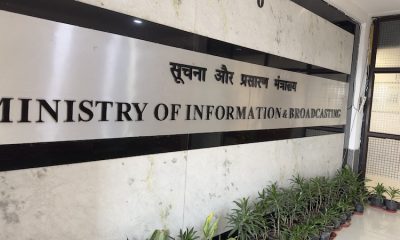




I&B Ministry
CBFC speeds up film certification; average approval time cut to 22 days
Over 71,900 films cleared in five years as digital system shortens approval timelines

MUMBAI: The Central Board of Film Certification (CBFC) has significantly reduced the time taken to certify films, with the average approval timeline now down to 22 working days for feature films and just three days for short films.
Operating under the Ministry of Information and Broadcasting, the statutory body certifies films for public exhibition in line with the Cinematograph Act, 1952 and the Cinematograph (Certification) Rules, 2024. The rules prescribe a maximum certification period of 48 working days, though the adoption of the Online Certification System has sharply accelerated the process.
Over the past five years, from 2020-21 to 2024-25, the board certified a total of 71,963 films across formats. Of these, the majority fell under the U category with 41,817 titles, followed by UA with 28,268 films and A with 1,878 films. No films were certified under the S category during the period.
Film approvals have also steadily risen in recent years. The CBFC cleared 8,299 films in 2020-21, a figure that peaked at 18,070 in 2022-23 before settling at 15,444 films in 2024-25. During the same period, 11,064 films were certified with cuts or modifications.
Despite the high volume of certifications, outright refusals remain rare. Only three films were denied certification over the last five years, with one refusal recorded in 2022-23 and two in 2024-25.
The board may recommend cuts or modifications if a film violates statutory parameters relating to the sovereignty and integrity of India, security of the state, friendly relations with foreign states, public order, decency or morality, defamation, contempt of court or incitement to an offence.
Filmmakers can challenge CBFC decisions in court. Data shows that such disputes remain limited but have seen some fluctuation. Between 2021 and 2025, a total of 21 certification decisions were challenged before High Courts, with the number rising to 10 cases in 2025.
Responding to a question in the Rajya Sabha, minister of state for information and broadcasting L. Murugan shared the data. The question was raised by Mallikarjun Kharge.
With faster timelines and a largely digital workflow, the certification process appears to be moving at a far brisker pace, signalling a shift towards quicker clearances for India’s growing film output.