I&B Ministry
I&B Ministry invites ideas for National Centre of Excellence in Animation, Gaming and Visual Effects

NEW DELHI: Stakeholders wanting to invest in the National Centre of Excellence in Animation, Gaming and Visual Effects have been requested to submit proposals based on which a detailed project report would be prepared for further action.
Information and Broadcasting Ministry sources told indiantelevision.com that the Centre is to be set up under the 12th Plan scheme.

The Planning Commission has given in-principle approval to the project. The objective of the scheme is to impart quality education and to ensure availability of skilled manpower.
The scheme would also ensure increasing ownership of Intellectual Property by Indians in animation/gaming/visual effect sector leading to increased revenues, employment generation, cultural pay-off and a subtle leveraging of India’s soft power in the global arena.
The size of animation, visual effects and post production industry in India, according to FICCI-KPMG Report 2014, is Rs 39.7 billion in 2013, with a growth of 12.4 per cent in the year 2014.
Out of this, the share of animation services and animation production comes to Rs 12.7 billion in 2013. It is projected that the Cumulative Annual Growth Rate (CAGR) in animation services and animation production for the period 2013-2018 would be 7.1 per cent.


I&B Ministry
CBFC speeds up film certification; average approval time cut to 22 days
Over 71,900 films cleared in five years as digital system shortens approval timelines
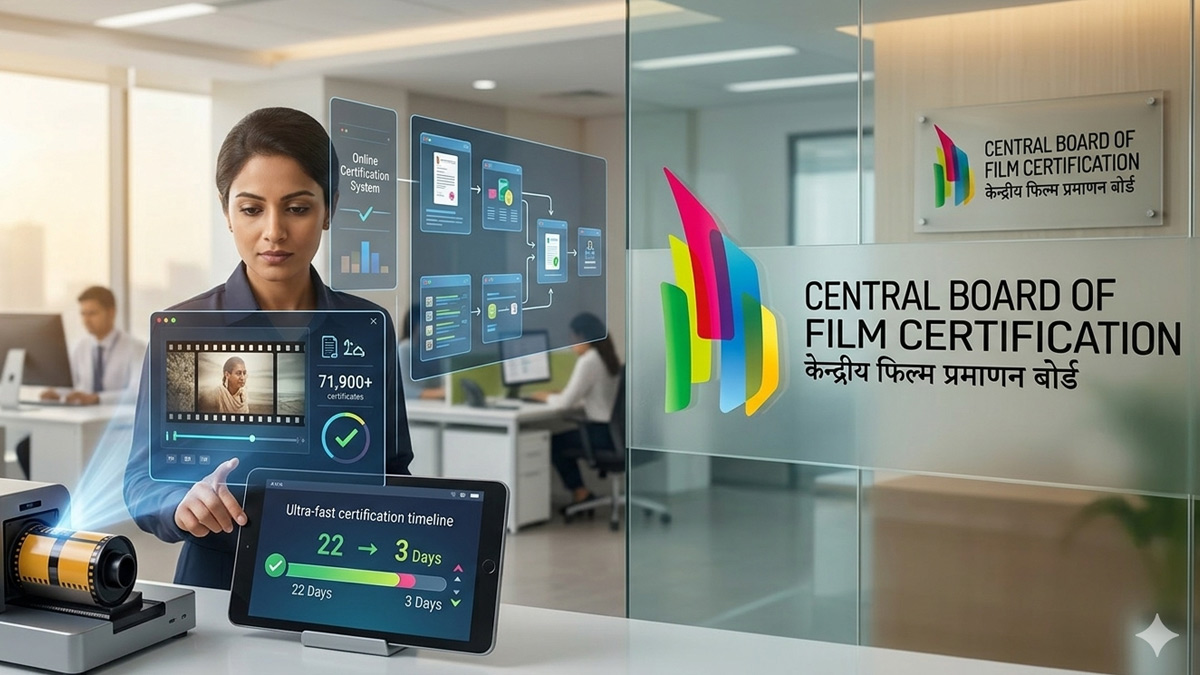
MUMBAI: The Central Board of Film Certification (CBFC) has significantly reduced the time taken to certify films, with the average approval timeline now down to 22 working days for feature films and just three days for short films.
Operating under the Ministry of Information and Broadcasting, the statutory body certifies films for public exhibition in line with the Cinematograph Act, 1952 and the Cinematograph (Certification) Rules, 2024. The rules prescribe a maximum certification period of 48 working days, though the adoption of the Online Certification System has sharply accelerated the process.
Over the past five years, from 2020-21 to 2024-25, the board certified a total of 71,963 films across formats. Of these, the majority fell under the U category with 41,817 titles, followed by UA with 28,268 films and A with 1,878 films. No films were certified under the S category during the period.
Film approvals have also steadily risen in recent years. The CBFC cleared 8,299 films in 2020-21, a figure that peaked at 18,070 in 2022-23 before settling at 15,444 films in 2024-25. During the same period, 11,064 films were certified with cuts or modifications.
Despite the high volume of certifications, outright refusals remain rare. Only three films were denied certification over the last five years, with one refusal recorded in 2022-23 and two in 2024-25.
The board may recommend cuts or modifications if a film violates statutory parameters relating to the sovereignty and integrity of India, security of the state, friendly relations with foreign states, public order, decency or morality, defamation, contempt of court or incitement to an offence.
Filmmakers can challenge CBFC decisions in court. Data shows that such disputes remain limited but have seen some fluctuation. Between 2021 and 2025, a total of 21 certification decisions were challenged before High Courts, with the number rising to 10 cases in 2025.
Responding to a question in the Rajya Sabha, minister of state for information and broadcasting L. Murugan shared the data. The question was raised by Mallikarjun Kharge.
With faster timelines and a largely digital workflow, the certification process appears to be moving at a far brisker pace, signalling a shift towards quicker clearances for India’s growing film output.







