News Broadcasting
How Mathrubhumi News keeps the show going during lockdown


MUMBAI: The show must go on, come what may. News channels, which have been tagged under the essential services category, continue to produce fresh news content by disseminating information to the viewers irrespective of the Covid2019 challenges. How do they go about their daily business in spite of the restrictions of social distancing? Mathrubhumi News chief executive officer Mohan Nair explains the modus operandi deployed by his channel during the lockdown, which has worked well for him even as it has now moved into a faster pace, following the lifting of the curbs in Kerala.
Nair told indiantelevision.com: “It is the most trying time, and being a news channel, you cannot compromise on the content and quality at a time when there has been a massive surge in the television news consumption.” The channel has implemented a three-pillar formula to continue with their smooth operation during the Covid2019 pandemic.
In an attempt to maintain social distancing and curb the spread of the virus at office premises, Mathrubhumi News divided itself into three parts with respect to the workforce, wherein two teams would come to the office and work for extended hours, while the third team is kept as a standby in a ‘no work remain home’ system, which has been monitored by the HR department,” says Nair. These are the two pillars of their strategy: the reduced staff at the office and a team on a standby as a last-minute resort.

He adds that these teams function in a rotational manner each week. For example, in the first week, if the first two teams have been working from the office with extended hours and third-team standby at home, then the consecutive week second and third team comes to the office and first-team stays as home as standby.
This division is done within all teams across bureaus that include PCR, MCR, anchors, editorial, admin, housing, technical among others, except for the reporters of the channel. Nair says: “The news we run is only of Covid2019 and reporters have been reporting from fields, hospitals, and interviewing those who are under quarantine. So the chances of them being exposed to the virus are high, and hence, we have asked them to report from wherever possible through video calling or TVU mobile applications.”
“We have a protocol of sanitising the office in between the shifts and also sanitise each employee coming to the office. Not just that, we don’t let the cameraman along with his equipment in before sanitising him, as well as the vehicle he has been travelling in,” says Nair. The moment Kerala started seeing a spike in Covid2019 cases, the Mathrubhumi News management had taken a decision to provide employees with all the necessary safety equipment such as gloves, masks, sanitizers.
The third and most important pillar is technology. “We have been using all necessary technologies to not only connect with reporters but also guests, politicians, chief minister’s office, and other important ministers through video calling applications or by the TVU mobile application. Through OFC lines, which are installed at chief minister's office, ministries, and other political party offices and their places, it becomes easy to connect to them digitally,” says Nair.
Nair adds: “The technology we have been using to connect to people is not new; we had been using it earlier too; however, the increase or dependency of it has increased substantially over the period of time due to the Covid2019 situation.” The channel uses Skype, WhatsApp, Zoom and all other video calling applications for broadcast but most-preferred one is TVU application that helps it to maintain broadcast quality and to overcome the other technical challenges.
The channel, so far, has hosted many interviews virtually, one of them with the state health minister to answer people’s queries and address their concerns about the virus. Moreover, in order to entertain the audience, the channel also brings the celebrities to talk to people, motivate them, entertain them and also share their daily lifestyle during the pandemic period.
Every other channel, be it mainstream or regional, is trying their best to run the show while engaging the audience. While news channels follow each other’s steps, Mathrubhumi is ensuring the show of broadcasting news continues uninterrupted.




News Broadcasting
UDF poised to return to power in Kerala, says Manorama-CVoter survey
Massive opinion poll projects shift in Kerala politics ahead of 2026 Assembly elections.
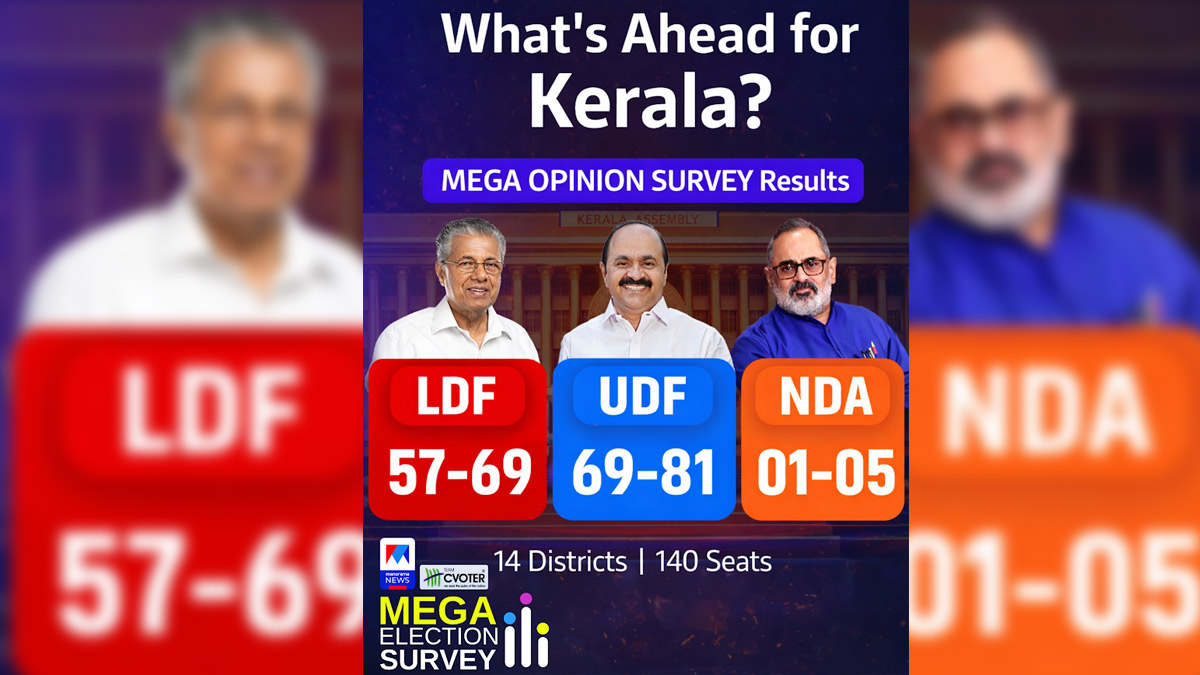
MUMBAI: The winds of change appear to be blowing through Kerala’s political landscape and this time, they seem to favour the United Democratic Front. A comprehensive mega opinion survey conducted by Manorama News in partnership with CVoter projects a potential comeback for the UDF in the upcoming Kerala Legislative Assembly Elections 2026. The survey, covering all 140 constituencies with a massive sample size of nearly 90,000 respondents, predicts the UDF could win between 69 and 81 seats.
The ruling Left Democratic Front (LDF) is expected to secure 57 to 69 seats, a significant drop from the 99 seats it won in the 2021 elections. This would mean the LDF losing 30 to 42 of its sitting seats. Meanwhile, the National Democratic Alliance (NDA), which drew a blank in 2021, is projected to open its account with 1 to 5 seats.
Region-wise, the UDF is expected to make strong gains in Malabar, winning 25 to 34 out of 48 seats, and in Central Kerala, where it could bag 29 to 33 out of 53 seats. In South Kerala, the LDF is likely to retain an edge with 21 to 25 seats, while the UDF may improve to 12 to 16 seats. The NDA could pick up 1 to 3 seats in the southern region.
The survey was conducted between 14 and 26 March 2026, with additional tracker and snap polls carried out from December 2025 to March 2026. A total of 89,693 respondents participated, ensuring representation across all demographics and social segments.
Manorama News has a strong track record of accuracy, with its previous projections closely matching the actual results of the 2019 and 2024 Lok Sabha elections as well as the 2021 Kerala Assembly polls.
In Kerala’s famously fierce political battles, this survey suggests the pendulum may be swinging back. Whether the final verdict matches these numbers or throws up another surprise, one thing is clear, the 2026 Assembly elections are shaping up to be one of the most keenly watched contests in the state’s history.






