iWorld
Hotstar targets billion minutes watch time daily

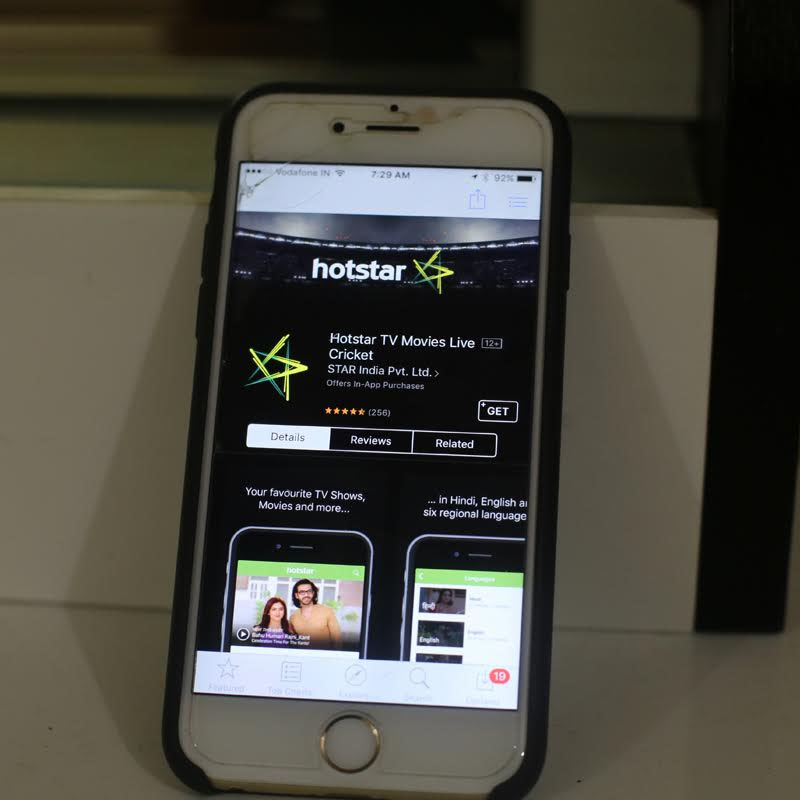
MUMBAI: The new mantra at the Twenty First Century Fox-owned Star India subsidiary Novi Digital’s Hotstar is the figure of a billion. Yes, a billion. Not a billion subscribers, but a billion minutes. Speaking at a conference in China yesterday, its senior vice-president and head of product Varun Narang stated that the OTT service’s target is to get to a billion minutes of watch time daily.
“Once you get to a billion minutes a day, you’re talking about a real, real business,” stated Narang at the conference.
Narang was roped in to Hotstar from Whipclip last year and has had more than half a decade’s product experience with top-notch services such as Hulu and Amazon in the US. He was recruited to lead the team which is helping build mobile solutions for the app and help innovate content discovery, quality of video playbacks as well as build native advertising platforms for the app.

Speaking at the Bank of America Merrill Lynch Media and entertainment conference earlier this month Twenty First Century Fox executive chairman Lachlan Murdoch had stated that Hotstar had gone from streaming 750 million minutes to 2.5 billion minutes between July and August 2016. That means it has some distance to travel before it gets to that billion minutes a day figure.
Responding to a question from ace analyst Jessica Jean Reif Cohen on the media powerhouse’s plans for India, Lachlan had elaborated that Hotstar is expected “to grow significantly with the launch of Reliance Jio’s mobile 4G service, which Hotstar is the exclusive (sic) program provider for. So, on the Reliance Jio phones — the biggest launch of consumer product in many many years – Hotstar is the exclusive television provider on the platform. And so we think where every single single consumer will have access to Hotstar premium which is a $3 service. And, they’ll have it provided by Reliance for free. So, it’s a very exciting time in India for us. Just to have this in perspective, those streaming numbers for Hotstar is about, if you compare with Netflix in India, Netflix is about six per cent the size of Hotstar”.
Among the initiatives, Hotstar is looking to scale up the product quickly is rolling it out globally in the near future, targeting the south Asian diaspora, Narang revealed at the conference. This was something that even Star India chairman Uday Shankar had stated at the Ficci Frames conference in Mumbai earlier this year.
Narang admitted that what was helping Hotstar is the fact that “content rights are a lot easier for us in India than they are in the US.”
Other things that could aid it get there is its catalogue of around 35,000 hours of entertainment content. At its investor call conference during the announcement of its annual results Twenty First Century Fox CFO John Nallen had pointed out that “in the beginning, we saw pretty severe sort of volatility and spike, largely around sports viewership on the Hotstar platform to when there was a big cricket tournament or something like that. But, gradually over the last year, what’s really built and gotten much more momentum is scripted programming, it’s Indian-scripted programming in multiple languages, and that’s really driving, that’s been the most gratifying and to see more consistent viewership of that and that’s really a big, big part of the volume now, and it’s the fastest way growing part of the volume on a consistent basis, local Indian-scripted programming at very high volumes.”
Currently, Hotstar has an estimated 72 million downloads with around 50 million active users.







iWorld
Bill Ackman’s Pershing Square makes $64 billion bid to acquire Universal Music Group
Ackman pitches NYSE relisting plan as UMG board weighs unsolicited offer

The hedge fund has proposed a business combination that values UMG at €30.40 per share, representing a hefty 78 per cent premium to its current trading price. The offer includes €9.4 billion in cash alongside stock in a newly formed entity, with shareholders set to receive €5.05 per share in cash and 0.77 shares in the new company for each UMG share they hold.
Under the proposal, UMG would merge with Pershing Square SPARC Holdings Ltd and re-emerge as a Nevada-based entity listed on the New York Stock Exchange. The move is designed to boost investor visibility and potentially secure inclusion in major indices such as the S&P 500.
Pershing Square Capital Management ceo Bill Ackman argued that while UMG’s operational performance remains strong, its market valuation has lagged due to external factors. “UMG’s stock price has languished due to a combination of issues that are unrelated to the performance of its music business,” Ackman said, pointing to concerns ranging from shareholder overhang to delayed US listing plans.
Ackman also flagged what he sees as untapped potential in UMG’s balance sheet and a lack of clear capital allocation strategy. He added that the market has not fully recognised the value of UMG’s €2.7 billion stake in Spotify, alongside gaps in investor communication.
The proposed transaction would also result in the cancellation of around 17 per cent of UMG’s outstanding shares, while maintaining its investment-grade balance sheet. Pershing Square has said it will fully backstop the equity financing, with debt commitments secured at signing. The deal is targeted for completion by the end of the year.
UMG, however, has struck a measured tone. The company confirmed that its board has received the non-binding proposal and will review it with advisers. It reiterated confidence in its current strategy and leadership under Lucian Grainge, signalling no immediate shift in stance.
The proposal comes at a time when global music companies are navigating evolving investor expectations, streaming economics and capital allocation pressures. For Pershing Square, the bet is clear: sharpen the financial story, relist in the US, and let the music play louder in the markets.
Whether UMG’s board is ready to change the tune remains to be seen, but the spotlight on its valuation just got a lot brighter.






