Applications
High-level object-oriented Python package for digitizers and Generators

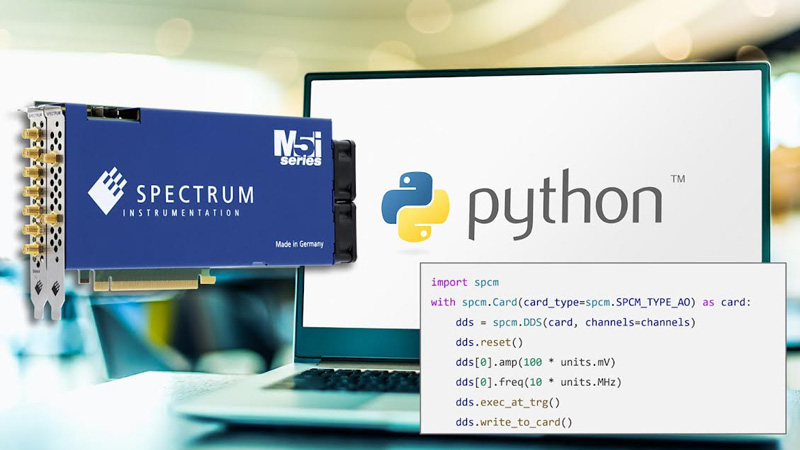
Mumbai. Spectrum Instrumentation presents a new open-source Python package (“spcm”) that is now available for the current line of all Spectrum Instrumentation test and measurement products. The new package makes the programming of all 200+ instruments, offering sampling rates from 5 MS/s to 10 GS/s, faster and easier. Python, popular for its simplicity, versatility and flexibility, boasts an extensive collection of libraries and frameworks (such as NumPy) that significantly accelerates programming development cycles. The new spcm package allows users to take full advantage of the Python language by providing a high-level Object-Oriented Programming (OOP) interface that is specifically designed for the Spectrum Instrumentation Digitizer, AWG and Digital I/O products. It includes the full source code as well as a number of detailed examples. Available on GitHub, spcm is free of charge under the MIT license.
Spectrum’s Python package safely handles the automatic opening and closing of cards, groups of cards and Ethernet instruments, as well as the allocation of memory for transferring data to and from these devices. All the device specific functionality is capsulated in easy-to-use classes. This includes clock and trigger settings, hardware channel settings, card synchronization, direct memory access (DMA) and product features such as Block Averaging, DDS and Pulse Generator.
The package supports the use of real-world physical quantities and units (e.g. “10 MHz”) enabling the user to directly program driver settings in their preferred unit system. This removes the need for tedious manual conversions to cryptic API settings. Moreover, this package also includes support for calculations with NumPy and Matplotlib, allowing the user to handle data coming from, or going to, the products with the vast toolbox provided by those packages. Detailed examples can be found in the GitHub repository.

Installing the package is easy, thanks to its availability in the pip repository. Simply install Python and then the package with a single command: $ pip install spcm
Users can include the Spectrum Instrumentation Python package in their own programs, or fork to the repository to add more functionality. The package is directly maintained by Spectrum engineers and updates are released regularly offering bug-fixes and new features.
The example in the photo shows the opening of the first analog-output card (AWG) and programming of a simple 10 MHz sine-wave output using the DDS option.
The Spectrum Python repository is found under: https://github.com/SpectrumInstrumentation/spcm

Applications
With 57 per cent single new users, Ashley Madison rebrands as discreet dating platform
Platform says majority of new members now identify as single

INDIA: Ashley Madison is shedding the “married-dating” label that defined it for two decades, repositioning itself as a platform for discreet dating in what it calls the post-social media age.
The rebrand, unveiled in India on 27 February, 2026, marks a structural shift in business model and identity. Once synonymous with married dating, the company now describes itself as the “premier destination for discreet dating” under a new tagline: Where Desire Meets Discretion.
The pivot is data-driven. Internal figures show that 57 per cent of global sign-ups between 1 January and 31 December, 2025 identified as single: a notable departure from the platform’s married core. The company argues that its community has already evolved beyond its original positioning.
“In an age where our lives have been constantly put on public display, privacy has become the new luxury,” said Ashley Madison chief strategy officer Paul Keable. He framed the platform’s offering as “ethical discretion” for singles, separated, divorced and non-monogamous users seeking private connections.
The shift also taps into wider digital fatigue. A global survey conducted by YouGov for Ashley Madison, covering 13,071 adults across Australia, Brazil, Canada, Germany, India, Italy, Mexico, Spain, Switzerland, the UK and the US, found mounting discomfort with hyper-public online lives.
Among dating app users, 30 per cent cited constant swiping and messaging as a source of fatigue, while 24 per cent pointed to pressure to curate public-facing profiles and early personal disclosure. Some 27 per cent said fears of screenshots or information being shared contributed to exhaustion; an equal share cited unwanted attention.
The retreat from oversharing appears broader. According to the survey, 46 per cent of adults actively try to keep most aspects of their life private online. Only 8 per cent feel comfortable sharing most aspects publicly, while 35 per cent say they are becoming more selective about what they disclose.
Ashley Madison is betting that this cultural recalibration towards controlled visibility can be monetised. By doubling down on privacy infrastructure and reframing itself around discretion rather than infidelity, the company is attempting to convert reputational baggage into a premium proposition.