News Broadcasting
HD TV is the new way to Nab 2005: Sony


MUMBAI: With more than 60 per cent of US households expected to have high definition television (HDTV) sets in 2005, the demand for HD production equipment is rapidly rising. Sony is looking to take advantage of this in a big way.
At this week’s National Association of Broadcasters (Nab) convention in Las Vegas Sony Electronics is ready to meet this demand, with more than 50 per cent of its professional broadcast products on display featuring HD production capabilities.
Under the theme of HD Highway the new Sony professional products at Nab include cameras, camcorders, optical disc technology, production switchers, non-linear editors, tape recorders and videotape, for use by TV and motion picture directors, network and affiliate news organisations and post-production facilities.

Sony Electronics president broadcast and business solutions John Scarcella said, “Sony broadcast and professional products are helping to drive the growth of HD consumer entertainment in every form, from the digital production of TV shows and movies, and even to digital projection in your local movie theatre. Applications for these products stretch beyond broadcast and video and into all aspects of everyday life, from medical and education to corporate and government uses.”
For broadcasters, Sony’s XDCam Professional Disc system, uses blue-laser optical media to capture footage instead of tape. Sony has announced that the ten owned and operated networks of ABC Television will adopt XDCam technology over the next 18 months for their newsgathering and production processes. This announcement comes on the heels of CBS Television’s decision to adopt XDCam technology for its network news division and 16 owned-and-operated stations.
Other high-profile XDCam customers include the E! Entertainment Network and five stations within the Gray Television Group. Also on display at Nab will be a technology demonstration of a high-definition version of Sony’s XDCAM system. For the growing digital cinema industry, Sony is showing its SXRD digital projector. This product is capable of displaying images at nearly four times the resolution of current HD displays, and higher levels of contrast than competing technology.
Sony claims that its SXRD technology is driving the introduction of digital cinema to the American mainstream. In the coming months Landmark Theatres takes delivery of six Sony projectors. The theatre chain will eventually convert all of its 59 theatres to digital projection. Sony’s HD production equipment is also prominent throughout the current TV prime time schedule. More than 50 new and returning shows have been shot digitally with Sony’s CineAlta line of acquisition and recording products.



News Broadcasting
Network18 channels lead YouTube news viewership in March 2026
CNN-News18, News18 India and CNBC channels top categories with record views
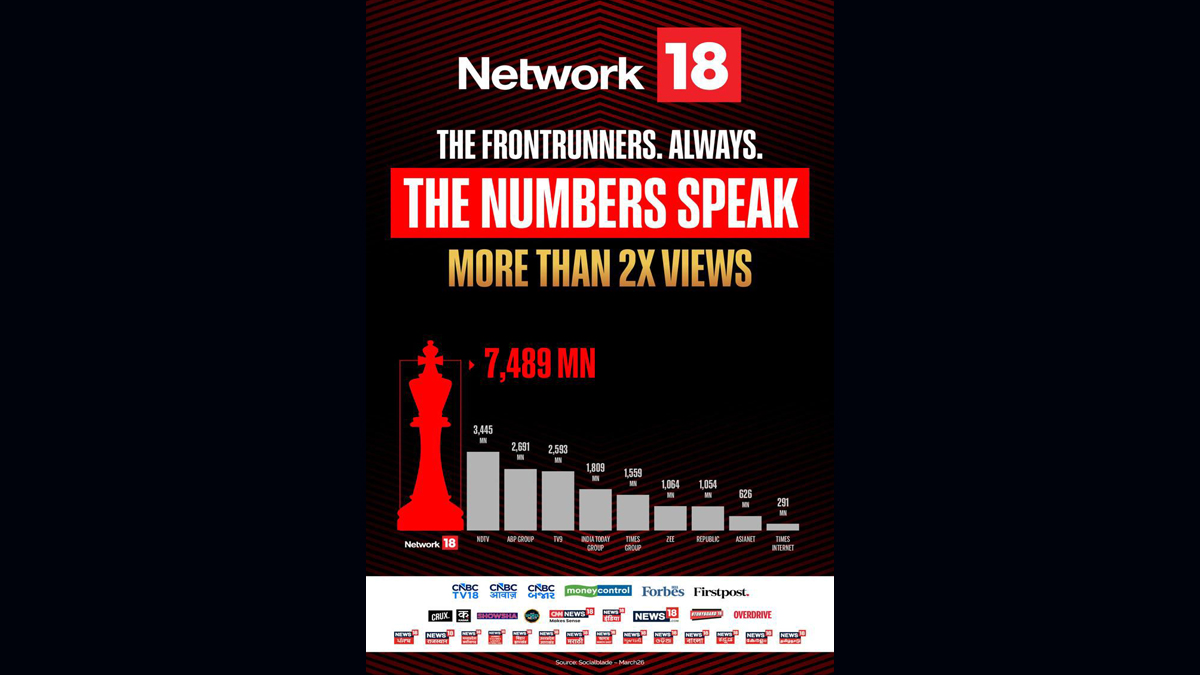
MUMBAI: When the world hit refresh on breaking news, Network18’s channels were already streaming ahead. As geopolitical tensions and war-driven headlines fuelled a surge in global news consumption, the network’s digital playbook delivered big clocking record Youtube viewership across English, Hindi and business news categories in March 2026.
At the forefront was CNN-News18, which emerged as the clear leader in the English news segment with 130 million live and video-on-demand views. The channel edged past competitors such as Times of India (126.5 million), Times Now (101.1 million), India Today (88.2 million) and NDTV (77.5 million), according to Databeings data for March.
In the Hindi news arena, News18 India delivered a commanding performance, racking up a staggering 3,297 million views on YouTube. The channel comfortably outpaced NDTV India, which recorded 3,119 million views, underlining its deep reach and consistent engagement with mass audiences, as per Playboard data.
The network’s dominance wasn’t confined to general news. In the Hindi business segment, CNBC Awaaz topped the charts with 92 million views, narrowly ahead of Zee Business (90 million) and well ahead of ET Now Swadesh (57 million). Meanwhile, its English counterpart CNBC-TV18 posted a strong 58 million views, reinforcing the network’s cross-category strength.
The spike in viewership reflects a broader shift in audience behaviour, with viewers increasingly turning to digital platforms particularly Youtube for real-time updates and in-depth coverage during high-intensity news cycles. For Network18, the numbers signal more than just scale; they underline the effectiveness of a multi-platform strategy that blends speed, credibility and continuous coverage.
In a month where the news never paused, it seems viewers chose to stay tuned where the stream never stopped.






