Cable TV
Hathway Cable files GTPL details with BSE


BENGALURU: Among the largest cable television operators in India, the listed Hathway Cable and Datacom Limited (Hathway) has a number of subsidiaries and partnership in the television signal carriage and broadband ecosystems in the company. The company has various levels of investments in these associations. One of its most profitable associations, and probably one of the largest contributors (besides Hathway itself) to Hathway’s consolidated numbers across major financial and operational parameters is GTPL Hathway Limited (GTPL), a material subsidiary, in which Hathway owns a 50 per cent stake.
Besides Hathway, another major shareholder of GTPL is its co-founder, Aniruddhasinhji Jadeja who directly owns 14.6 per cent and controls another 29.1 per cent through another shareholding entity Gujarat Digi Com Private Limited which is majority owned by him. The other co-founder Kanaksinh Rana owns 5.2 per cent shares of GTPL.
As reported by us earlier, the Hathway board has given approval to the initial public offering (IPO) proposal which seeks to raise funds for GTPL through a fresh issue of equity shares while giving an option to existing GTPL shareholders to sell their holdings. Hathway holds around 90 lakh shares in GTPL, according to a filing with the Bombay Stock Exchange, over the weekend.

Operational Matrices of GTPL
According to the presentation, GTPL is the largest MSO in Gujarat with 67 per cent market share and the second largest MSO in Kolkata and Howrah with a 24 per cent market share (in 2015, based on cable television subscribers).
As of 30 September 2016 (Q2-17),GTPL had active relationships with 13,775 local cable operators (LCOs). It says it has added 4,004 and 1,286 LCOs on a net basis in FY-16 and FY-15 respectively, and another 2,507 LCOs on a net basis as of 30 September 2016
As of Q2-17,GTPL is present in 169 towns across ten states of the country. The company claims a cable subscriber universe of 74.3 lakhas of 31 August 2016 of which 54.1 lakh (72.8 per cent) were active subscribers. GTPL claims to have seeded 61.9 lakh set top boxes or 83.3 per cent of its cable universe. Primary cable ARPU as on Q1-17 is Rs 220.34 and has been increasing steadily as per Hathway’s investor presentation submitted to the bourses.Currently in Gujarat, GTPL offers various monthly pay channel packages, including HD packages, to its digital cable television subscribers ranging from Rs 250 to Rs 470, including all applicable taxes.
It has 2.2 lakh broadband internet (broadband) subscribers and a broadband ARPU of Rs 463.87. Data consumption has been increasing steadily. Broadband ARPU has been increasing steadily over the past few years as per the Hathway’s investor presentation submitted to the bourses.
GTPL owns and operates 28 channels offering localised content across a wide range of genres including religious, culture, film, music and education.
Financial Performance
Please refer to Figure A below for GTPL’s revenue break-up over a five a period starting FY-12 (year ended 31 March 2012) until FY-16 (year ended 31 March 2016) as well as for the quarter ended 30 June 2016 (Q1-17). Further, Figure B below shows revenue breakup in Rs crore for the five year period starting FY-12 until FY-16.
In absolute rupees, all revenue or income heads have been increasing. In terms of per centage of operational revenue, this is not always the case.
As is obvious, contribution from activation revenue to operational revenue has been increasing with the implantation of DAS from FY-12 to FY-16 in terms of percentage of revenue, as well as in absolute rupees. However, contribution from activation revenue has declined in Q1-17. Broadband internet is another service that MSO’s have been offering for increase of overall ARPU, that has shown an upward trend, both in absolute rupees as well as in terms of percentage of operational revenues.

Though contribution from Placement/Carriage income to operational revenues has been declining in terms of per centage of revenue, it has been increasing steadily in absolute rupees.

The company has been a profitable one – both in terms of operating profits as well as in terms of profit after tax and has been earning money for its shareholders as is evident from its EBIDTA as well as profit after tax (PAT) numbers for the past five years and Q1-17 as well. Margins have been improving as is evident from Figure C below.

Notes: (1) The unit of currency in this report is the Indian rupee – Rs (also conventionally represented by INR). The Indian numbering system or the Vedic numbering system has been used to denote money values. The basic conversion to the international norm would be:
(a) 100,00,000 = 100 lakh = 10,000,000 = 10 million = 1 crore.
(b) 10,000 lakh = 100 crore = 1 arab = 1 billion.
(2) While the author has referred to an investor presentation submitted by Hathway to the Stock Exchanges, the surmise and opinions expressed in this report is his own. The author has no material stake in Hathway or GTPL or other associated or subsidy entities of Hathway or GTPL.




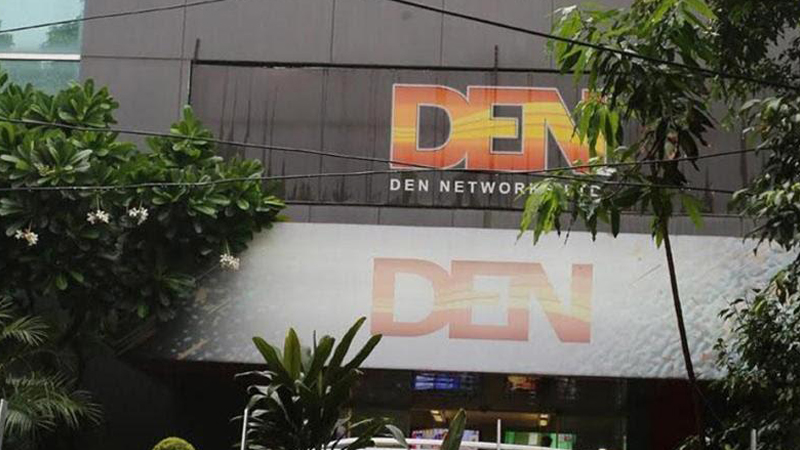
MUMBAI: When margins wobble, liquidity talks and in Q3 FY25-26, cash did most of the talking. Den Networks Limited closed the December quarter with consolidated revenue of Rs.251 crore, marginally higher than the previous quarter but down 4 per cent year-on-year, even as profitability stayed resilient on the back of strong cash reserves and disciplined cost control.
Subscription income softened to Rs.98 crore, slipping 3 per cent sequentially and 14 per cent from last year, while placement and marketing income offered some cheer, rising 15 per cent quarter-on-quarter to Rs.148 crore. Total costs climbed faster than revenue, up 7 per cent QoQ to Rs.238 crore, driven largely by higher content costs and operating expenses. As a result, EBITDA dropped sharply to Rs.13 crore from Rs.19 crore in Q2 and Rs.28 crore a year ago, pulling margins down to 5 per cent.
Yet, the bottom line refused to blink. Profit after tax stood at Rs.40 crore, up 15 per cent sequentially and only marginally lower than last year’s Rs.42 crore. A healthy Rs.57 crore in other income helped cushion operating pressure, keeping profit before tax at Rs.48 crore, broadly stable quarter-on-quarter despite the tougher cost environment.
The real headline-grabber, however, sits on the balance sheet. The company remains debt-free, with cash and cash equivalents swelling to Rs.3,279 crore as of December 31, 2025. Net worth rose to Rs.3,748 crore, while online collections accounted for 97 per cent of total receipts, underscoring strong cash discipline across operations, including subsidiaries.
In short, while Q3 showed signs of operating strain, the financial backbone remains solid. With zero gross debt, steady profits and a formidable cash war chest, the company enters the next quarter with flexibility firmly on its side proving that in uncertain markets, balance sheet strength can be the best growth strategy.






