Hindi
Hasee Toh Phasee… a run of the mill love story

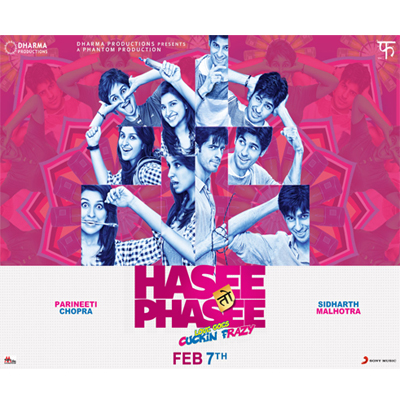
MUMBAI: Hasee Toh Phasee is a romantic feel good film along the usual lines which, in fact, is its strength. Tried and tasted has less chance of backfiring. The story is simple and oft told. In fact, two releases this week, Hasee Toh Phasee and Babloo Happy Hai have similar romantic angles. Also, since Sidharth Malhotra is barely one film old (Student Of The Year) and in the process of creating a following, the film’s star draw is Parineeti Chopra who has established herself as a capable actor. The film also uses the flavor of the season on TV as well as films, a girl with a Gujarati background.
Malhotra is attending a Gujarati wedding in Mumbai when he watches a tom boyish Chopra climbing the wall of her bungalow to runaway from home. She is stuck between barbed-wired fences and Malhotra helps her free herself. He is invited to join her in Goa but he is keener on attending the wedding with his two friends in tow. The main attraction at the pre-wedding aam ras drinking competition is Adah Sharma; Malhotra and Sharma’s eyes meet and sparks fly. It is love at first sight.

It has been seven years since sparks flew. Malhotra and Sharma are now ready to cement their bond with marriage. Even Sharma’s skeptical father, Manoj Joshi, who thinks of Malhotra only as a moocher, has agreed. It is seven days to wedding (seven seems to be lucky number of the makers; marriage after seven years, and seven days to wedding!) and Sharma has a special guest she does not want her family to meet. The job to accommodate her, look after her and keep her away is handed over by Sharma to her own fiancé, Malhotra. Well, manipulating a script is the only way to move it forward. The one Malhotra is asked to tend to is none other than Chopra, the girl he helped run away seven years back.
Chopra is a scholar and a genius, a PhD who can repair a toaster or charge car batteries using mobile phone charger with power stolen from a bus stop glow light! She can reel out medicine formulas as well as effects of the drugs. However, she is eccentric, heavily dependent on drugs and prone to bouts of quirky behavior. She consumes kilos of sugar, drinks litres of water and is prone to eating toothpastes. Being his fiancée’s guest, Malhotra makes sure Chopra is comfortable and failing to get her a decent accommodation in a hotel, brings her home where many of his family’s guests are lodged.
Malhotra soon learns that Chopra, who is being kept away by Sharma from her family, is, in fact, her sister. The reason is that Chopra had stolen a hefty sum of money when she ran away following which her father, Manoj, had suffered a heart attack. It’s a struggle for Malhotra to keep Chopra away from her father, whom she is very keen to meet. As Malhotra gets to know Chopra’s qualifications as well as her reasons for doing the things she did or has been doing, bonhomie develops between the two which, expectedly, turns into love. While Sidharth is always lost and uncertain about life, Chopra has a logical solution to everything.
Chopra was in China all these years and there she has devised a miracle ball. However, she has failed to return the loan to her startup funders. To add to that, she had forged her father’s signature as a guarantee. She expects the Chinese to create trouble for him. She needs ten crore and the solution she and Malhotra come up is to hack her father’s bank account and transfer funds; as farfetched as filmy fiction can get!
Malhotra has another problem, in his seven years with Sharma, he has got used to her returning his engagement ring and breaking off on per day basis. But, he is ’not the type’ to forsake her. He shrugs off Chopra’s suggestion that Sharma was not his type and he should marry her instead. The decision is left for the wedding day while doing the pheras.
The story is linear, proceeding at an easy pace with no twists and turns or surprises. This makes the director’s work simpler with no challenges as such. The romance blossoms even as Chopra is not projected as a romantic types, neither glamorous nor the type to strike chords. The film sags at times and a bit of trimming would have been good for the film. The film has good songs in Zehnaseeb…., Ishq bulaava….., Punjabi wedding number, and a homage to Shammi Kapoor with Shake it like Shammi….It is Chopra’s film all the way and she excels as expected. Malhotra is restrained and his good looks are his plus. Sharma is fair. Joshi is good as usual. Sameer Khakhar, back to acting, is a welcome. Sharat Saxena, Neena Kulkarni and the rest are aptly cast.
Hasee Toh Phasee has had a weak opening, what with the lingering exam season being bit of a put off. But, aimed mainly at the young multiplex audience, it is expected to get better, especially in major cities. But, that may prove to be a little too late.
Producers: Karan Johar, Vikas Bahl, Vikramaditya Motwane, Anurag Kashyap.
Director: Vinil Mathew.
Cast: Sidharth Malhotra, Parineeti Chopra, Adah Sharma, Manoj Joshi, Sharat Saxena, Neena Kulkarni, Sameer Khakhar.
Ya Rab… Terrorism has no religion
Ya Rab deals with Islamic themes related to terrorism. It shows two sides of the believers, two ways of interpreting the book. There is a section which has a logical approach to life and believes in going with the mainstream while the other cites the alleged atrocities committed on the community, amplifies them to incite youth, and creates terror. Not many would risk touching such a subject as there are bound to be reactions from various quarters. This has indeed been the case with Ya Rab, which kept fighting court battles till the release day and will have to continue fighting them.
Raju Kher is a practicing Muslim living happily with his family in Lucknow. His brother, Akhilendra Mishra is a much respected maulana. Having a huge following, the maulana gets his followers out of trouble with the authorities thus adding to his power. But the maulana’s intentions are not what they seem to be. He has a more sinister side to him, that of inciting mobs and spreading terrorism. He specialises in choosing boys for suicide bombing missions and brainwashes them in various ways including showing them films of atrocities against Muslims.
On the tail of the maulana is the ATS cop, Ajaz Khan, who has information that something is slated to happen in Lucknow on a certain date. Khan plays a Hindu cop whose love life has been shattered after his Muslim fiancée learnt that her brother is also a terrorist. She decides to atone for him by not marrying! Gradually, Ajaz has zeroed down on the maulana and worked out that a suicide bomber will destroy a crowded mall in the city. He makes it to the mall only to see the bomb going off.
The bomb blast will haunt the maulana as one of the victims is his brother’s pregnant daughter-in-law, Arjumman Mughal. ATS man Khan’a hopes rested on her since she was seen talking to the bomber before it went off which meant she knew him. She is the only witness to the bombing but she is brain-dead. While the surgeon, Manzar Sehbai (the Pakistani actor one may remember from Bol), wants to keep her alive till the doctors can bring the child out of her, the maulana makes all the efforts to kill her including threatening Sehbai with mob violence and destruction of his hospital.
The film’s producers as well as the director are Muslims and it is creditable that they chose to put money on this film. The film tries to draw a line between Muslims and terrorists with the message that terrorists have no religion. The film avoids including third force to the equation. Direction is good and so are performances by regulars while new faces also try to be convincing.
Producers: Mohsin Ali Khan, Meesam Ali Khan, Hoori Ali Khan.
Director: Hasnain Hyderabadwala.
Cast: Manzar Sehbai, Ajaz Khan, Akhilendra Mishra, Raju Kher, Vikram Singh, Arjumman Mughal, S M Zaheer.
Babloo Happy Hai… But why?
Babloo Happy Hai may sound like a fun and games movie about young lads. It starts of as such. However, in the tradition of director Nila Madhab Panda’s earlier films, I Am Kalam and Jalpari, this film also carries a message. I Am Kalam was about a poor Rajasthani boy’s craving for education and aspiration to be a big man some day after watching the former Indian President, APJ Abdul Kalam, on television. Jalpari, again based in a small Rajasthan village, dealt with the killing of the girl child before she was born. Babloo Happy Hai deals with HIV and how those affected can continue to live a normal life.
Sahil Anand, Sumit Suri and Amol Parashar are three close friends. Sahil is engaged to high-strung girl, Preet Kamal, Sumit is desperate to get rid of his bachelor tag and Amol is gay and committed to a suspicious and possessive partner. Preet thinks of herself as elite and does not quite like Sahil’s friends. The other two decide to throw a bachelor’s party for Sahil now that he is set to tie the knot. Sloshed out of his senses, Sahil ends up in bed with one of the girls at the party, Erica Fernandes. He faces the threat of his fiancée finding out, a risk that is averted.
It is Preet’s cousin’s wedding somewhere in Himachal hills and the trio has been invited by her to join in. Seeing this will be his last chance to travel and have fun with his friends, Sahil sets out on scenic roads to the destination, braving snowstorms and running out of gas as well as experiencing a dance performance by gypsy beauties who one thought had been consigned to history in film stories in the 1970s. While the other two have no care in the world, Sahil is always under pressure. His life is controlled by Preet, who sets his timetables and dress codes for the function; Sahil fails to live by any of those.
The world is small for at the wedding Sahil again comes across Erica, the girl he thought was his one night stand and now out of the picture. The circumstances created by the snowstorm prolong the group’s stay in the hills. Their shelter is an NGO, Ashray, tending to the needs of HIV/AIDS afflicted. It is run by a much in love couple, Anu Chaudhary and Pravin Dabas. The rule at the Ashray is ‘no free meals’ and the boys and girls are asked to work for the cause while they are there. The fun and games are over as an emotional tug of war takes over as Sahil is drawn more and more towards Erica at the same time realising Preet is not the one for him. The later part also involves a message on HIV and how and why those afflicted are not taboo and should not be forced out of day to day life.
Though director Panda’s intentions may be honourable, this is a script of convenience where loose ends are left untied and connections are manipulated. That limits the prowess of Panda as director. Cinematography by Subhransu Das, who has done more work for serials, is a plus point with beautiful locations to shoot. Music has limited appeal despite finding inspiration from old numbers. Sahil, Sumit and Amol are okay. Erica, with a few South films behind her, is good while Preet can’t act. Anu Choudhury (from Oriya films) and Pravin Dabas are the seasoned ones.
Babloo Happy Hai, with a title not quite conveying the film’s real purpose and lacking in face value faces tough times ahead at the box office.
Producers: Gagan Dhawan, Ravi Dutta.
Director: Nila Madhab Panda.
Cast: SahilAnand, Erica Fernandes, Preet Kamal, SumitSuri, AmolParashar, ReyhnaMalhotra, ParvinDabas, AnuChoudhury, PoojaTawde, KhusbhooPurohit (item number)



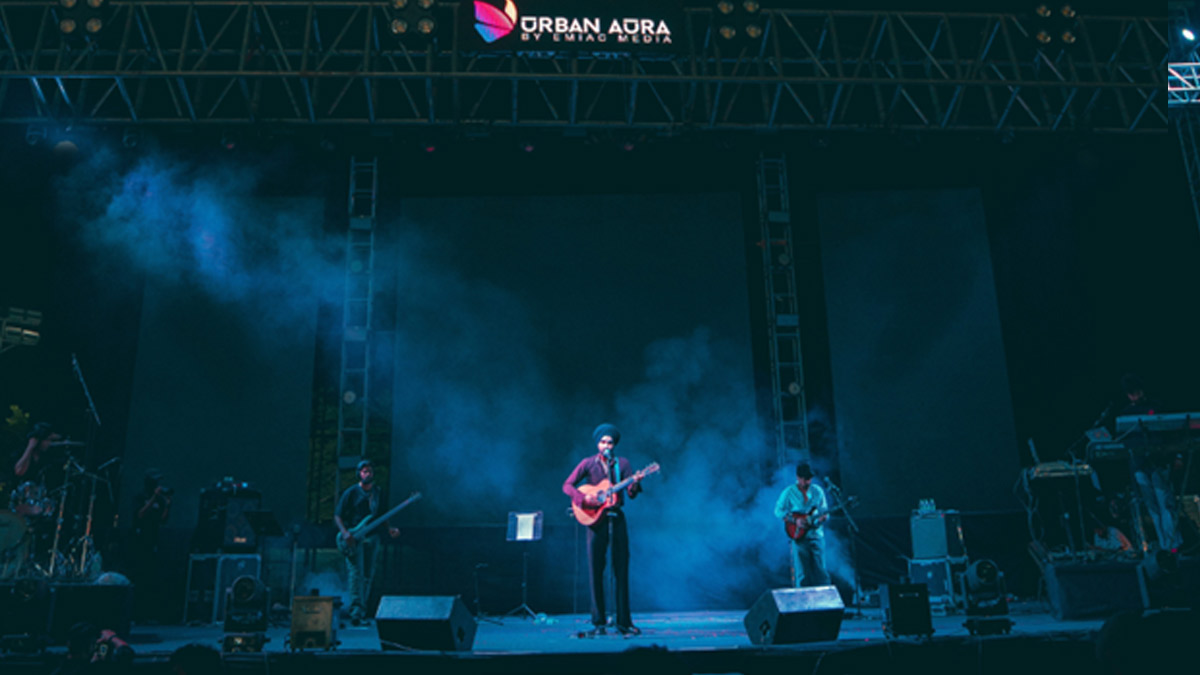
In a music industry that often rewards speed, spectacle, and instant recall, Navjot Ahuja’s journey feels refreshingly different. His story is not built on noise. It is built on patience, discipline, emotional honesty, and a quiet commitment to becoming better with every passing year. After 14 years of struggle, learning, performing, and writing, Navjot stands today as an artist whose success has not changed his centre. If anything, it has only made his purpose clearer.
For Navjot, music has never been about chasing fame alone. It has always been about expression. It is about writing more truthfully, singing more skillfully, understanding himself more deeply, and becoming a kinder human being in the process. That rare clarity is what gives his journey its beauty.
Where It All Began: A Writer Before a Singer
Indian singer and songwriter Navjot Ahuja’s musical journey began in the most familiar of places: school assemblies. But even then, what was growing inside him was not only the desire to sing. It was the need to write.
Long before he saw himself as a performer, he had already discovered the emotional release that writing offered him. For Navjot, words became the first true channel for feeling. Songwriting came before singing because writing was the only way he could let emotions flow through him fully. That inner pull shaped his artistic identity early on.
Like many young musicians, he sharpened his craft by creating renditions of popular songs.
Those experiments became his training ground. But the turning point came in 2012, when he wrote his first original song. That moment did not just mark the beginning of songwriting. It marked the beginning of self-definition.
A Calling He Did Not Chase, But Accepted
What makes the latest Indian singer-songwriter Navjot’s story especially compelling is the way he describes his relationship with music. He does not frame it as a career he aggressively pursued. In his own understanding, music was not something he chose. It was something that chose him.
There was a time when he imagined a very different future for himself. He wanted to become a successful engineer, like many young people shaped by ambition and conventional expectations. But life had a different script waiting for him. During his college years, around 2021, music entered his life professionally and began taking a firmer shape.
That shift was not driven by image-building or industry ambition. It came from acceptance. Navjot embraced the fact that music had claimed him in a way no other path could. That sense of surrender continues to define the artist he is today.
An Artist Guided by Instinct, Not Influence
Unlike many singers who speak openly about idols, icons, and musical role models, Navjot’s creative world is built differently. He does not believe his music comes from imitation or inherited influence. He listens inward.
He has never considered himself shaped by ideals in the traditional sense. In fact, he admits that he does not particularly enjoy listening to songs, especially his own. His decisions as a songwriter and singer come from instinct. He writes what feels right. He trusts what his inner voice tells him. He positions his music according to what he honestly believes in, not what trends demand.
That creative independence gives his work a distinct emotional sincerity. His songs do not feel calculated. They feel alive.
The Long Years of Invisible Struggle

Every artist carries a chapter of struggle, and Navjot’s was long, demanding, and deeply formative. One of the biggest challenges he faced was building continuity as the best new indian singer songwriter in an era where musical collaboration is increasingly fluid.
For emerging singers, especially those trying to build with a band, consistency can be difficult. Instrumentalists today have more opportunities than ever to freelance and perform with multiple artists. While that growth is positive and well deserved, it can make things harder for singers who are still trying to establish a steady team and sound around their work.
For Navjot, one of the most difficult phases came during 2021 and 2022, when he was doing club shows almost every day. It was a period of relentless performance, but not always personal fulfillment. He was largely singing covers because clubs were not open to original songs that audiences did not yet know.
For a new Indian singer and songwriter, that can be a painful compromise. To perform constantly and still not have the freedom to share your own voice requires not just resilience, but restraint.
“Khat” and the Grace of Staying Unchanged
After 14 years of effort, Navjot’s new love song Khat became a defining milestone. Professionally, he acknowledges that the song changed how society viewed him as a musician. It strengthened his place in the public eye and altered his standing in meaningful ways.
Yet personally, he remains unchanged.
That is perhaps the most striking part of his story. Navjot says his routine is still the same. His calm is still the same. His writing process is still the same. He does not want success or failure to interfere with the purity of his art. For him, emotional detachment from public outcomes is essential because the moment an artist becomes too attached to validation, the writing begins to shift.
His joy comes not from numbers, but from the attempt. If he has tried to improve his skill today, if he has written his heart out more honestly than before, then he is at peace.
Growth, Not Glory, Remains the Real Goal
Even now, Navjot is not consumed by labels such as singles artist, performer, or digital success story. His focus remains deeply personal. He wants to sing better. He wants to play instruments better. He wants to understand himself more. And he wants to become a kinder person.
That is what makes Navjot Ahuja’s journey so moving. It is not simply the story of a musician finding recognition. It is the story of an artist who continues to grow inward, even as the world begins to look outward at him. In an age obsessed with applause, Navjot reminds us that the most meaningful success often begins in silence, honesty, and the courage to remain true to oneself.






