News Broadcasting
Harvard Business School, India Today Group to launch South Asian edition of HBR


NEW DELHI: Harvard Business School Publishing Corporation and The India Today Group today announced a partnership to publish Harvard Business Review South Asia, an English-language edition of the world’s most influential business management magazine.
Harvard Business Review South Asia will run the same editorial content as the flagship U.S. edition and will include regional advertising. This will mark the 12th edition of the magazine. Collectively, Harvard Business Review’s English-language and translated editions reach nearly half a million readers worldwide.
Thomas A. Stewart, editor and managing director of Harvard Business Review, was quoted in an official statement as saying, “India is the world’s second’s fastest growing economy and boasts one of the world’s most dynamic and innovative business communities.”

He added that his company was “delighted by this partnership” as it is important for HBR to be on the ground in India as her contributions to “world business and management thinking increase.”
Aroon Purie, editor-in-chief of the India Today Group, said: “India has an enormous appetite for the kind of authoritative business content that HBR uniquely delivers. To keep pace with the competitive demands of an increasingly complex global economy, South Asian business leaders are looking for cutting-edge insights and tools to take their companies and their careers to new levels of performance.”
The premier issue of HBR South Asia will be launched at a special event in Mumbai on 16 October 2006, featuring a panel discussion with HBR editor Thomas Stewart and CEOs of India’s leading companies.
Harvard Business Review (www.hbr.org) is a leading monthly magazine of management thought and practice.
The magazine has a worldwide circulation of 242,000. Based in Boston, Massachusetts, Harvard Business Review is a business unit of Harvard Business School Publishing, a wholly owned, not-for-profit subsidiary of Harvard University.
In addition to HBR, HBSP’s offerings include books from Harvard Business School Press, newsletters like Harvard Management Update and the Balanced Scorecard Report, conferences, management development programs and services, and case studies from Harvard Business School and other leading academic institutions around the world.
Raymond Carvey, executive vice president and Chief Operating Officer of Harvard Business School Publishing, said: “Reaching the business leaders of India and greater South Asia is an important objective for Harvard Business School Publishing as we strive to bring our content to new markets and audiences around the world.”
He added that partnering with the India Today Group would help them in understand better and serve the needs and interests of those who are driving the rapid growth of this “vital (Indian) economy.”
Since its founding in 1922, Harvard Business Review has bridged the worlds of academia and business by publishing groundbreaking ideas from experts at the forward edge of management and leadership practice, in a format that businesspeople can apply in their own careers and companies.
The ideas published in HBR have wide-ranging impact, influencing strategy at leading corporations, setting the terms of management debate and discussion, and inspiring business leaders.
The India Today Group is India’s leading, diversified media group with interests in magazine, newspaper, television, radio, Internet and book publishing. It is India’s largest magazine publisher with print titles in the current affairs, general interest, lifestyle and business segments.
Speaking on this new partnership, Ashish Bagga, CEO of the India Today Group, said: “As the country’s largest magazine publisher, identifying niche segments and launching leading international media brands is an integral part of the growth strategy of the India Today Group.”
The India Today Group has successful licensing partnerships to publish other leading global media brands such as Reader’s Digest, Cosmopolitan, Golf Digest, Men’s Health, Good Housekeeping and Scientific American in India. In addition, the Group also represents the leading magazines Time and Fortune.
The November issue line up will include Harvard Business School professor Rosabeth Moss Kanter on innovation, Wharton School professor Michael Useem on governance, and HBS professor Andrew McAfee on information technology.






News Broadcasting
Network18 channels lead YouTube news viewership in March 2026
CNN-News18, News18 India and CNBC channels top categories with record views
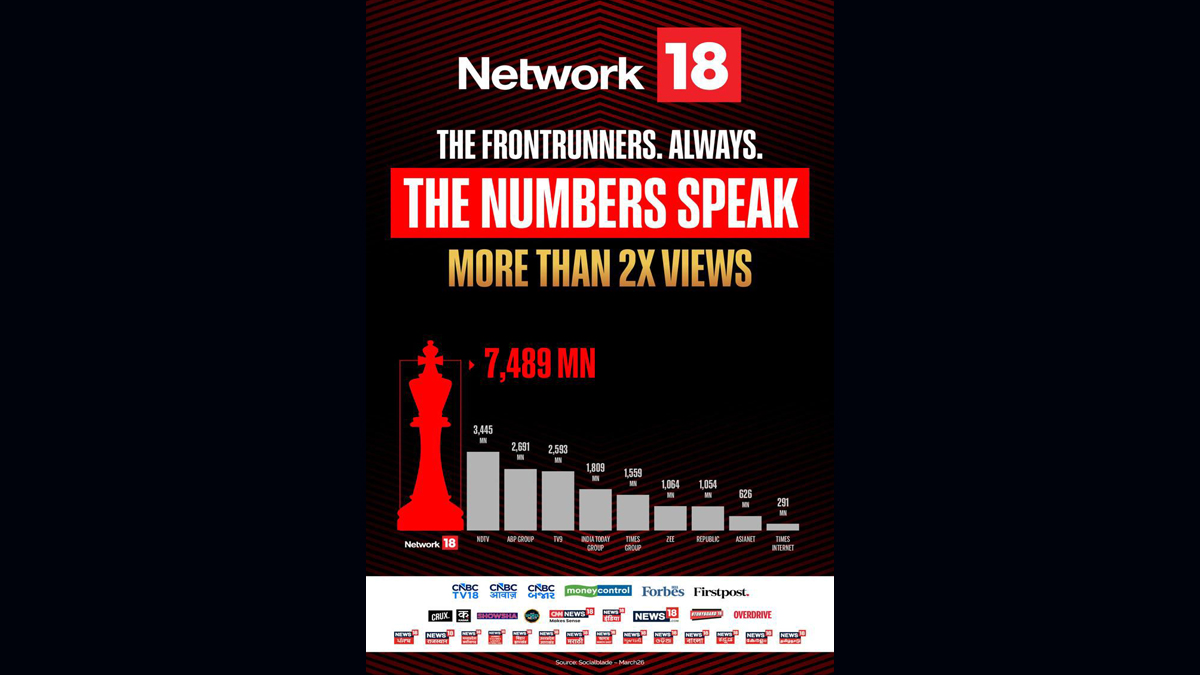
MUMBAI: When the world hit refresh on breaking news, Network18’s channels were already streaming ahead. As geopolitical tensions and war-driven headlines fuelled a surge in global news consumption, the network’s digital playbook delivered big clocking record Youtube viewership across English, Hindi and business news categories in March 2026.
At the forefront was CNN-News18, which emerged as the clear leader in the English news segment with 130 million live and video-on-demand views. The channel edged past competitors such as Times of India (126.5 million), Times Now (101.1 million), India Today (88.2 million) and NDTV (77.5 million), according to Databeings data for March.
In the Hindi news arena, News18 India delivered a commanding performance, racking up a staggering 3,297 million views on YouTube. The channel comfortably outpaced NDTV India, which recorded 3,119 million views, underlining its deep reach and consistent engagement with mass audiences, as per Playboard data.
The network’s dominance wasn’t confined to general news. In the Hindi business segment, CNBC Awaaz topped the charts with 92 million views, narrowly ahead of Zee Business (90 million) and well ahead of ET Now Swadesh (57 million). Meanwhile, its English counterpart CNBC-TV18 posted a strong 58 million views, reinforcing the network’s cross-category strength.
The spike in viewership reflects a broader shift in audience behaviour, with viewers increasingly turning to digital platforms particularly Youtube for real-time updates and in-depth coverage during high-intensity news cycles. For Network18, the numbers signal more than just scale; they underline the effectiveness of a multi-platform strategy that blends speed, credibility and continuous coverage.
In a month where the news never paused, it seems viewers chose to stay tuned where the stream never stopped.






