News Headline
GUEST COLUMN: How regional cinema outgrew Hindi cinema in 2025


CHENNAI: The lights dimmed 1,460 times across India in 2025, and audiences showed up in force. Indian cinema did not just survive the year, it thrived, roaring through twelve months with a gross of Rs 11,450.58 crore and a net collection of Rs 9,734.43 crore. These are not recovery numbers. This is resurgence, pure and unfiltered, with footfalls that suggest the multiplex doomsayers got it spectacularly wrong.
What makes 2025 remarkable is not merely the scale of box-office takings. It is the tectonic shift in where those rupees came from. The old Hindi-dominance model is crumbling, and in its place stands something far more interesting: a genuinely polycentric industry where regional powerhouses compete on equal terms, cross-cultural storytelling reigns, and pan-India releases have rewritten the rules of commercial cinema.
Hindi cinema still commands the largest single haul, Rs 3,978.01 crore net from 220 releases, and continues to dominate urban markets with its blend of content-driven narratives and mainstream spectacle. From multiplexes in Mumbai to single screens in tier-two cities, Hindi films delivered what audiences wanted: scale, star power and stories that could travel. But volume tells a different story. With just 220 releases compared to the south’s flood of product, Hindi cinema’s per-film average remains impressive. Yet the gap is narrowing.

Telugu cinema released 261 films in 2025, generating Rs 1,845.77 crore net. This is the industry that perfected the pan-India blockbuster formula: mass entertainers with interval blocks that send audiences into raptures, stars who command cult followings across state lines, and action sequences choreographed with military precision. Telugu producers understand something fundamental: spectacle travels better than subtlety. The result is an industry that punches well above its linguistic weight, with films routinely opening nationwide and occasionally even making noise internationally.
Tamil cinema contributed Rs 1,506.80 crore from 269 releases, maintaining its reputation for marrying cultural authenticity with technical excellence. Whether it is socially conscious dramas, edge-of-seat thrillers or grand historical epics, Tamil filmmakers have mastered the art of making films that feel distinctly rooted yet widely accessible. The industry’s technical sophistication, its sound design, visual effects work and cinematography, sets benchmarks that others scramble to match.
If 2025 has a breakout story, it is Malayalam cinema. With Rs 857.74 crore net from just 173 films, Kerala’s industry delivered the year’s most impressive per-film average. This is content cinema firing on all cylinders: tight scripts, naturalistic performances, and stories that do not pander or patronise. What began as a regional phenomenon has metastasised into national influence, with Malayalam films increasingly securing all-India releases and OTT platforms snapping up rights before cameras even roll.
The Malayalam model offers a blueprint for sustainable success. Make films that respect audience intelligence, keep budgets lean, prioritise story over star salaries, and trust that quality will find its audience. It is working. While other industries chase the Rs 200 crore opening weekend, Malayalam cinema builds slowly, holds strongly, and generates genuine word-of-mouth. The result is an industry that has become creatively bulletproof and commercially resilient.
Kannada cinema added Rs 379.34 crore from 228 releases, continuing its trajectory of growth fuelled by fierce regional pride and raw, unvarnished storytelling. The industry’s challenge remains breakout success beyond Karnataka, but the fundamentals are strengthening. Marathi cinema’s Rs 75.77 crore from 95 films suggests a market hungry for its next *Sairat*-level phenomenon. The audience is there, the cultural richness is undeniable, and all it needs is the right film at the right moment.
English-language films, predominantly Hollywood imports, collected Rs 601.64 crore net from 136 releases. It is respectable but hardly transformative. American studios maintain their metro foothold, with superhero franchises and big-ticket releases performing as expected in multiplexes across major cities. But expansion remains elusive. Beyond the urban elite and English-speaking middle class, Hollywood’s India story has stalled. The numbers suggest comfort rather than conquest.
Strip away the triumphalism and 2025’s box-office performance reveals several uncomfortable truths alongside the celebration. First, theatrical exhibition is not dead, but it is bifurcated. Big films with scale and spectacle draw crowds; mid-budget films increasingly struggle to justify theatrical costs when streaming offers better economics. The gap between hits and misses has widened into a chasm.
Second, regional industries are not merely catching up, they are redefining what Indian cinema means. The pan-India release model has demolished linguistic barriers that once seemed permanent. A Telugu film can now open simultaneously in Hindi, Tamil, Kannada and Malayalam, with dubbed versions performing as strongly as originals. This is not cultural homogenisation; it is cultural exchange at industrial scale.
Third, OTT platforms have fundamentally altered audience expectations and industry economics. Streaming services prime audiences for diverse content, provide crucial secondary revenue streams, and increasingly co-finance production. The hybrid model, theatrical release followed by streaming premiere, has become standard practice, with platforms paying premium rates for hot properties.
Fourth, the sheer volume of releases, 1,460 films across languages, points to chronic oversupply. Not every film deserves or can sustain a theatrical release, yet the production pipeline keeps churning. Many releases sink without trace, playing to empty halls for contractually obligated minimum runs before vanishing into streaming obscurity.
If current momentum holds, Indian cinema could breach Rs 15,000 crore gross before year’s end. But sustainability requires more than box-office bravado. The industry needs better theatrical windowing strategies, rationalised production volumes, and infrastructure investment in tier-two and tier-three cities where growth potential remains untapped.
The future belongs to filmmakers who understand that audiences, whether in Kerala or Kansas, Hyderabad or Hounslow, respond to authenticity and ambition in equal measure. Regional industries must keep pushing boundaries while Hindi cinema figures out how to compete when it no longer owns the advantage of scale. Hollywood will continue collecting its metro rents, but genuine market expansion seems unlikely without radically rethinking content strategies for Indian sensibilities.
What is certain is this: Indian cinema in 2025 proved it could deliver spectacle and substance, commerce and craft, in volumes that matter. The curtain has not fallen on this industry’s golden age. The real show is only beginning.
The author is the founder and managing director of South Screens Media Works Pvt Ltd. The views expressed in this article are the author’s own and indiantelevision.com need not subscribe to them.







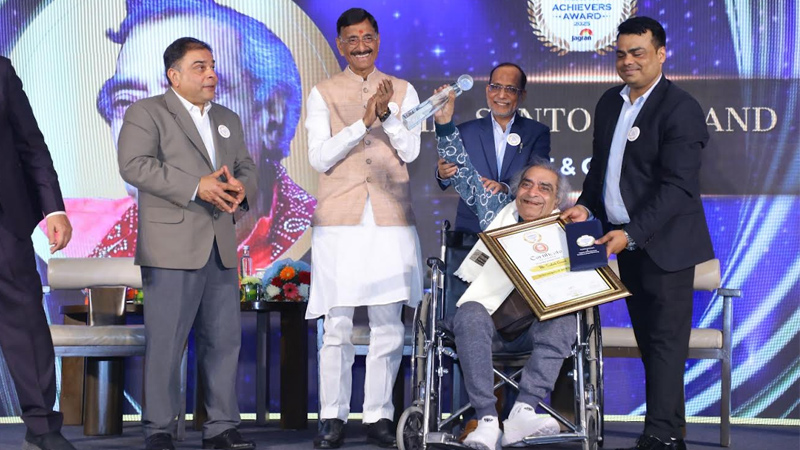
NEW DELHI: Hamdard Laboratories gathered a cross-section of India’s achievers in New Delhi on Friday, handing out the Hakeem Abdul Hameed Excellence Awards to figures who have left their mark across healthcare, education, sport, public service and the arts.
The ceremony, attended by minister of state for defence Sanjay Seth and senior officials from the ministry of Ayush, celebrated individuals whose work blends professional success with a sense of public purpose. It was as much a roll call of achievement as it was a reminder that influence is not measured only in profits or podiums, but in people reached and lives improved.
Among the headline awardees was Alakh Pandey, founder and chief executive of PhysicsWallah, recognised for turning affordable digital learning into a mass movement. On the sporting front, Arjuna Awardee and kabaddi player Sakshi Puniya was honoured for her contribution to the game and for pushing women’s participation onto bigger stages.
The cultural spotlight fell on veteran lyricist and poet Santosh Anand, whose songs have echoed across generations of Hindi cinema. At 97, Anand accepted the honour with characteristic humility, reflecting on a life shaped by perseverance and hope.
Healthcare honours spanned both modern and traditional systems. Manoj N. Nesari was recognised for strengthening Ayurveda’s place in national and global health frameworks. Padma shri Mohammed Abdul Waheed was honoured for his research-backed work in Unani medicine, while padma shri Mohsin Wali received recognition for his long-standing contribution to patient-centred care.
Education and social development also featured prominently. Padma shri Zahir Ishaq Kazi was honoured for decades of work in education, while former Meghalaya superintendent of Police T. C. Chacko was recognised for public service. Goonj founder Anshu Gupta received an award for his dignity-centred rural development initiatives, and the Hunar Shakti Foundation was honoured for empowering women and young girls through skill development.
The Lifetime Achievement Award went to former IAS officer Shailaja Chandra for her long career in public healthcare and governance, particularly in the traditional systems under Ayush.
Speaking at the event, Hamdard chairman Abdul Majeed said the awards were a tribute to those who combine excellence with empathy. “These awardees reflect Hakeem Sahib’s belief that healthcare, education and public service must ultimately serve humanity,” he said.
Minister Seth struck a forward-looking note, saying India’s young population gives the country a unique opportunity to become a global destination for learning, health and wellness by 2047.
The ceremony also featured the trailer launch of Unani Ki Kahaani, an upcoming documentary starring actor Jim Sarbh, set to premiere on Discovery on 11 February.
Instituted in memory of Unani scholar and educationist Hakeem Abdul Hameed, the awards have grown into a national platform that celebrates those building a more inclusive and resilient India. For one evening at least, the spotlight was not just on success, but on service with substance.






