DTH
GTPL Hathway is gearing up to make a major HIT

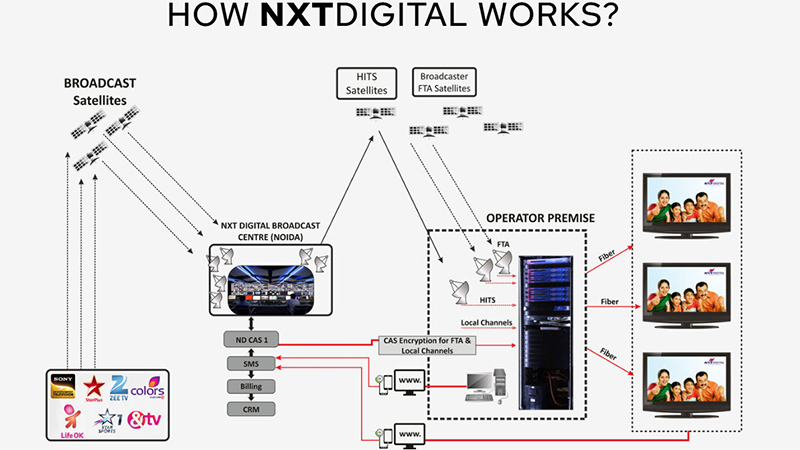
MUMBAI: In India’s noisy and fragmented cable TV business, where margins are wafer-thin and infrastructure is patchy, a quiet revolution is taking place above our heads. Quite literally. India’s largest cable and broadband heavyweight ) GTPL Hathway is choosing to break free from the grid by betting Rs 100 crore on a satellite-led future—launching a full-scale headend-in-the-sky (HITS) operation designed to reach the parts of India that cable lines and fibre have long ignored.
This isn’t just an upgrade—it’s a strategic reinvention. One that could upend the rules of TV distribution across Bharat.
From a sleek new uplink facility in Ahmedabad, GTPL is readying to transmit up to 900 encrypted, multiplexed channels using 12 leased C-band transponders from Indonesian satellite operator Telkomsat. The satellite signal is then beamed directly to local cable operators (LCOs), who deliver the final mile using existing coaxial or fibre lines.

It’s a model that minimises capital investment on the ground while maximising reach—especially in India’s 130–135 million “TV-dark” homes, a figure larger than the total households of Japan and the UK combined.
GTPL’s move brings it squarely into competition with the Hinduja-owned Nxt Digital, India’s sole HITS player until now, with a subscriber base of 2.4 million. Nxt has played a steady game—providing shared uplink infrastructure, cost-effective Cope (cable operator premises equipment) units priced between Rs 10.6–14 lakh, and STBs from Chinese OEMs like Changhong and Telesystems.
Its model helped reduce per-subscriber costs dramatically—from Rs 17 to just Rs 7 in some cases—offering a lifeline to smaller MSOs (multi-system operators) struggling to comply with the regulatory shift to digital. But Nxt’s footprint, while impactful, has remained modest.
GTPL is playing a different hand: scale. With 9.6 million cable TV subscribers already on its rolls and strongholds in Gujarat, Maharashtra, West Bengal and Bihar, the company intends to transition its entire base to HITS delivery over the next 24–36 months.
The vision? To be India’s largest HITS network—leapfrogging not only NXT, but also traditional satellite and cable architectures in one swoop.
This pivot is part of GTPL’s broader Rs 350 crore capex outlay for FY25, which also includes new broadband infrastructure and set-top boxes. The numbers make a compelling case: annual bandwidth costs, currently pegged at Rs 85–90 crore, are expected to drop by half.
Projected revenues from the satellite platform are equally promising. At 750,000 subscribers, GTPL expects to generate Rs 99 crore annually. That rises to Rs 132 crore with 1 million users. Add Rs 12 crore more from leasing infra services to 50 smaller MSOs (each paying Rs 2 lakh per month), and the business case becomes hard to ignore. Even under conservative adoption rates, the Rs 100 crore investment could be recouped within 12 months.
GTPL’s HITS play isn’t just about broadcast—it’s also about backend tech. The company is deploying a hybrid business model: retailing bundled TV channel packs to consumers via LCOs while offering platform-as-a-service tools to smaller MSOs. These include uplinking, encryption, conditional access system (CAS) and subscriber management system (SMS) solutions—effectively turning GTPL into a SaaS player for the cable industry.
In a sector plagued by fragmentation, opaque billing, and outdated infrastructure, this modular model could be just the reset smaller operators need to stay compliant, competitive, and cost-efficient.
India’s content delivery puzzle has long had three flawed pieces. OTT remains hobbled by poor last-mile broadband in rural areas, with even state-run BharatNet struggling to scale. DTH, while more pervasive, has long suffered from weather interference, installation costs, and churn. Cable TV, once the lifeline of urban India, is now chafing under regulatory pressure and infrastructure bottlenecks.
Enter HITS—a model that combines the robustness of satellite delivery with the flexibility of LCO-based distribution. It’s weather-resistant, quick to deploy, and doesn’t require laying new wires in hard-to-reach zones.
As a middle path, HITS may well become the delivery standard for Bharat—the vast, value-driven, and still under-connected expanse of Indian television.
Surprisingly, GTPL’s skyward expansion has not been met with resistance. The All India Digital Cable Federation (AIDCF) has raised concerns around broader issues like OTT content regulation and fair play by broadcasters—but not specifically about the HITS model. Major networks such as Zee, Sony, and Disney Star have voiced concerns over the pricing dynamics introduced under TRAI’s NTO 3.0 framework, but formal objections to GTPL’s satellite platform are absent.
The company, for its part, holds a valid grant of permission agreement (GOPA) from the ministry of information & broadcasting (MIB) and has participated in various TRAI and MIB consultations, signalling alignment with the regulatory ecosystem.
GTPL’s pricing strategy will be region-specific, with affordability and adaptability built in. Final LCO-facing Cope and channel package rates will be finalised once broadcasters declare new pay channel prices. While margins may initially be tight, the long-term play is rooted in volume, retention, and backend monetisation.
This isn’t a short-term stunt—it’s a structural realignment of India’s content delivery infrastructure.
GTPL’s satellite push is more than just a tech upgrade—it’s a masterstroke of timing, vision, and market understanding. With one eye on underserved consumers and the other on the backend tech stack, the company is positioning itself as both a broadcaster and a platform.
As India’s media future heads skyward, GTPL’s HITS move may well become the blueprint for digital inclusion across Bharat.
(If you are an Anime fan and love Anime like Demon Slayer, Spy X Family, Hunter X Hunter, Tokyo Revengers, Dan Da Dan and Slime, Buy your favourite Anime merchandise on AnimeOriginals.com.)


DTH
Prasar Bharati’s WAVES earns Rs 2.9 crore in first year
Platform scales content, users but monetisation gaps limit revenue growth.
MUMBAI: Big waves, small ripples at least for now. When Prasar Bharati launched its OTT platform WAVES at the 55th International Film Festival of India in November 2024, it pitched a bold vision: a homegrown rival to global and domestic streaming giants, blending video, audio, gaming and commerce into a single digital ecosystem. Five months into FY2024–25, however, the platform’s revenue stands at just Rs 2.90 crore, a figure that underscores the gap between ambition and monetisation.
On paper, WAVES looks anything but modest. The platform has ingested 13,608 titles, totalling 9,495 hours of content, with over 13,000 titles already live. It has streamed more than 575 live events from the Mahakumbh Amrit Snan and the 76th Republic Day parade to the Hockey India League, Kabaddi World Cup and Mann Ki Baat while offering 74 live TV channels and 12 radio channels. With over 10 lakh registered users and more than 200 content partners onboarded, the scale resembles that of a fully operational streaming service rather than a pilot project.
The architecture supporting this scale is equally robust. Built under Prasar Bharati’s Central Archives vertical, WAVES runs on a cloud-based infrastructure with DRM, encryption and an integrated analytics dashboard. It includes dedicated units for content ingestion, quality control, publishing, graphics, marketing and billing, and is distributed across platforms such as OTTplay, Tata Play and BSNL. The offering extends beyond video to include audio-on-demand, e-games and even e-commerce via ONDC integration.
Yet, the numbers reveal a core disconnect. Despite its scale, WAVES generated just Rs 2.90 crore in a market where India’s OTT industry crossed Rs 23,000 crore in 2024. A key bottleneck lies in monetisation infrastructure: subscriptions cannot currently be purchased within the app and must be completed via an external website. In a mobile-first country where over 95 per cent of OTT consumption happens on smartphones, this extra step creates friction that most users are unlikely to overcome.
Ironically, content is not the problem, it is the platform’s biggest strength. Prasar Bharati holds one of the world’s richest broadcast archives, including 45,154 hours of digitised Akashvani programming and 35,723 hours from Doordarshan. For WAVES alone, over 3,800 hours of archival content have been made OTT-ready, including classics such as Ramayan and Shaktimaan, alongside rare cultural recordings and historical broadcasts.
There are early signs that this library holds commercial potential. Revenue from archival content licensing rose sharply to Rs 3.38 crore in FY24, up from Rs 67 lakh the previous year. Meanwhile, free digital platforms continue to drive massive reach, the PB Archives Youtube channel clocked 119.78 million views and added 4,02,000 subscribers in FY2024–25, crossing 1.7 million in total, while DD News has over 5.84 million subscribers.
That, however, presents a strategic dilemma. While free distribution builds scale, it also conditions audiences to expect content at zero cost making it harder to transition to paid models. WAVES, designed as a hybrid AVOD-SVOD platform with advertising and subscription layers, is yet to fully crack this balance.
The broader challenge is not technological but strategic. In an ecosystem dominated by platforms offering seamless payments, aggressive pricing and high-budget originals, WAVES is still bridging the gap between being a content repository and a commercially viable product.
For now, the platform reflects both promise and paradox. It has the scale, the content and the infrastructure but until monetisation catches up, WAVES remains less a revenue engine and more a digital showcase of what India’s public broadcaster could become.






