News Broadcasting
Govt ultimatum to channels on downlink norms


NEW DELHI: The Indian government has issued an ultimatum to all TV channels that those failing to adhere to downlink norm deadline of 10 May will not be allowed to downlink into the country.
In a statement issued on 3 May, the government has said, “It is clarified that (television) channels for which even complete applications, with processing fees, are not received on or before May 10, 2006, shall not be permitted to be downlinked thereafter.”
The information and broadcasting ministry has come out with clarifications on various queries on the policy guidelines for downlinking of television channels in India on its website.

The guidelines stipulate a time of 180 days from 11 November 2005 for completion of all formalities of registration under downlinking guidelines.
On queries relating to foreign direct investment (FDI) permitted in television ventures, the government statement states that 100 per cent FDI is permitted in the broadcasting sector, which is not under the automatic route and all such proposals will have to be routed through the Foreign Investment Promotion Board (FIPB).
The government has also clarified that as on the date of submission of application for permission under downlinking guidelines, the applicant company must have requisite net worth and continue to satisfy the requirement thereafter.
The information and broadcasting ministry had earlier stipulated different net worth of television companies as per categories, namely entertainment, news, etc, in an effort to differentiate between the serious and non-serious players.
The downlink guidelines state that all TV channels wishing to be downlinked into the country would have to get themselves registered with a designated authority and also establish a permanent establishment, amongst some other stipulations that have been dubbed stringent by some media companies.
For example, the government reiterated on Wednesday that an applicant company is required to provide a facility where online monitoring of content being beamed into India is possible.
Also, the system should have the capacity to store data for 90 days, which should be available to the government at any point of time in India at a pre-designated place.
The companies need not set up new facilities for this purpose, but could authorize any of their multi service operators (MSOs) or head end operators to provide this facility, the ministry has clarified.
The government has shot off letters relating to various queries on downlink norms to the Indian Broadcasting Foundation, Star Group and Time Warner, according to information posted on the site of the I&B ministry.
Earlier in March, the government had turned down a request from the Indian Broadcasting Foundation to extend the 180-day deadline for fulfilling newly-formulated downlinking norms by broadcasting companies.
Indiantelevision.com has learnt from government sources that Star group, for instance, has applied under downlink norms for various family channels separately.






News Broadcasting
Network18 channels lead YouTube news viewership in March 2026
CNN-News18, News18 India and CNBC channels top categories with record views
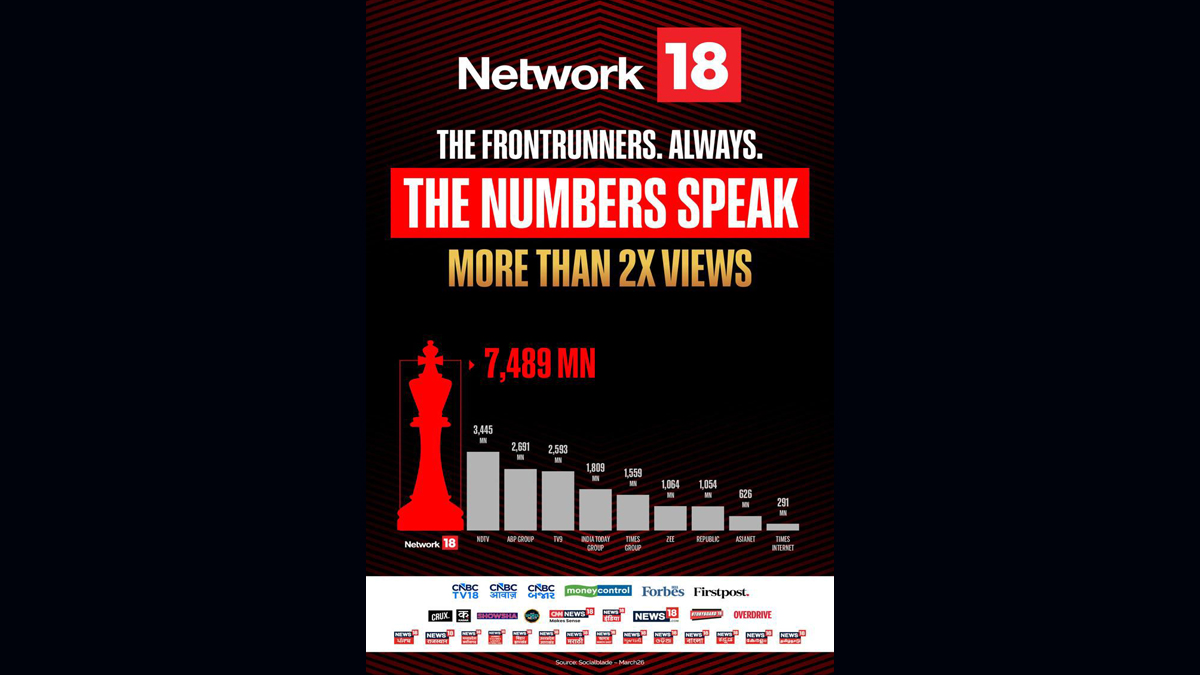
MUMBAI: When the world hit refresh on breaking news, Network18’s channels were already streaming ahead. As geopolitical tensions and war-driven headlines fuelled a surge in global news consumption, the network’s digital playbook delivered big clocking record Youtube viewership across English, Hindi and business news categories in March 2026.
At the forefront was CNN-News18, which emerged as the clear leader in the English news segment with 130 million live and video-on-demand views. The channel edged past competitors such as Times of India (126.5 million), Times Now (101.1 million), India Today (88.2 million) and NDTV (77.5 million), according to Databeings data for March.
In the Hindi news arena, News18 India delivered a commanding performance, racking up a staggering 3,297 million views on YouTube. The channel comfortably outpaced NDTV India, which recorded 3,119 million views, underlining its deep reach and consistent engagement with mass audiences, as per Playboard data.
The network’s dominance wasn’t confined to general news. In the Hindi business segment, CNBC Awaaz topped the charts with 92 million views, narrowly ahead of Zee Business (90 million) and well ahead of ET Now Swadesh (57 million). Meanwhile, its English counterpart CNBC-TV18 posted a strong 58 million views, reinforcing the network’s cross-category strength.
The spike in viewership reflects a broader shift in audience behaviour, with viewers increasingly turning to digital platforms particularly Youtube for real-time updates and in-depth coverage during high-intensity news cycles. For Network18, the numbers signal more than just scale; they underline the effectiveness of a multi-platform strategy that blends speed, credibility and continuous coverage.
In a month where the news never paused, it seems viewers chose to stay tuned where the stream never stopped.






