News Broadcasting
Govt to heed KPMG suggestions on entertainment sector

NEW DELHI: The Indian government will consider the suggestions made in the FICCI-KPMG report titled “The Indian entertainment sector – in the spotlight” while formulating policies.
Replying to a question by Dr M V V S Murthi and others in India’s Lower House of Parliament (Lok Sabha) today, minister of information & broadcasting Ravi Shankar Prasad said that many of the suggestions are focussed on the industry for action.
The minister said the report suggests that the film industry needs to transcend from being a simple unorganized, creative pursuit to an organized business that encourages and nurtures creativity and makes commercial sense. The strengthening of the cable and satellite dominance and increasing focus on subscription revenues together with the Conditional Access System (CAS) hold promise for the future growth of the Indian television industry.

To sustain healthy growth, the report recommends that the music industry in India, which is still at a nascent stage, needs to revamp the way it operates, with support from the key players and also evolve new revenue streams to hedge risks. The corporatisation in the film industry is expected to have a catalytic effect on the music industry, which would move increasingly towards a revenue sharing model, the minister said.
IMPROVEMENT OF DD PROGRAMMES
Doordarshan has taken a number of steps for improving the production of in-house programmes, the minister said in reply to a question by Bhartruhari Mahtab.
The steps included setting up of a Creative Advisory Committee with eminent media personalities for quality-improvement/production presentation/packaging of programmes, setting up of a Development Communication Division dedicated to the production/telecast of social communication messages in a professional manner.
Prasad said that campaigns by Development Communication Division have resulted in quality/quantity improvement of in-house production, using Doordarshan’s creative talents and infrastructure.
The minister further said that nearly 43 per cent of the total transmission of programmes from various channels/State networks/production centres of Doordarshan is produced in-house. The minister informed that there are 59 studio centres of DD in the country besides OB vans, DGNGs/ENG units for production of programmes outside the studios.
DD is telecasting programmes, which contain a mixture of information, education and entertainment according to the mandate in the Prasar Bharati Act, 1990.






News Broadcasting
India Today Group sweeps top honours at Ramnath Goenka Awards
Journalists recognised for fearless investigative and civic reporting.
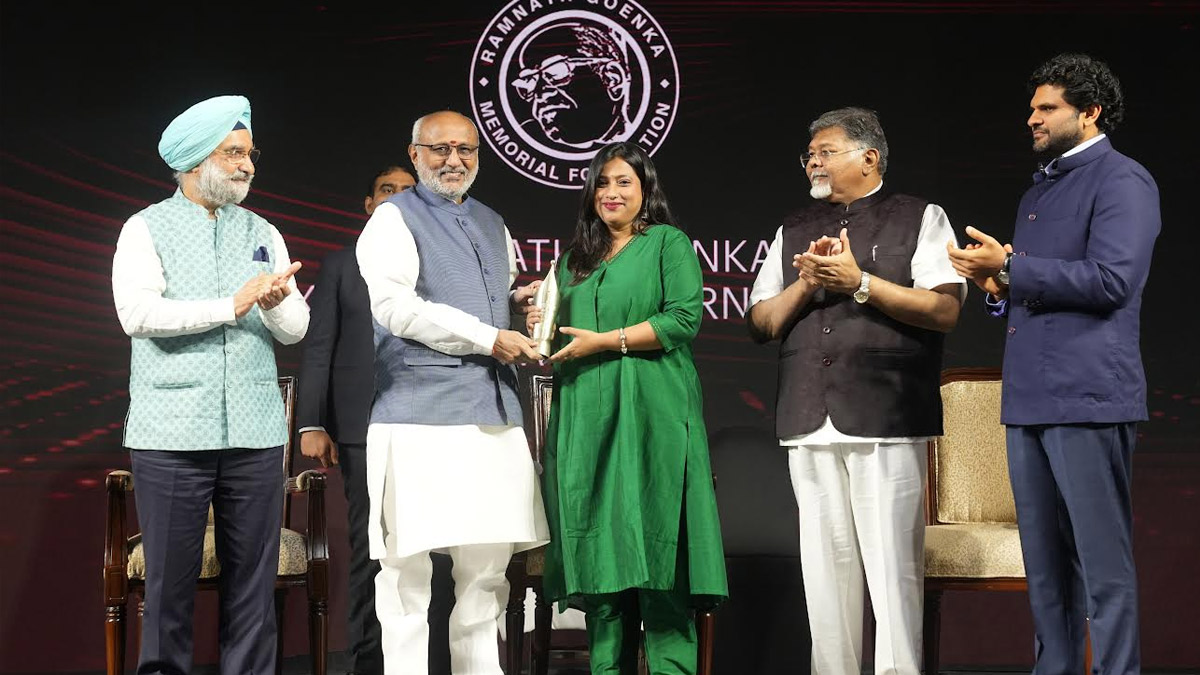
MUMBAI: India Today Group just turned the Ramnath Goenka Awards into its own trophy cabinet because when your reporters dig this deep, even the judges have to award a clean sweep. India Today Group journalists have secured multiple top honours at the latest edition of the prestigious Ramnath Goenka Excellence in Journalism Awards, reinforcing the network’s legacy as the gold standard of Indian journalism. The awards were conferred by vice president C. P. Radhakrishnan at a ceremony held on 27 March 2026.
Sreya Chatterjee won in the ‘Investigative Reporting – Broadcast’ category for her powerful India Today TV report ‘Operation Illegals: The Alarming Rise in Bangladeshi Infiltration Across India’s Fragile Eastern Frontier’. The investigation stood out for its depth, on-ground rigour and national relevance.
In the ‘Civic Journalism – Print/Digital’ category, Sreya Chatterjee along with Arvind Ojha were honoured for their indiatoday.in report on unregulated water extraction and the ‘Tanker Mafia’ in Delhi’s Bawana Industrial Area. The story exposed critical systemic gaps and environmental challenges affecting daily life.
Additionally, aajtak.in was recognised in the ‘Investigative Reporting – Print/Digital’ category for its hard-hitting exposé ‘The Surrogate Mother Market’, which highlighted the human, legal and ethical dimensions of the surrogacy ecosystem.
India Today Group emerged as the only network honoured in Investigative Journalism across both Print/Digital and Broadcast categories. The wins reflect the strength of its multi-platform newsroom and its unwavering commitment to credible, high-impact reporting that informs public discourse and drives accountability.
In an era when speed often trumps substance, these awards remind us that the most powerful stories are still the ones dug out with courage, told with clarity, and delivered with conscience, one fearless byline at a time.








