News Broadcasting
Govt. to consider separate content code for news broadcasters

NEW DELHI: The information and broadcasting ministry today agreed to consider a suggestion that news channels should not be guided by the content code drawn up for broadcasters. The code is to be put up on the website of the ministry by 1 July.
A meeting of officials of the ministry chaired by Secretary Asha Swarup today agreed to examine the need for a separate code for news channels.
The News Broadcasters Association said that the system of Channel Auditor under the proposed content code may not work in the case of news channels where speed is of the essence.

The officials examined the various suggestions received and shortlisted those which could be incorporated. The process of incorporating these will take a few days after which it will again be examined by the Secretary before being put on the website www.mib.nic.in.
Though some of the broadcasters feel imposition of a code amounts to policing and infringement of their freedom, the ministry is said to be clear that the only way the proposed Broadcast Services Regulation Bill can be implemented is through the content code.
After the final meeting of the Committee headed by Swarup on 1 June, it had been generally agreed that those members who wanted to give any further suggestions could do so by 15 June after which the final draft would be put up in the ministry website for people to send in their reactions.
I&B ministry sources today told Indiantelevision.com that most of the suggestions received from representatives of women’s organizations and NGOs were being incorporated. After the code is put on the website, there will be some meetings with broadcasters who have expressed strong reservations, and also a seminar wherein eminent citizens and stakeholders would be asked to give their views.
Broadcasters have objected to the procedure for redressal of complaints among other provisions. The code as drawn up stipulates a three-step procedure for self-regulation and redressal of complaints alleging violation of the programme or advertising codes.
The first forum to hear the complaints would be a Content Auditor at the level of the programme/service providers. In case a complaint is not suitably redressed, then it will go to the next stage – respective Consumers’ Complaints Committees set up at the industry-segment level organizations.
The third and final stage would be the Broadcast Regulatory Authority of India proposed in the comprehensive Broadcast Bill to be introduced in Parliament in the monsoon session.
Broadcasters have also expressed reservations about the provision in the draft Code that ‘the Chief Editor of the channel, by whatever designation he is known in the broadcast service producer, shall be responsible for the final decision to accept or modify the guidance given by the Content Auditor/s, and to schedule and broadcast the programme.’ They feel that whatever is broadcast should be seen as a corporate matter and not that relating to the Editor alone.
Some of the suggestions sought to be incorporated relate to making the nature of violations more specific, particularly with regard to portrayal of women, showing of violence and the role of children in the serials and other programmes including news bulletins.
The meeting today was attended among others by P N Vasanti from the Centre for Media Studies who along with her colleague Prawin Kumar prepared the draft Code.
The ministry is understood to have rejected the view that there is no need for a separate ‘U/A’ (Under the Supervision of an Adult) category and this should be merged in the category ‘U’ (Universal) as far as certification of films was concerned.
The Code as drafted stipulates that films certified as ‘U’ or ‘S’ (Specialized) can be telecast at any time. Films certified as ‘U/A’ can be shown between 8 pm and 4 pm, while films for ‘A’ (adult) audiences should only be telecast between 11 pm to 4 am.





News Broadcasting
CNN-News18 to host Fury in the Gulf conclave on West Asia crisis
Three-hour summit to unpack geopolitical fallout and impact on India

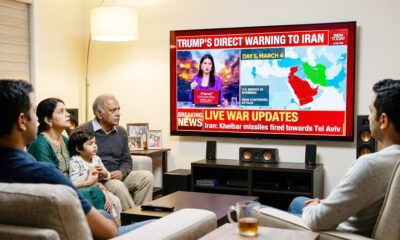
MUMBAI: CNN-News18 is set to host a special three-hour broadcast, Fury in the Gulf – War Conclave, on April 7, aiming to decode the escalating West Asia crisis and its far-reaching implications for India.
Scheduled from 4:00 PM to 7:00 PM, the conclave comes at a time when tensions between Iran and the United States are reshaping global geopolitics and triggering economic uncertainty. With India’s deep energy ties, trade links and large diaspora in the Gulf, the developments carry significant domestic relevance.
Built around the theme ‘Conflict, Consequences, and The Future,’ the programme will feature six curated sessions combining one-on-one interviews and panel discussions. The focus is to cut through the clutter and offer viewers a clearer understanding of the fast-evolving situation.
Key sessions include ‘Diplomacy in Times of War’ featuring Shashi Tharoor, and ‘World After the Iran Conflict’ with voices such as Ram Madhav, Reuven Azar, representatives from the European Union and the Iranian Deputy Envoy. Another session titled ‘Another Dunkirk?’ will bring together K. J. S. Dhillon and Jitin Prasada among others.
CNN-News18 editorial affairs director Rahul Shivshankar said, “In times of war, clarity becomes the most powerful tool. Fury in the Gulf – War Conclave brings together credible voices to address the questions and confusion that arise amid an overwhelming influx of information.”
He added that the initiative is aimed at delivering “facts, perspective, and insight” at a time when misinformation can easily cloud public understanding.
Echoing the sentiment, CNN-News18 CEO– English and business news Smriti Mehra said the conflict marks a defining global moment, with consequences that extend well beyond the region. She noted that the conclave seeks to present the crisis with “depth, nuance and responsibility” so audiences can better grasp its real-world impact.
As geopolitical tensions continue to dominate headlines, the conclave positions itself as an attempt to bring order to the noise, offering viewers a structured, insight-led look at a complex and rapidly shifting global situation.






