News Headline
Govt policies to help media & entertainment ecosystem to generate $53 billion annually by 2025: Anurag Thakur

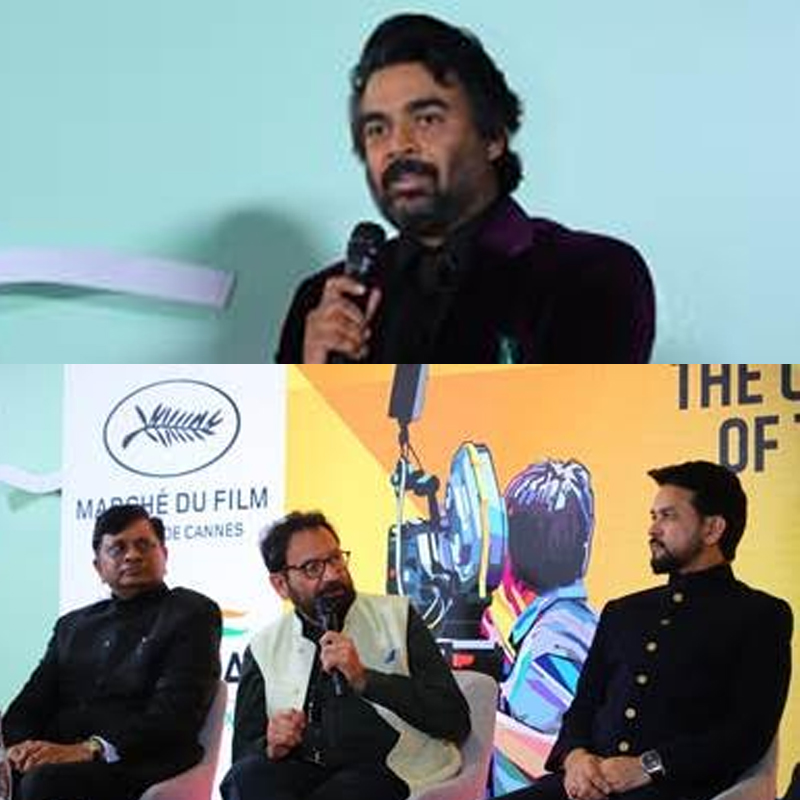
MUMBAI: In the next five years, India will be among the leading quality content producing nations across the globe. The government policies to help the media and entertainment ecosystem to generate $53 billion annually by 2025. There is an old rush amongst broadcasters as well as telcos to set up their own OTT platforms for India. The Indian government will take all measures to speed up co-production collaborations from around the world. The Union Minister of Information and Broadcasting Anurag Thakur said this while addressing the India Forum at the famous Palais des Festivals in Cannes.
The session was moderated by Indian producer, Central Board of Film Certification member and film personality Vani Tripathi Pikoo; Ministry of Information And Broadcasting secretary Apurva Chandra; writer, poet and Central Board of Film Certification chairman Prasoon Joshi; Indian actor, writer, director and producer R Madhavan; Indian filmmaker actor, television presenter and entrepreneur and Film and Television Institute of India chairman Shekhar Kapur; Hollywood Reporter editor Scott Roxborough and producer Philip Avril.
This year marks the 75th year of celebration of both the Cannes Film Festival and the establishment of India-France diplomatic relations. Speaking on the importance of Cannes Thakur said that over the years, ‘Festival de Cannes’ has played a significant role in strengthening Indo-French relations.

The minister noted historic highs of Indian cinema and said that Indian content has been ruling the hearts and minds of the global audience and the stepping stone was laid by bestowing the Palme d’Or to the prolific Indian filmmaker Chetan Anand’s film Neecha Nagar in 1946 and a decade later in 1956, Satyajit Ray’s Pather Panchali won the Palme d’Or.
Today the recognition of our cinematic excellence the world over is set to manifest the country into the ‘content hub of the world’, the Minister added.
Speaking on India’s current presence in Cannes, the Minister said “India intends to give you – the global audience, a flavour of the country’s cinematic excellence, technological prowess, rich culture and illustrious heritage of storytelling. India’s red carpet presence captured the diversity of our cinematic excellence not only in terms of representation of actors and film-makers from various languages and regions but also on OTT platforms, with a strong presence of music composers and folk artists who have enthralled audiences both young and old”.
The Minister informed the audience about the presence of Indian startups in Cannes and said the startups from the media and entertainment sector will showcase their technological prowess and pitch to the best from the world of AVGC along with a strong delegation of animation professionals from the sector.
The Minister informed the audience of the various measures by both the Union and State governments and said while the Center has envisioned major initiatives over the last eight years to boost co-productions, film shoots and film facilitations in India, States like Uttar Pradesh and Madhya Pradesh have formulated their film facilitation policies and provided co-production opportunities. He stated that these efforts aimed at boosting India’s media and entertainment ecosystem, which is expected to generate $53 billion annually by 2025.
In one such measure, he said, “The government officially designated audiovisual services as one of 12 ‘champion service sectors’ and recently set up an AVGC task force comprising of industry leaders to prepare a policy roadmap for India to take a quantum leap in this sector and position us as the preferred ‘post-production hub of the world’ “.
Thakur added that on one hand artificial intelligence, virtual reality, and immersive technologies such as the metaverse, present immense possibilities to India’s IT skilled workforce, the OTT market in India is predicted to grow by 21 per cent annually to nearly $2 billion by 2024 on the other.
The minister promised that the government will take all necessary measures to transform India into a ‘Global Content Sub Continent’ and use the skills of our youth to make India the preferred post-production hub for the AVGC sector and to that end government will speed up co-production collaborations from around the world and also offer the best locations in India for Film Shoots. These Thakur envisioned, will in the next five years, catapult Bharat into the league of leading quality content producing nations across the globe.
Thakur concluded his statement by extending a warm invitation to shoot in India, bask in its hospitality and relish its landscape.
Meanwhile, Kapur spoke about the effect of access to cheap broadband and mobile devices having a disruptive effect on movie industry and said that India is about to become the world’s biggest ‘influencer economy’ and that cinema will soon be redefined by the young film makers.
“India is a pool of restless dreams, dreams that are restless to make it big, of looking forward”, said Prasoon Joshi to the comment Kapur. Joshi further added that India has more and more self-belief, and that it shows in terms of the quality of recent cinematic productions. “When a civilisation can express its core authentically, he argued, it becomes even stronger,” he said.
Chandra cited movies like “Lunchbox”, “Mr and Mrs Iyer” and “Rocketry” that are typically Indian in their story but have resonated with audiences across the world. He further reiterated the incentives announced by the government for filmmakers from across the world.
Madhavan commented on how India has so much to tell the world in the field of science and technology and the cinema world must explore this idea. From Aryabhatta to Sundar Pichai India has extraordinary stories which are aspirations of youngsters around the world. Madhvan also argued that the advance of new technologies is offering new opportunities to the cinema industry. He reminded the audience that, under the leadership of Prime Minister Narendra Modi, the micro economy has grown spectacularly; he suggested that digitalisation will offer new avenues to shine for Indian cinema.
Avril who has worked in the past with Tamil and Malayalam movies, applauded the move, which he labelled as significant. He further commented that India has immense talent and extraordinary potential in terms of story-telling but that cultural barriers can sometimes prevent stories to reach foreign audiences. To ensure that Indian stories are not lost in translation and effectively reach foreign audiences, Avril noted the importance of encouraging co-production across countries, which is precisely the strategy of the government.







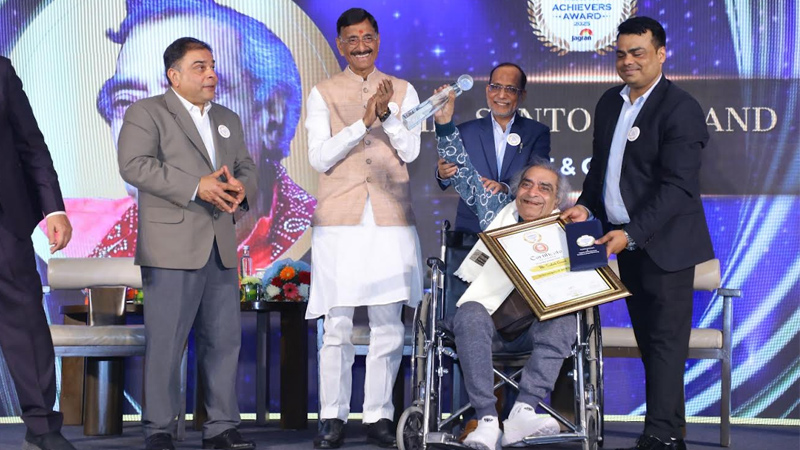
NEW DELHI: Hamdard Laboratories gathered a cross-section of India’s achievers in New Delhi on Friday, handing out the Hakeem Abdul Hameed Excellence Awards to figures who have left their mark across healthcare, education, sport, public service and the arts.
The ceremony, attended by minister of state for defence Sanjay Seth and senior officials from the ministry of Ayush, celebrated individuals whose work blends professional success with a sense of public purpose. It was as much a roll call of achievement as it was a reminder that influence is not measured only in profits or podiums, but in people reached and lives improved.
Among the headline awardees was Alakh Pandey, founder and chief executive of PhysicsWallah, recognised for turning affordable digital learning into a mass movement. On the sporting front, Arjuna Awardee and kabaddi player Sakshi Puniya was honoured for her contribution to the game and for pushing women’s participation onto bigger stages.
The cultural spotlight fell on veteran lyricist and poet Santosh Anand, whose songs have echoed across generations of Hindi cinema. At 97, Anand accepted the honour with characteristic humility, reflecting on a life shaped by perseverance and hope.
Healthcare honours spanned both modern and traditional systems. Manoj N. Nesari was recognised for strengthening Ayurveda’s place in national and global health frameworks. Padma shri Mohammed Abdul Waheed was honoured for his research-backed work in Unani medicine, while padma shri Mohsin Wali received recognition for his long-standing contribution to patient-centred care.
Education and social development also featured prominently. Padma shri Zahir Ishaq Kazi was honoured for decades of work in education, while former Meghalaya superintendent of Police T. C. Chacko was recognised for public service. Goonj founder Anshu Gupta received an award for his dignity-centred rural development initiatives, and the Hunar Shakti Foundation was honoured for empowering women and young girls through skill development.
The Lifetime Achievement Award went to former IAS officer Shailaja Chandra for her long career in public healthcare and governance, particularly in the traditional systems under Ayush.
Speaking at the event, Hamdard chairman Abdul Majeed said the awards were a tribute to those who combine excellence with empathy. “These awardees reflect Hakeem Sahib’s belief that healthcare, education and public service must ultimately serve humanity,” he said.
Minister Seth struck a forward-looking note, saying India’s young population gives the country a unique opportunity to become a global destination for learning, health and wellness by 2047.
The ceremony also featured the trailer launch of Unani Ki Kahaani, an upcoming documentary starring actor Jim Sarbh, set to premiere on Discovery on 11 February.
Instituted in memory of Unani scholar and educationist Hakeem Abdul Hameed, the awards have grown into a national platform that celebrates those building a more inclusive and resilient India. For one evening at least, the spotlight was not just on success, but on service with substance.






