News Broadcasting
Govt looks set to nix revenue-sharing model for FM

NEW DELHI: The government is unlikely to accept a recommendation of the broadcast and cable regulator that a revenue-sharing model be adopted during the second phase of FM radio in the country.
It would also make it mandatory for licence holders in metros to obtain a licence in smaller cities. This step is likely to be taken with an aim to spread the FM radio coverage in the country.
Government sources also said that there will be no review of the existing ban on news and current affairs on private FM radio stations, though Trai has said that the government may go in for a review of this policy.

Keeping news out of bounds for private FM players is a way to ensure that All-India Radio, now having sole prerogative to broadcast news on FM frequencies, does not get financially hit or its development stymied.
Telecom Regulatory Authority of India (Trai), in a comprehensive set of recommendations on radio broadcast policy earlier this week, had said that the government should go for a one-time licence fee with an annual 4 per cent revenue share in place of auctioning off FM licences.
According to government sources, non-acceptance of this suggestion owes its genesis to the financial implications that it would have on government’s revenue collection.
Pointing out that adequate monitoring was difficult in the radio FM sector, unlike the telecom sector, the sources said that there would be severe fall in government revenue if revenue share model were adopted.
According to initial calculations done in the information and broadcasting ministry, if the revenue-share model is adopted at the rate of 4 per cent, then the annual mop is likely to be in the region of Rs 100 million, in sharp contrast to almost double the amount that the government collected during the first phase of auctioning of licences.
Indiantelevision.com also learns, however, that to ease the financial burden of the private sector FM players, the government would use the highest bid in a city, for example, as the benchmark for handing out licences.
Questioned on the sidelines of a function to unveil an Independence Day special issue of Employment News (a government publication), information and broadcasting minister Jaipal Reddy today said, “I cannot comment on them (Trai recommendations) at this stage.”
Asked whether the government is aware of a deadline of 29 August on licence fee payment by private sector FM players, the minister said, “All those aspects would be taken into consideration when we decide (on the egulator’s
recommendations).”
A full radio broadcast policy, which is expected within two months, is likely to have another rider that would ensure licencees in A+ cities, like the metros, also have to take a licence in nearby cities that may not be considered too attractive financially.
This stipulation is akin to the telecom sector where private sector telecom companies have to fulfill some social obligations in the form of spreading telephony in rural areas. Alternately, they also contribute financially to a fund called the Universal Service Obligation fund.
For those seeking to set up FM stations in the north-eastern region of the country, there would be several concessions.






News Broadcasting
UDF poised to return to power in Kerala, says Manorama-CVoter survey
Massive opinion poll projects shift in Kerala politics ahead of 2026 Assembly elections.
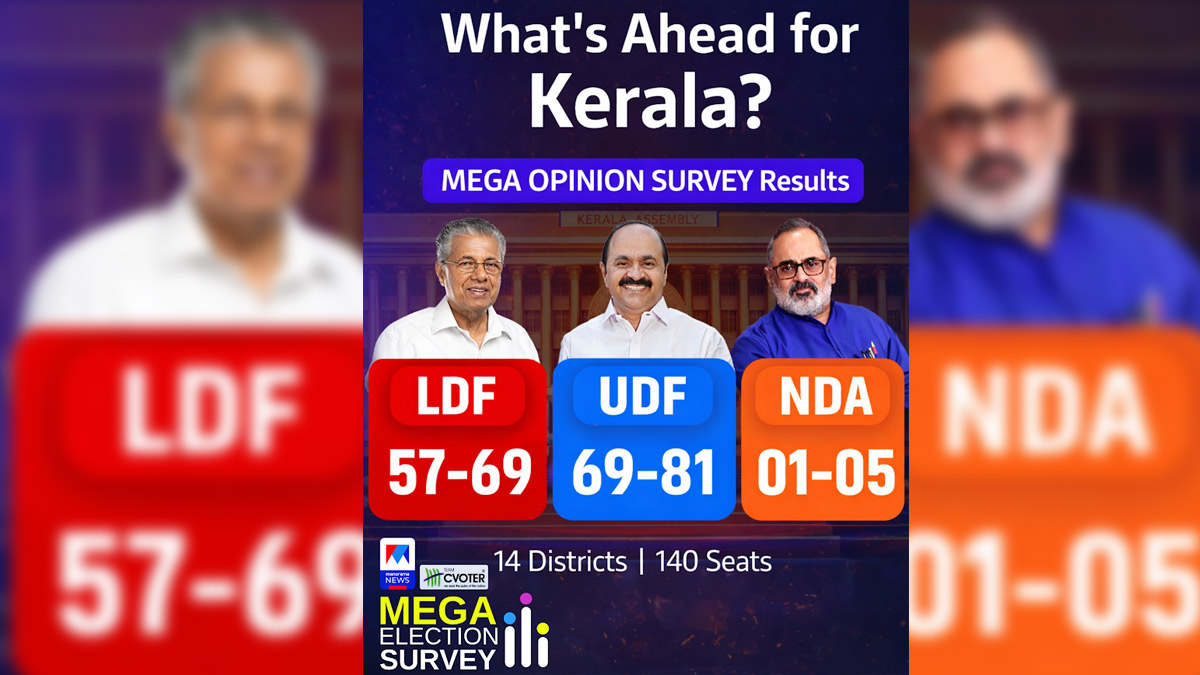
MUMBAI: The winds of change appear to be blowing through Kerala’s political landscape and this time, they seem to favour the United Democratic Front. A comprehensive mega opinion survey conducted by Manorama News in partnership with CVoter projects a potential comeback for the UDF in the upcoming Kerala Legislative Assembly Elections 2026. The survey, covering all 140 constituencies with a massive sample size of nearly 90,000 respondents, predicts the UDF could win between 69 and 81 seats.
The ruling Left Democratic Front (LDF) is expected to secure 57 to 69 seats, a significant drop from the 99 seats it won in the 2021 elections. This would mean the LDF losing 30 to 42 of its sitting seats. Meanwhile, the National Democratic Alliance (NDA), which drew a blank in 2021, is projected to open its account with 1 to 5 seats.
Region-wise, the UDF is expected to make strong gains in Malabar, winning 25 to 34 out of 48 seats, and in Central Kerala, where it could bag 29 to 33 out of 53 seats. In South Kerala, the LDF is likely to retain an edge with 21 to 25 seats, while the UDF may improve to 12 to 16 seats. The NDA could pick up 1 to 3 seats in the southern region.
The survey was conducted between 14 and 26 March 2026, with additional tracker and snap polls carried out from December 2025 to March 2026. A total of 89,693 respondents participated, ensuring representation across all demographics and social segments.
Manorama News has a strong track record of accuracy, with its previous projections closely matching the actual results of the 2019 and 2024 Lok Sabha elections as well as the 2021 Kerala Assembly polls.
In Kerala’s famously fierce political battles, this survey suggests the pendulum may be swinging back. Whether the final verdict matches these numbers or throws up another surprise, one thing is clear, the 2026 Assembly elections are shaping up to be one of the most keenly watched contests in the state’s history.






