Hardware
Government toying easing downlink norms

NEW DELHI: The Indian government is expected to formally notify the amendments in the uplink norms together with the first-ever downlink guidelines some time next week after possibly diluting them a bit.
According to senior information and broadcasting ministry official, “The draft notification has gone for law ministry’s approval subsequent to which they will be notified for the legislations to come into effect formally.”
The official added that the notification could be expected after Diwali or the festival of lights, which falls in the first few days of November.

Though the government official was evasive on easing the stringent downlink norms that would give landing rights to foreign news channels, the I&B ministry is toying with dilution after being petitioned by players concerned, including those in the print medium.
The government has said that all foreign news channels desirous of uplinking from India and then landing back should not have any content or advertising especially targeting the Indian audiences. This means that dedicated Indian feed cannot be put together by the likes of CNN and BBC World.
Additionally, the government has given itself discretionary powers to waive the aforementioned clause in special cases.
A select group of ministers, which vetted the uplink and downlink norms before Cabinet’s approval on 21 October, had suggested that any norm relating to regulating ads and content on a news platform should be uniform for both the electronic and print mediums.
This suggestion has been accepted by the government too.
However, disallowing local ads would make the business of printing of facsimile editions of newspapers like Financial Times (Indian partner Business Standard), International Herald Tribune (Indian associates MJ Akbar and owners of Deccan Chronicle) and The Wall Street Journal that much more unattractive in India.
The case becomes somewhat similar for the likes of BBC World and CNN, which announced on Thursday that it has entered into a co-branding deal with a proposed Indian-promoted general news channel in English.
Sources in the I&B ministry reluctantly admitted that it has been petitioned by some media houses to do away with the clause relating to India-targeted advertising and content in TV news channels as well as in facsimile editions of foreign newspapers.
A final decision on this matter is pending, but the issue would then have to get another Cabinet nod, which might turn out to be time consuming.




Hardware
India clears Rs 1.6 lakh crore semiconductor projects under Semicon India
Ten projects cleared as production begins and design ecosystem gathers pace
NEW DELHI: India’s push to become a global electronics powerhouse is gaining momentum, with the Semicon India Programme driving the creation of a full-fledged semiconductor ecosystem from design to manufacturing.
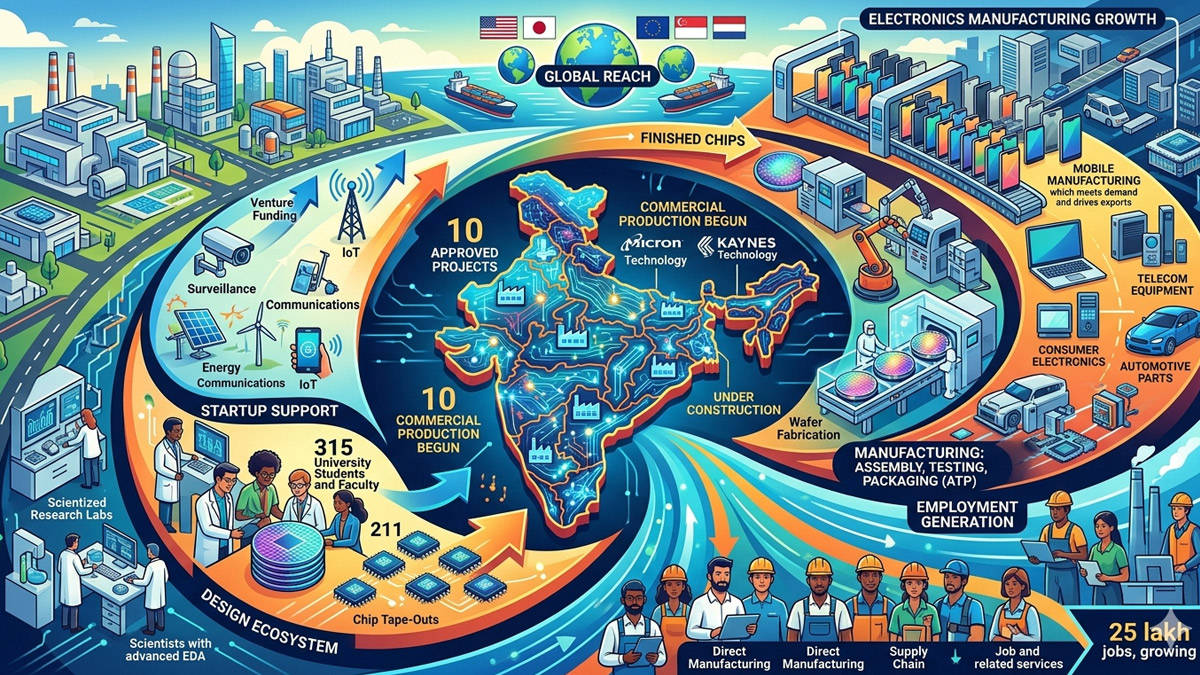
Launched in 2022, the programme aims to build capabilities across the entire value chain, including chip design, fabrication, assembly, testing and packaging. In just four years, the government has approved 10 semiconductor projects with a combined investment commitment of around Rs 1.6 lakh crore.
Two of these facilities have already begun commercial production, including units led by Micron Technology Inc. and Kaynes Technology India Limited. Two more plants are expected to go live later this year, signalling that India’s chip ambitions are moving from blueprint to factory floor.
The broader electronics manufacturing story has also seen sharp growth over the past decade. Production has jumped from roughly Rs 1.9 lakh crore in 2014-15 to about Rs 12 lakh crore in 2024-25, while exports have surged nearly eightfold. Mobile phone manufacturing, once heavily import-dependent, now meets almost all domestic demand and has become a major export driver.
Alongside manufacturing, the government is investing heavily in design capabilities. Through access to advanced chip design tools provided free to 315 universities, students and researchers have clocked over 200 lakh hours of usage. This effort has already resulted in 211 chip tape-outs from 75 institutions.
Support for startups is also picking up pace. Twenty-four chip design projects have been approved, targeting sectors such as surveillance, energy, communications and IoT. Of these, 14 companies have collectively raised over Rs 650 crore in venture funding, while several designs have progressed to fabrication, including at advanced nodes.
To strengthen supply chains, India has also signed semiconductor cooperation agreements with countries including the United States, Japan, the European Union, Singapore and the Netherlands. These partnerships aim to reduce global dependencies while boosting domestic capabilities.
The employment impact is equally significant. The electronics sector now supports an estimated 25 lakh jobs, with mobile manufacturing alone accounting for nearly half. As more semiconductor units come online under the India Semiconductor Mission, indirect job creation across supply chains is expected to rise further.
Sharing these updates in Parliament, Ministry of Electronics and Information Technology minister of state Jitin Prasada underscored the government’s focus on building a resilient, end-to-end semiconductor ecosystem.
With factories taking shape, designs moving to silicon and investments flowing in, India’s semiconductor story is steadily shifting gears from ambition to execution.






