News Headline
Government to issue notification disallowing post-CAS bundling

NEW DELHI: The local law of the land cannot be taken for granted and its adherence should be must.
This seems to be the strict message that the Indian government is giving out to broadcasters, cable operators, MSOs and others on the contentious and
controversial issue of conditional access (CAS) and its implementation in the four metros from 14 July.
For the first time, the government also officially confirmed that they are planning to bring in another notification of rules under an existing Act to see that broadcasters don’t resort to any sort of bundling — cutting across present bouquet lines — in a post-CAS regime.
“If a certain law has been passed by Parliament, it should be adhered to. Those who feel that dilly-dallying tactics (on CAS) can be resorted to, should think otherwise,” information and broadcasting ministry (I&B) secretary Pawan Chopra told indiantelevision.com today. This stance of his is in line with what he told pubcaster Doordarshan, yesterday, in an interview.
According to Chopra: “Bundling of any channel cannot be allowed under the present rules and if there is any lacunae, then we are thinking of notifying additional rules on this. Every cable operators has to display the individual price of every pay channels and the consumer must be free to choose whatever he wants without feeling any additional financial burden.”
However, a bureaucrat’s job, as anywhere in the world, is to pacify everybody. In line with that, the I&B ministry also plans to hold meetings with broadcasters on the issue of unbundling of channels and the maximum retail price of pay channels. “We’ll take the convenience of the broadcasters too, into consideration so that they don’t feel robbed of any level playing field,” Chopra said.
The government also feels that “continuing lobbying” by broadcasters and others would not be of much help as the policy guidelines have been framed after much deliberations. And this also includes the availability (or the lack of it) of set top boxes (STB) which would be needed to route the pay channels through. No STB, no pay channels.
According to Chopra: “If a certain section of the industry feels that delaying the implementation of CAS would solve problems, then we don’t think so. Even if CAS implementation, for instance, is deferred by six months,
then also the situation is likely remain the same as it would on 14 July. So, why insist on one-city rollout?” Yes, the government has a point.
But so do the broadcasters. The broadcasters, at least some of them, are contending that because adequate number of STBs is not likely to be readily available by 14 July at affordable prices, there would be chaos in the four metros. Yes, that’s likely to happen.
If one looks at the situation from the government’s side, the thing is, if the industry has failed to iron out issues, including that of boxes, in six months time, the chances of them getting sorted in another six months time are less. What guarantee is there that the broadcast and cable industry would not crib after February 2004 (taking into account a six month extension on rollout does become a reality)?
Still, the government is willing to lend its ears to the broadcasters and sweeten the CAS pill a bit for those think it is too bitter.
According to government officials, if the broadcasters want to have dual feeds of their (pay) channels and come to an understanding with the service providers that in certain areas — for example, where people from the
economically weaker section live and cannot affort boxes for pay channels — they won’t charge the cable ops for the household, then the government would not interfere in that process.
“Such subsidisation (of pay channels) is between the content and service provider where the market forces are coming into play. The government does not see there is any need to interfere,” senior government official explained. No wonder Star News has already started a so-called free to air feed for downlinking in non-urban areas in an effort to, what Star says, increase penetration.
But this dual feed route is something that many a broadcaster managing pay channels may be contemplating as it looks like an honourable escape route from the days of lofty statements that “no pay channels would turn free to air”. Especially if the government is willing to look the other way.






NEW DELHI: Hamdard Laboratories gathered a cross-section of India’s achievers in New Delhi on Friday, handing out the Hakeem Abdul Hameed Excellence Awards to figures who have left their mark across healthcare, education, sport, public service and the arts.
The ceremony, attended by minister of state for defence Sanjay Seth and senior officials from the ministry of Ayush, celebrated individuals whose work blends professional success with a sense of public purpose. It was as much a roll call of achievement as it was a reminder that influence is not measured only in profits or podiums, but in people reached and lives improved.
Among the headline awardees was Alakh Pandey, founder and chief executive of PhysicsWallah, recognised for turning affordable digital learning into a mass movement. On the sporting front, Arjuna Awardee and kabaddi player Sakshi Puniya was honoured for her contribution to the game and for pushing women’s participation onto bigger stages.

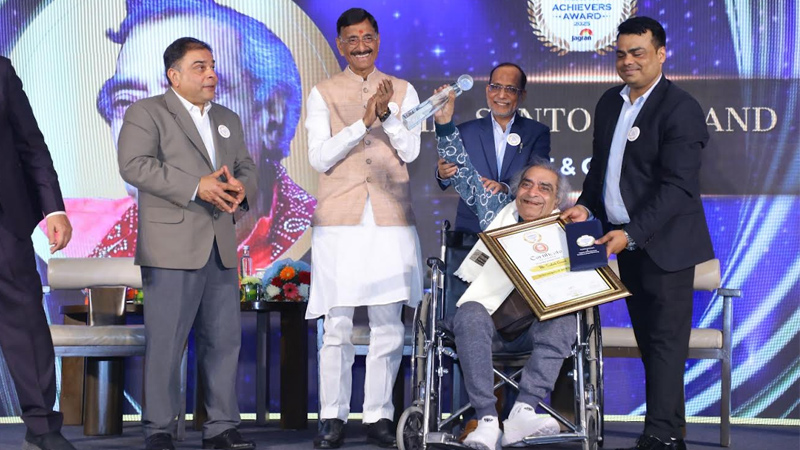
The cultural spotlight fell on veteran lyricist and poet Santosh Anand, whose songs have echoed across generations of Hindi cinema. At 97, Anand accepted the honour with characteristic humility, reflecting on a life shaped by perseverance and hope.
Healthcare honours spanned both modern and traditional systems. Manoj N. Nesari was recognised for strengthening Ayurveda’s place in national and global health frameworks. Padma shri Mohammed Abdul Waheed was honoured for his research-backed work in Unani medicine, while padma shri Mohsin Wali received recognition for his long-standing contribution to patient-centred care.
Education and social development also featured prominently. Padma shri Zahir Ishaq Kazi was honoured for decades of work in education, while former Meghalaya superintendent of Police T. C. Chacko was recognised for public service. Goonj founder Anshu Gupta received an award for his dignity-centred rural development initiatives, and the Hunar Shakti Foundation was honoured for empowering women and young girls through skill development.
The Lifetime Achievement Award went to former IAS officer Shailaja Chandra for her long career in public healthcare and governance, particularly in the traditional systems under Ayush.
Speaking at the event, Hamdard chairman Abdul Majeed said the awards were a tribute to those who combine excellence with empathy. “These awardees reflect Hakeem Sahib’s belief that healthcare, education and public service must ultimately serve humanity,” he said.
Minister Seth struck a forward-looking note, saying India’s young population gives the country a unique opportunity to become a global destination for learning, health and wellness by 2047.
The ceremony also featured the trailer launch of Unani Ki Kahaani, an upcoming documentary starring actor Jim Sarbh, set to premiere on Discovery on 11 February.
Instituted in memory of Unani scholar and educationist Hakeem Abdul Hameed, the awards have grown into a national platform that celebrates those building a more inclusive and resilient India. For one evening at least, the spotlight was not just on success, but on service with substance.






