News Broadcasting
Government mulls USO Fund for Prasar Bharati


NEW DELHI: Private broadcasters and big MSOs in the country might soon be called to lend a helping hand in the financial restructuring of pubcaster Prasar Bharati.
According to one of the options relating to funding of Prasar Bharati, suggested by a government panel, a corpus can be created from contributions from the broadcast and cable industry on the lines of the universal service obligation (USO) fund in the telecom sector.
Five per cent of a private telecom operator’s annual revenues go towards the USO fund, which is used to finance new rural telephony projects identified by the government.

The panel on Prasar Bharati’s financial restructuring has suggested that private broadcasters and MSOs can be asked to contribute between 5-10 per cent of their annual revenues for a USO fund-type corpus, which can be used to support the over 45,000 workforce of the pubcaster.
Prasar Bharati, which manages Doordarshan and All India Radio, is in the middle of a debate over ways to augment its earnings.
This recommendation, along with others in a nearly 300-page report, is being presently studied by a group of ministers (GoM) before the issue is taken to the Union Cabinet for a formal okay.
The GoM met briefly last week, information and broadcasting minister Priya Ranjan Dasmunsi told Indiantelevision.com. He did not give any time frame on taking the Prasar Bharati matter to the Cabinet.
However, industry players observe whether there would be increased accountability of Prasar Bharati if a USO fund is created via private sector players’ contribution to partly fund pubcaster’s activities. More importantly, whether the funds would be properly used.
According to Hindu Business Line, of the Rs 107.53 billion collected by the government from telecom companies in the form of USO fund since its inception in 2002-03, a staggering Rs. 70 billion is yet to be disbursed.
The newspaper quoted the Telecom Regulatory Authority of India as saying that undisbursed amount is estimated to cross Rs 250 billion by 2010 against a total collection of Rs. 375 billion, which means only 48 per cent of the fund is expected to be utilised for extending telephone services in the rural areas. The numbers assume significance even as the digital divide between rural and urban is ever increasing.
Meanwhile, letting the pubcaster tap the capital markets and levying a cess on sale of every TV and radio set in the country are amongst some of the other options suggested by the committee on financial rejig of Prasar Bharati.
Though Prasar Bharati closed FY 2006 with record-breaking revenues of over Rs 12 billion, its expenses are so huge that the government is finding it difficult to bridge the chasm between income and expenditure.






News Broadcasting
UDF poised to return to power in Kerala, says Manorama-CVoter survey
Massive opinion poll projects shift in Kerala politics ahead of 2026 Assembly elections.
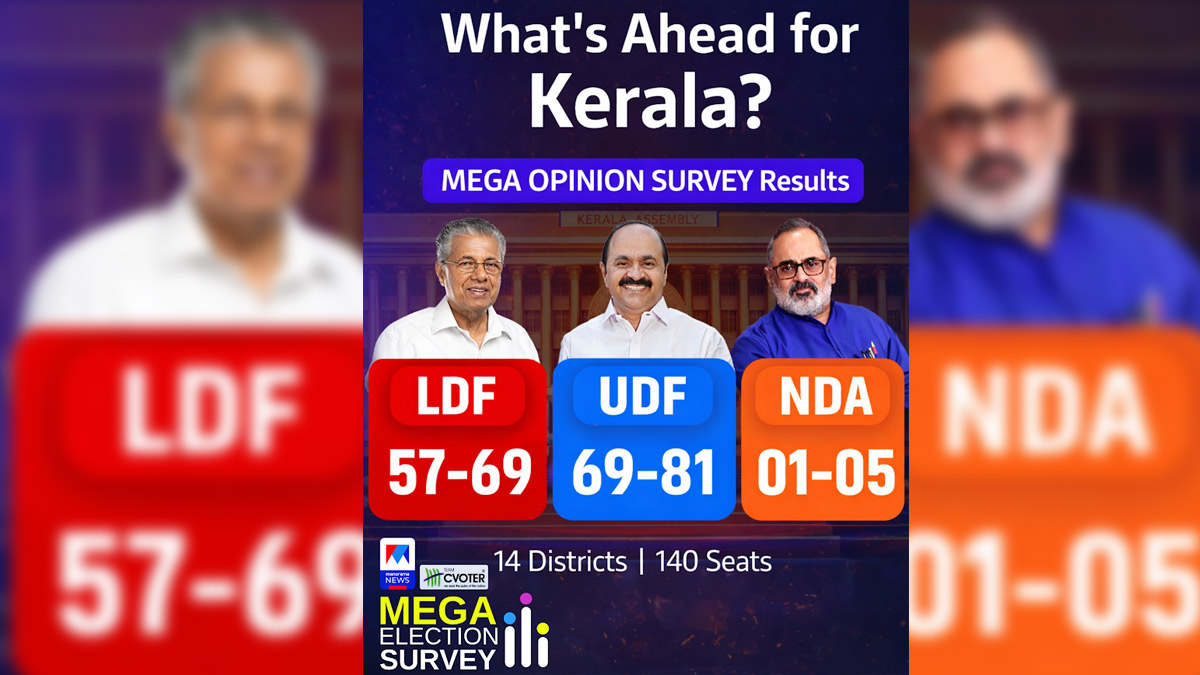
MUMBAI: The winds of change appear to be blowing through Kerala’s political landscape and this time, they seem to favour the United Democratic Front. A comprehensive mega opinion survey conducted by Manorama News in partnership with CVoter projects a potential comeback for the UDF in the upcoming Kerala Legislative Assembly Elections 2026. The survey, covering all 140 constituencies with a massive sample size of nearly 90,000 respondents, predicts the UDF could win between 69 and 81 seats.
The ruling Left Democratic Front (LDF) is expected to secure 57 to 69 seats, a significant drop from the 99 seats it won in the 2021 elections. This would mean the LDF losing 30 to 42 of its sitting seats. Meanwhile, the National Democratic Alliance (NDA), which drew a blank in 2021, is projected to open its account with 1 to 5 seats.
Region-wise, the UDF is expected to make strong gains in Malabar, winning 25 to 34 out of 48 seats, and in Central Kerala, where it could bag 29 to 33 out of 53 seats. In South Kerala, the LDF is likely to retain an edge with 21 to 25 seats, while the UDF may improve to 12 to 16 seats. The NDA could pick up 1 to 3 seats in the southern region.
The survey was conducted between 14 and 26 March 2026, with additional tracker and snap polls carried out from December 2025 to March 2026. A total of 89,693 respondents participated, ensuring representation across all demographics and social segments.
Manorama News has a strong track record of accuracy, with its previous projections closely matching the actual results of the 2019 and 2024 Lok Sabha elections as well as the 2021 Kerala Assembly polls.
In Kerala’s famously fierce political battles, this survey suggests the pendulum may be swinging back. Whether the final verdict matches these numbers or throws up another surprise, one thing is clear, the 2026 Assembly elections are shaping up to be one of the most keenly watched contests in the state’s history.






