I&B Ministry
Government keen to resolve issues facing M&E industry

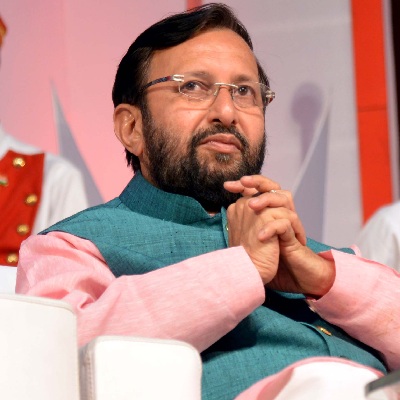
NEW DELHI: While exuding confidence in the Media and Entertainment industry in the country, Information and Broadcasting Minister Prakash Javadekar today said it was important for the stakeholders to keep the welfare of the citizens in mind.
He said he knew the sector had immense opportunities and the world “is fascinated by our culture and Indian cinema is becoming very popular.”

“Education and entertainment are the primary needs after roti, kapda and makaan (food, cloth and shelter),” Javadekar added.
The Minister said that his attempt in keeping with the mandate of the new government would be to take decisions on pending issues as soon as possible as “delay is out, decision is in.” The work of the government is not to create roadblocks but to give impetus to entrepreneurship and industry.
Addressing the ASSOCHAM meet on media and entertainment, SCREENS 2014, the Minister, said the path-breaking initiatives on digitisation were bound to improve the quality of television broadcasting in the country. Both the government and the industry should work together for the welfare of the consumers. “There are issues of distribution, there are issues of taxation,” he added.
“We, both the industry and the government, have to think about the final consumer. Government and industry have to think about the welfare of common citizen and to that end we are partners, we are the facilitators,” he said.
Later, Additional Secretary (Films) Raghvendra Singh said that the government was in the process of revamping the Cinematograph Act 1952 which had been drafted when there was no television or other media,
Realising that media and entertainment was the biggest market in terms of consumer needs; the government is also on the threshold of announcing a major initiative for curbing piracy.
He was conscious that entertainment tax being a state subject was not uniform, and that there was a grievance about service tax. He hoped all these issues would be subsumed in the proposed Goods and Sales Tax, which the government hopes to bring forward soon.
He said that the government was very keen to upgrade the Film and Television Institute of India and the Satyajit Ray Film and Television Institute, also to set up a centre of excellence for animation and special effects as soon as possible.
He also informed that the government was finalising its work on the National Film Heritage Mission for assessment of preservation and restoration of film material.
“Funds have already been provided in the Ministry’s allocations for anti-piracy measures but this was not possible without collaboration from the industry itself,” said Singh.
Telecom Regulatory Authority of India member Vijayalakshmy K Gupta stressed that addressability has led to better television and online video viewership has grown 13 per cent between December 2012 and December 2013.
It has also led to reduction of carriage fee, she claimed on the basis of the first two phases of digital access system.
She said that TRAI was firm on its decision not to permit state or central government units in private radio or television broadcasting.
She felt that as far as cinema was concerned, there was need for a Film Commission for dealing with various issues.
TRAI advisor N Parameshwaran said, “One major problem is that all multi-system operators are ‘pulling in different directions’ and therefore it is difficult to resolve their problems.”
He agreed that there was need for rationalisation of taxes in the country as far as media and entertainment were concerned.
He said TRAI was already working on the issue of increasing bandwidth in view of 4G technologies coming in after HD.
He denied charges by cable operators that broadcasters or MSOs were being protected as he said they had also been prosecuted for violating rules.





I&B Ministry
Digital radio, D2M tech set to reshape broadcasting and public messaging
Govt pushes next-gen delivery while TRAI tightens grip on spam ecosystem
NEW DELHI: India’s broadcasting and telecom landscape is undergoing a quiet but significant upgrade, with digital radio and Direct-to-Mobile (D2M) technologies emerging as powerful tools for mass communication, while regulators step up efforts to tackle spam calls.
According to the Ministry of Information and Broadcasting, digital radio and D2M are poised to transform how content reaches audiences by making more efficient use of spectrum. In simple terms, multiple channels can now be delivered over a single frequency, opening the door to a wider range of free-to-air content.
D2M technology takes this a step further by enabling video, audio and data to be broadcast directly to mobile handsets without relying on SIM cards or mobile data. The result is a resilient and cost-effective data pipe that can deliver everything from entertainment and education to critical emergency alerts, even in low-connectivity scenarios.
At the same time, the Telecom Regulatory Authority of India is tightening its grip on unsolicited commercial communication, better known as spam calls. The regulator has deployed a distributed ledger technology platform to bring transparency and accountability into the system.
Through this blockchain-based setup, consumers can register their preferences on receiving promotional messages, while businesses and telemarketers must also sign up and operate within defined rules. The platform also includes a complaint mechanism that allows users to report spam, with complaints shared across telecom operators for coordinated action.
The government’s broader push is being supported by infrastructure upgrades under the Broadcasting Infrastructure and Network Development scheme. Implemented through Prasar Bharati, the initiative focuses on modernising networks such as Akashvani and Doordarshan, including digitisation and adoption of next-generation broadcast equipment.
In a written reply in the Lok Sabha, Ministry of Information and Broadcasting minister of state for information and broadcasting L. Murugan said these steps are part of a larger effort to promote emerging technologies and strengthen the country’s broadcasting backbone. The response came to a query raised by member of Parliament Rao Rajendra Singh.
Together, these developments point to a dual-track strategy: expanding access to reliable, low-cost content while cleaning up the communication ecosystem. As digital pipes get smarter and spam filters sharper, India’s airwaves may soon feel a lot less noisy and far more useful.






