News Headline
Government issues regulations for spectrum trading

NEW DELHI: Spectrum trading will be allowed only between two access service providers, holding Cellular Mobile Telephone Service (CMTS) License, Unified Access Service License (UASL), Unified License (Access Services)(UL(AS)) and Unified License (UL) with authorization of Access Service in a licensed service area.
All access spectrum bands earmarked for Access Services by the licensor will be treated as tradable spectrum bands, according to the Communications and Information Technology Ministry.

The decision of the government has been announced after considering the recommendations of the Telecom Regulatory Authority of India (TRAI) in this connection.
Only outright transfer of right to use the spectrum from the Access Service Provider who is transferring the right to use the spectrum is (seller) to Access Service Provider who is acquiring the right to use spectrum (buyer) will be permitted. Leasing of spectrum is not permitted.
Spectrum trading will be permitted only on a pan-LSA (Licensed Service Area) basis. In case the spectrum assigned to the seller is restricted to part of the LSA by the Licensor, then, after trading, the rights and obligations of the seller for the remaining part of the LSA with regard to assignment of that spectrum shall also stand transferred to the buyer. Further, relevant provisions of NIA with respect to spectrum assignment in part of the LSA, which were applicable to seller before the spectrum trade, will apply to buyer subsequent to the spectrum trade.
The National Telecom Policy envisages to move at the earliest towards liberalisation of spectrum to enable use of spectrum in any band to provide any service in any technology as well as to permit spectrum pooling, sharing and later, trading to enable optimal utilisation of spectrum through appropriate regulatory framework.
The spectrum trading leads to greater competition provides incentives for innovation, better services being available to consumers at cheaper tariffs, better choice to consumer, etc. This also facilitates ease of doing business in India by allowing free play in the commercial decisions and leads to optimisation of resources apart from improving the spectral efficiency and quality of service.
Spectrum trading shall be permitted only in the following block sizes (band wise):
Spectrum band
Block Size
800 MHz
2×1.25 MHz
900 MHz
2×200 KHz
1800 MHz
2×200 KHz
2100 MHz
2×5 MHz
2300 MHz
20 MHz in TDD
2500 MHz
20 MHz in TDD and 2×10 in FDD
Spectrum trading will not alter the original validity period of spectrum assignment as applicable to the traded block of spectrum.
Only the spectrum specified in the table is permissible to be traded which has either been assigned through an auction in the year 2010 or afterwards, or on which the Telecom Service Provider (TSP) has already paid the prescribed market price as per para 24 below. In such a case, entire spectrum would be tradable. In respect of spectrum in 800 MHz acquired in the auction held in March 2013, trading of spectrum shall be permitted only if the differential of the latest auction price and the March 2013 auction price on pro-rata basis on the balance period of right to use the spectrum is paid
Both the licensees trading the spectrum shall jointly give a prior intimation for trading the right to use the spectrum at least 45 days before the proposed effective date of the trading as per prescribed format to Wireless Adviser, Wireless Planning and Coordination Wing, Department of Telecommunications, 6th floor, Sanchar Bhawan, 20, Ashok Road, New Delhi – 110001.
Both the licensees will also give an undertaking that they are in compliance with all the terms and conditions of the guidelines for spectrum trading and the license conditions and will agree that in the event, it is established at any stage in future that either of the licensee was not in conformance with the terms and conditions of the guidelines for spectrum trading or/and of the license at the time of giving intimation for trading of right to use the spectrum, the Government will have the right to take appropriate action which inter-alia may include annulment of trading arrangement.
The seller will clear all its dues prior to concluding any agreement for spectrum trading. Thereafter, any dues recoverable up to the effective date of trade shall be the liability of the buyer.
The Government at its discretion will be entitled to recover the amount, if any, found recoverable subsequent to the effective date of the trade, which was not known to the parties at the time of the effective date of trade, from the buyer or seller, jointly or severally. The demands, if any, relating to licenses of seller, stayed by the Court of Law, shall be subject to outcome of decision of such litigation.
Where an issue, pertaining to the spectrum proposed to be transferred is pending adjudication before any court of law, the seller shall ensure that its rights and liabilities are transferred to the buyer as per the procedure prescribed under the law and any such transfer of spectrum will be permitted only after the interest of the Licensor has been secured.
The relevant provisions in the NIA for auction of spectrum with regard to liberalisation of existing spectrum holding in 800 MHz/1800 MHz band shall apply. In respect of other bands, where spectrum has not been acquired through auction, terms and conditions of liberalisation shall be as decided by the Government from time to time.
A TSP will be allowed to sell the spectrum through trading only after two years from the date of its acquisition through auction or spectrum trading or administratively assigned spectrum converted to tradable spectrum.
In case of administratively assigned spectrum converted to tradable spectrum after paying the prescribed market price, period of two years will be counted from the effective date of assignment of administrative spectrum.
If a buyer is acquiring the entire spectrum holding of the seller in a spectrum band, then it shall fulfil the associated roll-out obligations within the balance time period for compliance subject to a minimum period of two years.
If the buyer is acquiring a part of the spectrum holding of the seller in a spectrum band, then both buyer and seller will have spectrum holding in that band after the trade. In such a scenario, both will be responsible for the roll-out obligations. There is no change in the roll-out obligations prescribed for seller, even if it is holding a lesser quantity of spectrum in that band post-trade. In addition, buyer will also be required to fulfil entire roll-out obligations. Since there is no change in the roll-out obligations of seller and there will be additional roll-out obligations for buyer, the buyer shall be given entire time duration to fulfil these roll-out obligations.
The seller should clear its Spectrum Usage Charges (SUC) and its instalment of payment due (in case seller had acquired the spectrum through auction and opted for deferred payment) till the effective date of trade and thereafter, the buyer shall clear all these dues.
A non-refundable transfer fee of one per cent of the transaction amount of aforesaid trade or one per cent of the prescribed market price, whichever is higher shall be imposed on all spectrum trade transactions, to cover the administrative charges incurred by Government in servicing the trade. The transfer fee shall be paid by the buyer to the Government. Transaction amount refers to the amount payable by the buyer to the seller to purchase the rights to use the spectrum block(s). It will be decided exclusively by the buyer and the seller. The market prices shall be equal to the auction determined amount prorated for the balance validity period of spectrum assignment. In case more than one set of market determined prices are available, the latest market determined price available at the time when the TSP wants to trade its spectrum holding, would be applicable. If the auction determined prices are more than one year old, the prevailing market price shall be applied by indexing the last auction price at the rate of SBI PLR.
Frequency swapping/reconfiguration from within the assignments made to the licensees shall not be treated as trading of spectrum. The conditions in the NIA shall govern frequency swapping/reconfiguration.
A licensee shall not be allowed to trade in spectrum if it has been established that the licensee had breached the terms and conditions of the license and the Licensor has ordered for revocation/termination of its license.






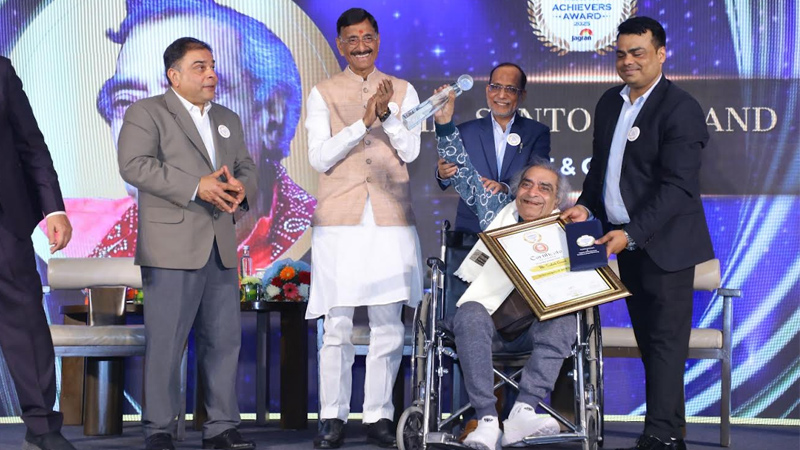
NEW DELHI: Hamdard Laboratories gathered a cross-section of India’s achievers in New Delhi on Friday, handing out the Hakeem Abdul Hameed Excellence Awards to figures who have left their mark across healthcare, education, sport, public service and the arts.
The ceremony, attended by minister of state for defence Sanjay Seth and senior officials from the ministry of Ayush, celebrated individuals whose work blends professional success with a sense of public purpose. It was as much a roll call of achievement as it was a reminder that influence is not measured only in profits or podiums, but in people reached and lives improved.
Among the headline awardees was Alakh Pandey, founder and chief executive of PhysicsWallah, recognised for turning affordable digital learning into a mass movement. On the sporting front, Arjuna Awardee and kabaddi player Sakshi Puniya was honoured for her contribution to the game and for pushing women’s participation onto bigger stages.
The cultural spotlight fell on veteran lyricist and poet Santosh Anand, whose songs have echoed across generations of Hindi cinema. At 97, Anand accepted the honour with characteristic humility, reflecting on a life shaped by perseverance and hope.
Healthcare honours spanned both modern and traditional systems. Manoj N. Nesari was recognised for strengthening Ayurveda’s place in national and global health frameworks. Padma shri Mohammed Abdul Waheed was honoured for his research-backed work in Unani medicine, while padma shri Mohsin Wali received recognition for his long-standing contribution to patient-centred care.
Education and social development also featured prominently. Padma shri Zahir Ishaq Kazi was honoured for decades of work in education, while former Meghalaya superintendent of Police T. C. Chacko was recognised for public service. Goonj founder Anshu Gupta received an award for his dignity-centred rural development initiatives, and the Hunar Shakti Foundation was honoured for empowering women and young girls through skill development.
The Lifetime Achievement Award went to former IAS officer Shailaja Chandra for her long career in public healthcare and governance, particularly in the traditional systems under Ayush.
Speaking at the event, Hamdard chairman Abdul Majeed said the awards were a tribute to those who combine excellence with empathy. “These awardees reflect Hakeem Sahib’s belief that healthcare, education and public service must ultimately serve humanity,” he said.
Minister Seth struck a forward-looking note, saying India’s young population gives the country a unique opportunity to become a global destination for learning, health and wellness by 2047.
The ceremony also featured the trailer launch of Unani Ki Kahaani, an upcoming documentary starring actor Jim Sarbh, set to premiere on Discovery on 11 February.
Instituted in memory of Unani scholar and educationist Hakeem Abdul Hameed, the awards have grown into a national platform that celebrates those building a more inclusive and resilient India. For one evening at least, the spotlight was not just on success, but on service with substance.







