News Broadcasting
Government issues notifications disallowing bundling and setting terms for STB offtake


NEW DELHI: The Indian government today further tightened the screws on the broadcast and cable industry on conditional access system (CAS) by issuing a notification that is aimed at safeguarding the cable consumer from bundling of channels by broadcasters and ensuring that the cable operator makes provisions for rent and security deposit on set-top boxes in the manner specified by the government.
Both the initiatives had been first reported by indiantelevision.com (Government mulls notification on STB offtake terms and Government to issue notification disallowing post-CAS bundling)
However, the government has made some concessions for the broadcasters and left some room for maneuverings by stating that discounts can be given to the subscribing public.

Announcing the initiatives, information and broadcasting minister Ravi Shankar Prasad told journalists, “The broadcasters have been given time till 15 June to furnish details about the channels they operate, the mode in which they are done and the pricing of individual channels. But if any broadcaster has not provided the details, the cable operators would be directed not to beam such channels after 14 July when CAS is supposed to come into force.”
The relevant parts of the cleverly-worded notification states: “Every cable operator shall publicise either through advertisements in the print and electronic media or through other means to the subscribers, the subscription rates and the periodic intervals at which the subscriptions are payable for receiving various pay channels provided by such cable operator.”
“Every cable, operator shall, while so publicising, be required to indicate precisely the following information: rates of subscription of each individual pay channel provided by the cable operator and discounts, if any, offered on subscribing to a minimum number of channels or more, provided that discounts so offered for subscribing to the minimum number of channels or more shall not be such as to dilute/nullify the choice of subscribing to individual channels.”
“Provided further that the subscriber shall not be forced to buy more than the channel(s) of his choice through the mechanism of discounted pricing and by grouping of channels in such a way as to tender the choice of individual pay channels offered an illusory one.”
Reacting to the government move, Jawahar Goel, additional vice-chairman of Zee Telefilms said, “I still have to study the government announcement in detail, but what I have gathered is that there is nothing bad for the broadcasters. Certainly for the consumers it looks great and if the government wants us broadcasters to announce the price of each pay channel, we should do it quickly.”
Sony Entertainment Television India CEO Kunal Dasgupta said the notification has made it clear that it was the responsibility of the cable operators to announce the prices of the pay channels they had on offer. “It’s good in that it makes it clear that the cable operators have to announce individual prices or packages of pay channels to their subscribers. Therefore, it is now incumbent on the cable operators to work out deals with pay channels before the 15th (June).”
Dwelling on the provisions for the STBs, the notification states, “The cable operator shall make provisions for rent and security deposit, or refund thereof, as well as warranty, repair and maintenance, in the manner notified by the government.”
The notification makes one thing clear: the government actually has put a lot of responsibility on the cable operator, while not targeting broadcasters directly in the notification. It is the cable ops duty to stop beaming errant channels after 14 July and it will also be the service provider’s duty to keep track of security deposits on STBs.
NO FREQUENT HIKE OF SUBSCRIPTION RATES OF PAY CHANNELS
According to Prasad, though the government would leave the pricing of the pay channels to market forces, it would see that frequent hikes in subscription rates of pay channels do not inconvenience consumers.
When I&B ministry secretary Pawan Chopra was quizzed on the validity of the time period for a pay channel’s pricing, he said, “Once announced, the prices must be valid for six to 12 months.”
That means, if a pay channel announces its price on June 15 and CAS comes into effect from 14 July, the particular price would have to be effective for at least a period of six months.
Asked whether government was contradicting itself by disallowing bundling of channels even while allowing discounting of channels, Prasad said, “Discounting (and the resultant indirect bundling) in this case would be in consumer interest as consumers should get discounts on bulk buys and CAS is all about being consumer-friendly.”
TALKING TO CRITICS OF CAS
Reiterating what he had told indiantelevision.com yesterday in an interview, Prasad said that critics of CAS still abound, but he is not ready to get “cowed down.”
“People who talk of having a broadcast regulatory authority in place before CAS is implemented are using arguments put forward by motivated groups who oppose CAS. I’m not ready to buy these arguments or get cowed down,” the minister thundered, giving a clear message to that segment of industry that is opposing CAS’ implementation.
Prasad also admitted that the government would have to hold talks with consumer groups too, as it is doing with other stakeholders of the industry.
“I have already held talks with some consumer groups,” Prasad said, adding that a lot of misinformation is being spread on CAS vis–vis consumers.
On availability of STBs, Prasad said that the MSOs and cable ops have assured him that by 14 July at least 2.7 million boxes would be in the market in the four metros.
The minister said a decision whether to include neighbouring townships of the four metros in the first phase of CAS has not yet been taken as also a final one cross-service restrictions.




News Broadcasting
India Today Group sweeps top honours at Ramnath Goenka Awards
Journalists recognised for fearless investigative and civic reporting.
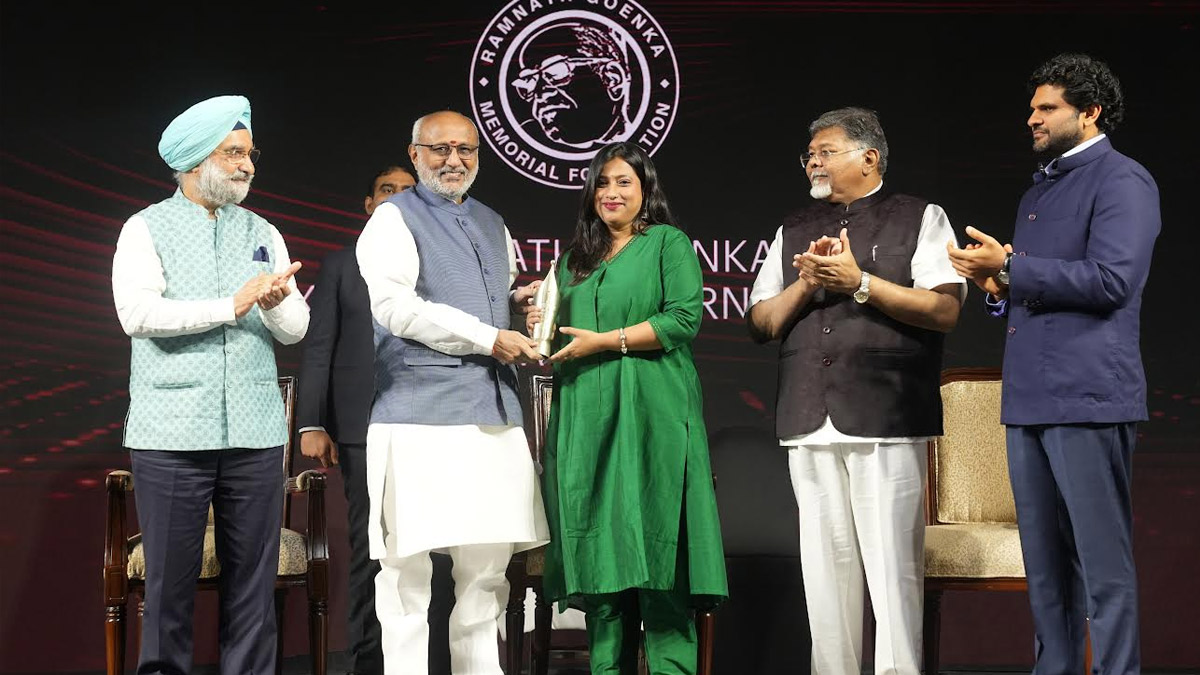
MUMBAI: India Today Group just turned the Ramnath Goenka Awards into its own trophy cabinet because when your reporters dig this deep, even the judges have to award a clean sweep. India Today Group journalists have secured multiple top honours at the latest edition of the prestigious Ramnath Goenka Excellence in Journalism Awards, reinforcing the network’s legacy as the gold standard of Indian journalism. The awards were conferred by vice president C. P. Radhakrishnan at a ceremony held on 27 March 2026.
Sreya Chatterjee won in the ‘Investigative Reporting – Broadcast’ category for her powerful India Today TV report ‘Operation Illegals: The Alarming Rise in Bangladeshi Infiltration Across India’s Fragile Eastern Frontier’. The investigation stood out for its depth, on-ground rigour and national relevance.
In the ‘Civic Journalism – Print/Digital’ category, Sreya Chatterjee along with Arvind Ojha were honoured for their indiatoday.in report on unregulated water extraction and the ‘Tanker Mafia’ in Delhi’s Bawana Industrial Area. The story exposed critical systemic gaps and environmental challenges affecting daily life.
Additionally, aajtak.in was recognised in the ‘Investigative Reporting – Print/Digital’ category for its hard-hitting exposé ‘The Surrogate Mother Market’, which highlighted the human, legal and ethical dimensions of the surrogacy ecosystem.
India Today Group emerged as the only network honoured in Investigative Journalism across both Print/Digital and Broadcast categories. The wins reflect the strength of its multi-platform newsroom and its unwavering commitment to credible, high-impact reporting that informs public discourse and drives accountability.
In an era when speed often trumps substance, these awards remind us that the most powerful stories are still the ones dug out with courage, told with clarity, and delivered with conscience, one fearless byline at a time.








